Why Taiwan Semiconductor and Meta Could Be the Hidden Bull Case for Broadcom
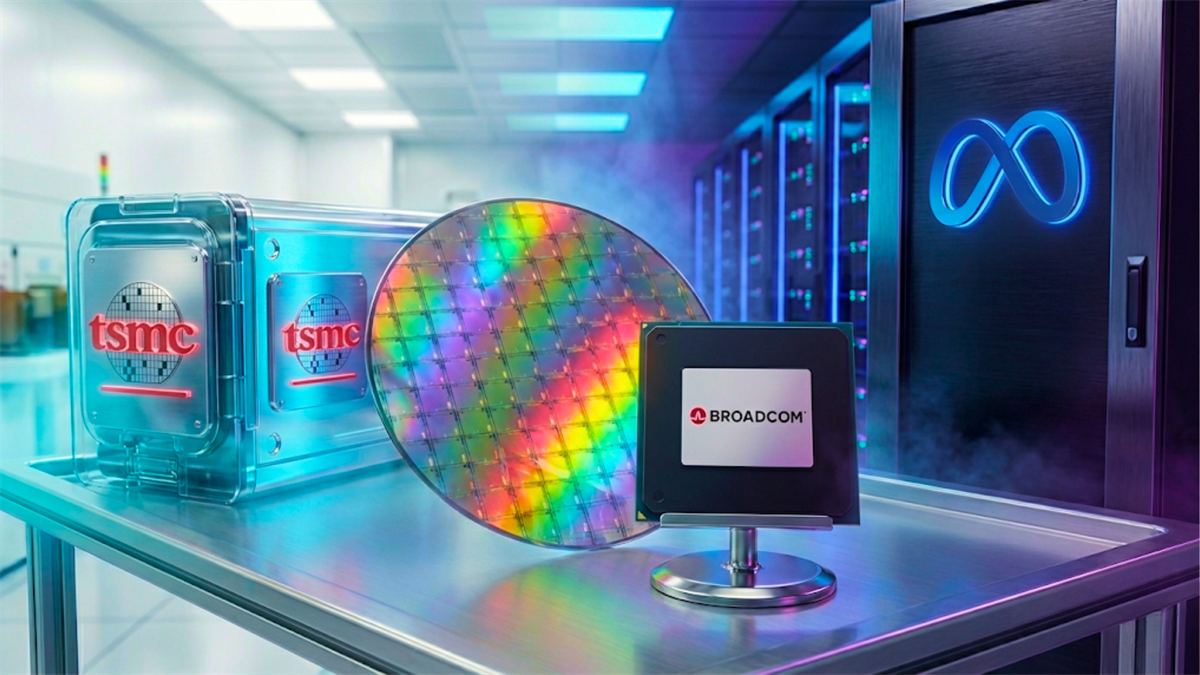
After ending 2025 in a bad way, shares of semiconductor giant Broadcom (NASDAQ: AVGO) have continued to face pressure in 2026. Year-to-date, shares are down nearly 4%. Still, it is important to note that Broadcom isn’t alone in its weakness. Artificial intelligence (AI) processor stock NVIDIA (NASDAQ: NVDA) is also down 4.5%.
Broadcom’s 2026 tumble comes even though key players in the AI arena are flashing promising signals for the company’s future. These signals come from the likes of Taiwan Semiconductor Manufacturing (NYSE: TSM) and Meta Platforms (NASDAQ: META). Recent announcements provide evidence that the momentum in Broadcom’s business can continue in 2026 and potentially beyond.
TMSC Signals Strong AI Accelerator Demand Going Forward
On Jan. 15, TSMC released its latest earnings report. The numbers for the most recent quarter were strong. Revenues rose by more than 25%, significantly better than the approximately 19% growth rate analysts forecasted. TSMC is one of Broadcom’s key manufacturing partners. Thus, strong sales growth for it is an indicator of upstream demand from Broadcom, and by extension, Broadcom’s customers.
However, the real story is the growth TSMC projects for the future. In 2026, the firm sees sales rising close to 30%, a minimal deceleration versus the company’s 2025 growth of 31.6%. This signals a continuation of strong demand from Broadcom’s customer base.
Looking further out, the news is even better for Broadcom. TSMC also reports growth projections for AI-accelerator-specific revenues. This is the exact category of technology that Broadcom’s XPUs fall into, along with NVIDIA’s graphics processing units (GPUs).
Within AI-accelerators, TSMC expects sales to grow at a compound annual rate approaching the mid-to-high 50% range from 2024 to 2029. This is a stark increase over the company’s previous long-term growth projections in the mid-40% range. This is another positive sign for Broadcom, showing that AI-accelerator demand may have more staying power than some expected.
Meta Compute Benefits AVGO’s Custom Chip Outlook
Meta Platforms CEO Mark Zuckerberg also made an implicit overture to Broadcom during his Meta Compute announcement. Zuckerberg described Meta Compute as the company's initiative to greatly expand its data center capacity over the coming years and decades.
Within the announcement, Zuckerberg referenced the company’s “silicon program," or its effort to develop chips in-house. While the two companies have not officially confirmed the relationship, Broadcom is generally believed to be Meta’s partner in developing its in-house chips. Meta calls these chips its Meta Training and Inference Accelerators (MTIA).
Having a strong commitment to custom silicon makes sense for Meta. In June of 2025, Meta released a research paper on its second-generation chip, the MTIA 2i. Researchers found that when used on supported models, the MTIA 2i reduced the company’s total cost of ownership by 44% versus GPUs. While this is impressive, Meta has only deployed its second-generation chip at scale. This leaves significant room for improvement in future chip generations.
Broadcom’s largest custom chip development partner is Google's parent company, Alphabet (NASDAQ: GOOGL). The firm recently released the seventh edition of its tensor processing unit (TPU). Goldman Sachs notes that the TPU v7 offers a 70% reduction in cost per token compared to the TPU v6. This drastically improves the economics of running AI workloads and is “on par” with NVIDIA’s Grace Blackwell 200, according to Goldman.
This data shows the potential benefits Meta can reap by continuing to develop chips with Broadcom. Referencing its silicon program within Meta Compute signals a long-term commitment toward Meta continuing to develop its in-house chip capabilities. This supports Broadcom’s outlook, as the company should benefit from Meta’s growing demand for custom chips.
Still, just because Broadcom co-develops Meta’s custom chips today does not mean it always will. However, the company’s demonstrated success with Google provides support for continued collaboration with Meta.
META’s 2026 CapEx Guidance: A Potential Catalyst for AVGO
Despite Broadcom’s slow start to 2026, good news tied to the company has been far from bereft. Meta is set to report its full-year 2025 earnings on Jan. 28. During the event, analysts expect the company to release its capital expenditure (CapEx) guidance for 2026. Given the firm’s relationship with Broadcom, Meta’s planned spending could lead to a significant up or down move in AVGO shares.
Where Should You Invest $1,000 Right Now?
Before you make your next trade, you'll want to hear this.
MarketBeat keeps track of Wall Street's top-rated and best performing research analysts and the stocks they recommend to their clients on a daily basis.
Our team has identified the five stocks that top analysts are quietly whispering to their clients to buy now before the broader market catches on... and none of the big name stocks were on the list.
They believe these five stocks are the five best companies for investors to buy now...
The article "Why Taiwan Semiconductor and Meta Could Be the Hidden Bull Case for Broadcom" first appeared on MarketBeat.
Mentioned In This Article
Latest News
| 18 min | |
| 1 hour | |
| 1 hour | |
| 3 hours | |
| 4 hours | |
| 4 hours | |
| 4 hours | |
| 5 hours | |
| 5 hours | |
| 6 hours | |
| 6 hours | |
| 7 hours | |
| 7 hours | |
| 7 hours | |
| 9 hours |
