This Unstoppable Stock Soared by 264% in 2025. Here's What Could Happen in 2026.
Key Points
Opendoor Technologies buys homes from willing sellers and attempts to flip them for a profit, which is a risky business model during the best of times.
The U.S. real estate market is in a rut right now with significantly more sellers than buyers.
Retail investors used social media to whip up a buying frenzy in Opendoor stock during 2025, but it could be set for a reversal in 2026.
Opendoor Technologies (NASDAQ: OPEN) stock delivered a return of 264% in 2025, but that only tells a small part of the story. The stock hit a record low of $0.51 in June before rocketing higher by more than 2,000%, to reach $10.87 by September, as retail investors whipped up a buying frenzy using social media platforms like Reddit and X (formerly Twitter).
Opendoor operates in the real estate sector, so with the U.S. Federal Reserve cutting interest rates six times since late 2024, a little optimism from investors might be warranted. However, this company faces some structural issues that will be very difficult to overcome, even with a new chief executive officer who's implementing a fresh strategy.
Where to invest $1,000 right now? Our analyst team just revealed what they believe are the 10 best stocks to buy right now, when you join Stock Advisor. See the stocks »
Here's what could be in store for Opendoor stock during 2026.

Image source: Getty Images.
Opendoor's business model has a concerning track record
Selling a home is an enormous undertaking for most owners, which is why they hire a professional agent to manage the process. But not even the best agents can guarantee a timely sale, which leaves the seller in a state of uncertainty for weeks or even months.
Opendoor operates a direct-buying service. Willing sellers can enter some basic details about their home on the company's website, and they will be presented with a cash offer they can accept or reject. If they choose to proceed, Opendoor can get the deal closed in just a couple of weeks -- no open homes, no uncertain settlements, no fuss.
The company makes money by attempting to flip the house for a profit, which is straightforward when real estate prices are rising but extremely risky when the housing market is weak. After the last housing boom peaked in 2021, companies like Zillow and Redfin shut their direct-buying businesses because they were suffering substantial losses. In fact, Zillow's direct-buying service was losing so much money that it threatened the financial stability of the entire company.
Unfortunately, the real estate market isn't very strong right now. U.S. existing home sales came in at 4.35 million annualized units in December, which remained near a five-year low. Plus, according to data from Redfin, there were 529,770 more sellers than buyers last November, which is near a record high. It's very hard for Opendoor to generate sales in these conditions, especially at favorable prices.
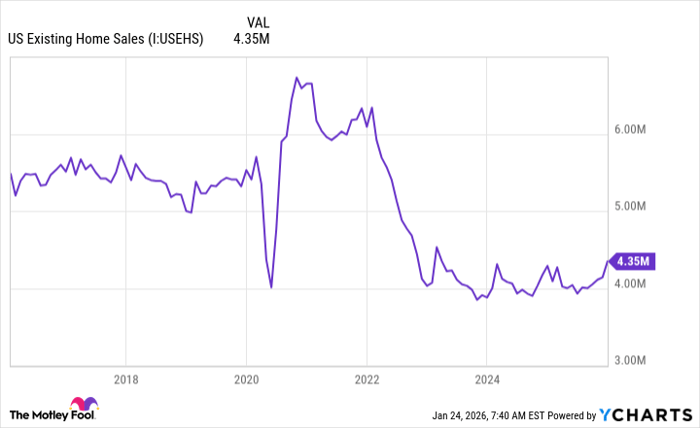
U.S. Existing Home Sales data by YCharts.
Fortunately, the Fed's interest-rate cuts are steadily reducing mortgage costs, and President Donald Trump is trying to accelerate the decline by instructing government-controlled enterprises Fannie Mae (Federal National Mortgage Association) and Freddie Mac (Federal Home Loan Mortgage Corporation) to intervene in the market for mortgage-backed securities. Anything that helps jump-start the housing market will help Opendoor's business.
Opendoor continues to lose money
Opendoor sold 9,813 homes during the first three quarters of 2025, generating $3.6 billion in revenue. However, it only acquired 6,535 homes during the same period, as management deliberately reduced inventory in light of the tough market conditions. Therefore, we already know the company's revenue is likely to shrink in the early stages of 2026.
However, Opendoor's real problem is on the bottom line because it reported a $204 million net loss on a generally accepted accounting principles (GAAP) basis during the first three quarters of 2025. Even after excluding one-off and non-cash expenses like stock-based compensation, the company's adjusted (non-GAAP) loss still came in at $133 million.
Opendoor had $962 million in cash on hand as of Sept. 30, so it can afford to sustain losses of this magnitude for the foreseeable future. That provides some runway for the company's new CEO Kaz Nejatian, who was appointed in September. He previously held leadership roles at Shopify, PayPal, and LinkedIn and has a plan to turn this ship around.
Nejatian wants to use technologies like artificial intelligence (AI) to speed up the pace at which Opendoor sells each home after acquiring it, which will theoretically leave the company less exposed to housing-market swings. He strongly believes boosting sales volume (and therefore, market share) will give Opendoor more control over prices, which will create a pathway to sustainable profits.
However, I'm not totally convinced. Zillow was an extremely high-volume player in the direct-buying market and still couldn't make the numbers work.
Investors should proceed with caution
The CME Group's FedWatch tool suggests there could be two more interest-rate cuts in 2026, which should bring more buyers into the real estate market. However, it's important to remember that interest rates were near a historic low when Zillow and Redfin exited the direct-buying business, so there's no guarantee lower rates will be a magic bullet for Opendoor.
Opendoor stock has already plummeted by 46% from last year's peak, and I think there could be more downside coming during 2026. Previous stocks that were swept up in social media-fueled retail buying frenzies include GameStop and AMC, and both went on to lose most of their value once the hype settled down. That appears to be the most likely outcome in this case, too.
Should you buy stock in Opendoor Technologies right now?
Before you buy stock in Opendoor Technologies, consider this:
The Motley Fool Stock Advisor analyst team just identified what they believe are the 10 best stocks for investors to buy now… and Opendoor Technologies wasn’t one of them. The 10 stocks that made the cut could produce monster returns in the coming years.
Consider when Netflix made this list on December 17, 2004... if you invested $1,000 at the time of our recommendation, you’d have $464,439!* Or when Nvidia made this list on April 15, 2005... if you invested $1,000 at the time of our recommendation, you’d have $1,150,455!*
Now, it’s worth noting Stock Advisor’s total average return is 949% — a market-crushing outperformance compared to 195% for the S&P 500. Don't miss the latest top 10 list, available with Stock Advisor, and join an investing community built by individual investors for individual investors.
*Stock Advisor returns as of January 27, 2026.
Anthony Di Pizio has no position in any of the stocks mentioned. The Motley Fool has positions in and recommends PayPal, Shopify, and Zillow Group. The Motley Fool recommends CME Group and Reddit and recommends the following options: long January 2027 $42.50 calls on PayPal and short March 2026 $65 calls on PayPal. The Motley Fool has a disclosure policy.
Mentioned In This Article
Latest News
| Sep-28 | |
| Sep-28 | |
| Sep-20 | |
| Sep-17 | |
| Sep-16 | |
| Sep-15 | |
| Sep-13 | |
| Sep-10 | |
| Sep-10 | |
| Sep-08 | |
| Sep-04 | |
| Aug-31 | |
| Aug-13 | |
| Aug-13 | |
| Aug-05 |
