Apple To Focus On Premium iPhone Launches In 2026 Amid Memory Chips Constraint: Report
Apple Inc. (NASDAQ:AAPL) is reportedly focusing on the production and shipment of its top-tier iPhone models for 2026, delaying the release of its standard model due to supply chain constraints.
Apple To Focus On Foldable iPhone Launch
The tech giant is set to prioritize the launch of its first-ever foldable iPhone, along with two non-folding models featuring advanced cameras and larger displays, in the second half of 2026, according to a Nikkei Asia report on Friday. The standard iPhone 18 is now expected to ship in the first half of 2027.
Apple did not immediately respond to Benzinga‘s request for comment.
The move is intended to streamline resources and boost revenue as costs rise for memory chips and other components. It will also help Apple navigate potential manufacturing hurdles tied to its new foldable iPhone, which demands more advanced production methods and materials.
A source told Nikkei that the strategy shift is expected to help Apple streamline its supply chain and sharpen its marketing focus, with an iPhone supplier executive noting that supply chain stability and a renewed emphasis on premium models influenced the decision.
Previous reports suggest that Apple is developing at least five new iPhone models, including a redesigned ultra-thin iPhone Air, the standard model, and three premium versions.
Strong iPhone Sales Drive Apple Strategy
This move comes on the heels of Apple’s impressive Q1 earnings, where the company beat analyst estimates with a revenue of $143.76 billion. This was largely driven by strong iPhone sales, with the company’s active installed base crossing 2.5 billion.
Moreover, Apple’s ‘Best iPhone Quarter In History’, as put by CEO Tim Cook, was marked by a 38% year-over-year surge in revenue from Greater China, driven by the iPhone 17 lineup. This suggests a strong demand for premium iPhone models, which could have influenced Apple’s decision to prioritize their production.
Additionally, Fitz-Gerald Group CIO Keith Fitz-Gerald has indicated a major product launch from Apple this spring, with predictions of a revolutionary form factor change akin to the iPhone.
AI Boom Deepens Memory Chip Shortage
Meanwhile, a surge in AI data center spending has worsened the global memory chip shortage by boosting demand for high-bandwidth memory, diverting supply toward AI servers, and reducing availability for consumer electronics like smartphones and PCs.
Micron Technology Inc. (NASDAQ:MU) CEO Sanjay Mehrotra recently stated that dealing with this shortage demands capacity expansion for memory chipmakers, which would have a significant lead time. Earlier this week, the company announced plans to invest about $24 billion (SG$31 billion) over the next ten years to build a state-of-the-art wafer fabrication plant in Singapore.
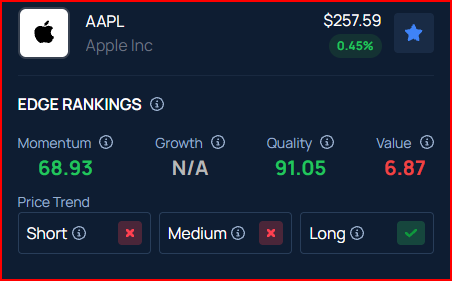
Benzinga’s Edge Rankings place Apple in the 91st percentile for quality and the 69th percentile for momentum, reflecting its mixed performance. Benzinga's screener allows you to compare Apple's performance with its peers.
Price Action: Over the past year, Apple stock climbed 8.71%, as per data from Benzinga Pro. On Thursday, the stock climbed 0.72% to close at $258.28.
Disclaimer: This content was partially produced with the help of AI tools and was reviewed and published by Benzinga editors.
Image via Shutterstock
Mentioned In This Article
Latest News
| 1 hour | |
| 5 hours | |
| 7 hours | |
| 7 hours | |
| 8 hours | |
| 8 hours | |
| 8 hours | |
| 9 hours | |
| 9 hours | |
| 9 hours | |
| 10 hours | |
| 10 hours | |
| 10 hours | |
| 11 hours | |
| 12 hours |
