Hyperscalers to Spend Over $500 Billion on AI in 2026: Here Are the 3 Stocks to Buy
Key Points
Hyperscalers, including Microsoft, Amazon, Alphabet, and Meta Platforms, are raising their capital expenditure budgets for 2026.
Rising infrastructure spend bodes well for the semiconductor industry.
Hyperscalers are racing to secure additional GPUs, while also investing in custom silicon designs.
According to a recent report published by Goldman Sachs, artificial intelligence (AI) hyperscalers are forecast to spend more than $500 billion on infrastructure this year. As capital expenditure (capex) budgets become larger, developers like Microsoft, Alphabet, Amazon, and Meta Platforms share a common idea: Accelerate data center build-outs.
Let's dig into three companies poised to benefit from these explosive AI-related infrastructure tailwinds both during 2026 and beyond.
Where to invest $1,000 right now? Our analyst team just revealed what they believe are the 10 best stocks to buy right now, when you join Stock Advisor. See the stocks »
Image source: Nvidia.
1. The jack of all trades: Nvidia
The most obvious beneficiary of accelerating infrastructure spend is Nvidia (NASDAQ: NVDA). Nvidia kicked off the AI revolution three years ago after big tech realized the company's graphics processing units (GPUs) could be used to build numerous generative AI applications.
Data by YCharts.
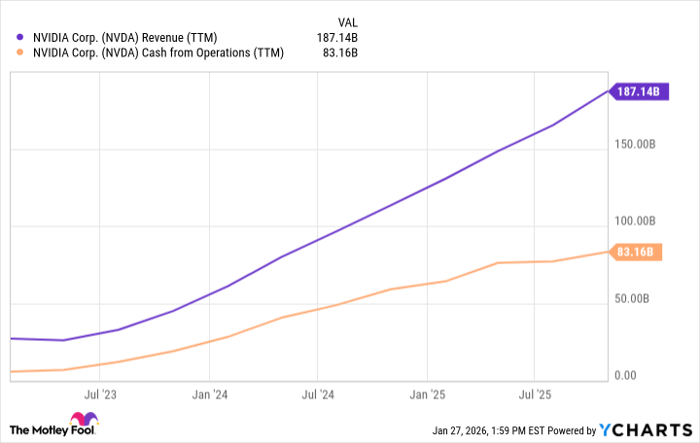
On the surface, relentless demand for Nvidia's GPUs has fueled an unprecedented rise in the company's top line. But Nvidia's profitability profile should be what smart investors are focusing on.
As the company's operating cash flow continues to grow, Nvidia has positioned itself to double down on its innovation road map -- releasing new GPU architectures about every 18 months. While the company's current Blackwell series is considered the gold standard, Nvidia is already building a massive backlog -- reportedly in the hundreds of billions of dollars -- as hyperscalers rush to secure the company's newest chips, dubbed Rubin.
This is all to say that as investments in training and inference continue to skyrocket, demand for Nvidia's general-purpose chipsets doesn't appear to be diminishing in the slightest.
2. The networking specialist: Broadcom
There is more to building AI data centers than just outfitting these facilities with rows of GPU clusters. What makes AI chips such a hot commodity is their ability to process extremely sophisticated algorithms at high speeds. However, there are underlying challenges to these technological dynamics.
Broadcom (NASDAQ: AVGO) supplies the nuts and bolts that keep GPU clusters running efficiently around the clock. What I mean by that is developers need to allocate meaningful budget spend to less glorious products such as networking switches and interconnects.
Another way Broadcom benefits from rising infrastructure spend is through custom silicon. Major companies such as Apple, ByteDance, Alphabet, and Meta reportedly collaborate with Broadcom to design custom application-specific integrated circuits (ASICs).
This is a fancy way of saying that the hyperscalers are looking to complement their existing GPU stacks with their own architectures as a way to lower costs and migrate away from an overreliance on a single provider.
While Broadcom doesn't find its name in the headlines as much as Nvidia or Advanced Micro Devices, the company's diversified product suite is just as important to the overall AI narrative. As big tech buys more GPUs, builds more data centers, and introduces next-generation products, Broadcom is in a lucrative position to win incremental business alongside its peers thanks to the rapid expansion of infrastructure capacity.
3. The pick-and-shovel giant: Taiwan Semiconductor Manufacturing
I can't think of a better company that stands to benefit from the chip demand spike than Taiwan Semiconductor Manufacturing (NYSE: TSM). If Nvidia and Broadcom contain the chips driving the AI revolution, TSMC holds the keys to get the car started.
TSMC is the largest chip manufacturer in the world as measured by revenue -- holding an estimated 70% market share. Nvidia, AMD, Broadcom, Micron Technology, and some of the hyperscalers outsource their chip production to TSMC's foundry.
This role makes TSMC a pick-and-shovel provider for the AI infrastructure boom. In other words, it doesn't really matter which chip architectures are in high demand. So long as enterprises are spending on AI chips, odds are that TSMC is the company making them. From a macro point of view, rising capital expenditure budgets could be seen as a proxy for TSMC's trajectory, given the company's leading role in bringing AI hardware to life.
Per the company's fourth-quarter earnings report, TSMC's management sees AI as a generational growth trend -- one that should produce robust revenue and profit margin expansion throughout the rest of the decade.
Against this backdrop, TSMC might be the biggest beneficiary of all when it comes to the secular themes fueling infrastructure -- making it potentially the safest AI chip stock in the market right now for long-term investors.
Should you buy stock in Nvidia right now?
Before you buy stock in Nvidia, consider this:
The Motley Fool Stock Advisor analyst team just identified what they believe are the 10 best stocks for investors to buy now… and Nvidia wasn’t one of them. The 10 stocks that made the cut could produce monster returns in the coming years.
Consider when Netflix made this list on December 17, 2004... if you invested $1,000 at the time of our recommendation, you’d have $448,476!* Or when Nvidia made this list on April 15, 2005... if you invested $1,000 at the time of our recommendation, you’d have $1,180,126!*
Now, it’s worth noting Stock Advisor’s total average return is 945% — a market-crushing outperformance compared to 197% for the S&P 500. Don't miss the latest top 10 list, available with Stock Advisor, and join an investing community built by individual investors for individual investors.
*Stock Advisor returns as of January 31, 2026.
Adam Spatacco has positions in Alphabet, Amazon, Apple, Meta Platforms, Microsoft, and Nvidia. The Motley Fool has positions in and recommends Advanced Micro Devices, Alphabet, Amazon, Apple, Goldman Sachs Group, Meta Platforms, Micron Technology, Microsoft, Nvidia, and Taiwan Semiconductor Manufacturing. The Motley Fool recommends Broadcom. The Motley Fool has a disclosure policy.
Mentioned In This Article
Latest News
| 13 min | |
| 25 min | |
| 28 min | |
| 28 min | |
| 43 min | |
| 1 hour | |
| 1 hour | |
| 1 hour | |
| 1 hour | |
| 1 hour | |
| 1 hour | |
| 2 hours | |
| 2 hours | |
| 2 hours | |
| 3 hours |
