This Super Semiconductor Company Just Struck a $6 Billion AI Deal With Meta Platforms
Key Points
Corning supplies fiber-optic cables for data centers, which transmit information far more efficiently than copper cables.
The company believes the market for data center optical fiber could triple from here as demand from AI developers soars.
Corning just signed a blockbuster deal with Meta Platforms, and there could be several more just like it in the pipeline.
Corning (NYSE: GLW) is best known for having supplied the tough, scratch-resistant glass for Apple's iPhone since 2007. However, its stock has more than tripled over the last two years for a completely different reason.
Corning has become a leading supplier of fiber-optic cables for data centers, which are significantly more efficient at moving information between chips and devices than their copper counterparts. As a result, these cables are in high demand from artificial intelligence (AI) developers, and in fact, Facebook parent Meta Platforms (NASDAQ: META) just placed a multi-year order worth a whopping $6 billion.
Where to invest $1,000 right now? Our analyst team just revealed what they believe are the 10 best stocks to buy right now, when you join Stock Advisor. See the stocks »
Here's what this could all mean for Corning stock going forward.
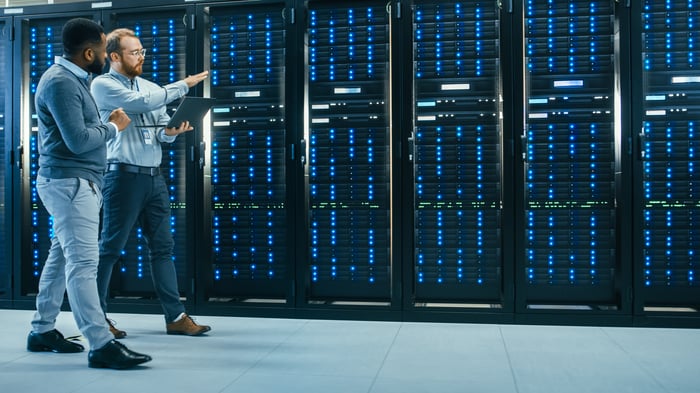
Image source: Getty Images.
The transition to fiber is a huge opportunity
The typical data center stack includes graphics processing units (GPUs), central processing units (CPUs), high-bandwidth memory, storage chips, switches, adapters, and more. Nvidia's flagship NV-Link 72 rack includes 72 GPUs that are connected to all of those other components using around two miles of cables.
Most data center operators are still using copper, but they are quickly transitioning to fiber-optic cables instead because this material can transmit information faster and over much further distances, with minimal data loss.
This is increasingly important because data center nodes are growing in size, so while a 72-GPU stack is common right now, that figure will eventually increase to hundreds of GPUs. This means data has to travel over much longer distances, making optical fiber the clear choice.
Meta has around 30 data centers either in operation or planned, including one called Hyperion, which is under construction in Louisiana. Construction is scheduled to finish in 2030, and it will be the company's biggest facility so far. Early estimates suggest it will house around 1.3 million GPUs, so if a single Nvidia NV-Link 72 node uses two miles of cable, this facility will likely require over 36,000 miles of cable overall.
Corning CEO Wendell Weeks believes the market for data center optical fiber could triple in size over the long term because of these tailwinds, which presents the company with a substantial opportunity.
The Meta deal could drive substantial growth
Corning generated core revenue of $16.4 billion during 2025, a 13% increase from the previous year. Its optical communications business accounted for $6.2 billion of that revenue, and it grew at a much faster pace of 35%.
If we zoom in even further, Corning's enterprise optical communications business brought in $3 billion for the year, which represented an eye-popping 61% growth, and the hyperscale data center segment specifically saw revenue more than double. The $6 billion in potential revenue from the Meta deal will flow directly into Corning's enterprise business over the next several years, where it could drive a significant amount of growth.
The optical communications segment's net income (profit) also soared by 71% to $1.05 billion in 2025, accounting for almost half of Corning's total net income of $2.2 billion. The incredible demand for optical fiber is giving the company an incredible amount of pricing power, which is boosting profit margins.
Corning stock could be a solid long-term buy
Corning generated core non-GAAP (generally accepted accounting principles) earnings of $2.52 per share during 2025, placing its stock at a price-to-earnings (P/E) ratio of 40.8. That is a steep premium to the S&P 500 and even the Nasdaq-100, which trade at P/E ratios of 26.6 and 32.6, respectively.
However, Corning might still be cheap relative to many other stocks in the AI semiconductor space. Nvidia stock, for example, trades at a P/E ratio of 47.1, and major semiconductor equipment supplier Broadcom has a P/E ratio of 48.5. Therefore, Corning stock might still have room to run.
In his fourth-quarter conference call with investors, Wendell Weeks said Corning is finalizing several other agreements that are similar in size and scope to the Meta deal. If that's the case, Corning stock is likely much cheaper than it appears right now because of the substantial potential earnings in the pipeline.
Should you buy stock in Corning right now?
Before you buy stock in Corning, consider this:
The Motley Fool Stock Advisor analyst team just identified what they believe are the 10 best stocks for investors to buy now… and Corning wasn’t one of them. The 10 stocks that made the cut could produce monster returns in the coming years.
Consider when Netflix made this list on December 17, 2004... if you invested $1,000 at the time of our recommendation, you’d have $450,256!* Or when Nvidia made this list on April 15, 2005... if you invested $1,000 at the time of our recommendation, you’d have $1,171,666!*
Now, it’s worth noting Stock Advisor’s total average return is 942% — a market-crushing outperformance compared to 196% for the S&P 500. Don't miss the latest top 10 list, available with Stock Advisor, and join an investing community built by individual investors for individual investors.
*Stock Advisor returns as of February 2, 2026.
Anthony Di Pizio has no position in any of the stocks mentioned. The Motley Fool has positions in and recommends Apple, Corning, Meta Platforms, and Nvidia. The Motley Fool recommends Broadcom. The Motley Fool has a disclosure policy.
Mentioned In This Article
Latest News
| 38 min | |
| 46 min | |
| 1 hour | |
| 2 hours | |
| 2 hours | |
| 3 hours | |
| 4 hours | |
| 4 hours | |
| 8 hours | |
| 9 hours | |
| Oct-08 | |
| Oct-08 | |
| Oct-08 | |
| Oct-08 | |
| Oct-08 |
