Tesla's Robotaxi Plans for 2026: Is Musk's Timeline Finally Realistic?
Tesla TSLA is betting big on autonomous driving, and its robotaxi program is a key part of its long-term growth strategy. Tesla started its first robotaxi service in Austin, TX, on June 22, 2025, and the program has been growing steadily since. After missing ambitious autonomy timelines in the past, the big question now is whether Tesla’s expanding Robotaxi footprint makes Musk’s latest targets more realistic.
Early Progress and Expansion Plans
Today, Tesla’s robotaxis operate in Austin and the California Bay Area. Austin has seen faster progress. The company started testing fully driverless rides in December 2025 and began removing Safety Monitors in January on some customer trips. This shift matters. It signals growing confidence in the system and opens the door to wider, lower-cost deployment. In the Bay Area, rides still have a safety driver, but Tesla plans to expand coverage to major airports once regulators give the green light.
The company intends to launch robotaxi services in seven new cities during the first half of the year— Dallas, Houston, Phoenix, Miami, Orlando, Tampa and Las Vegas. By doing so, Tesla aims to capture a significant portion of the ride-hailing market, directly competing with traditional platforms like Uber and Lyft, which are often more expensive and dependent on driver availability.
Since their launch, Tesla’s robotaxis have logged nearly 700,000 paid miles. The fleet now has more than 500 vehicles between Austin and the Bay Area and is doubling roughly every month, as the company noted on its latest earnings call. Tesla is also investing heavily in service and infrastructure to support this rapid growth.
Tesla is also working on Cybercab, a vehicle built specifically for autonomous driving. It doesn’t have a steering wheel or pedals, making it more efficient for robotaxi use. Volume production of the Cybercab is expected this year, which could help Tesla scale even faster.
Well, expanding robotaxis will require regulatory approval, strong safety performance, and public trust. But Tesla has a huge advantage — a large fleet of cars already equipped with self-driving hardware and a strong brand. Notably, Musk’s team has set bold targets, including 10 million Full Self-Driving subscriptions and 1 million robotaxis in commercial use, which are tied to his massive $1 trillion pay package.
Can Musk Deliver on the Timeline This Time?
Elon Musk has said that, pending regulatory approval, fully autonomous Tesla vehicles could reach roughly a quarter to half of the U.S. population by the end of the year. It’s worth remembering that back in July 2025, he made a similar claim, suggesting autonomous ride-hailing could reach “probably” half the U.S. population by year-end—a target that ultimately slipped.
Given that history, some skepticism is natural. The key question now is whether this timeline is finally realistic or just another ambitious goal. For now, it remains a wait-and-see story, though this time, the progress on the ground makes the target look more plausible.
How Tesla Stacks Up Against Waymo and Zoox
Alphabet’s GOOGL Waymo is a clear leader in the robotaxi domain. Waymo’s robotaxi service is now logging more than 450,000 paid rides per week in the United States, nearly double the level it reported in April 2025. The company is also expanding fast, rolling out freeway driving in multiple cities and launching autonomous services in places like Miami, Dallas, Houston, San Antonio and Orlando.
Amazon’s AMZN Zoox is taking a different path. Instead of retrofitting existing cars, Zoox has built a vehicle from scratch for autonomy. Its compact, boxy shuttles have no steering wheel, pedals, or mirrors, and feature inward-facing seats designed for shared rides. Zoox began offering free public rides around the Las Vegas Strip and in parts of San Francisco last year, with plans to start charging customers in 2026.
The Zacks Rundown on TSLA Stock
Shares of Tesla have gained 8% over the past year, underperforming the industry.
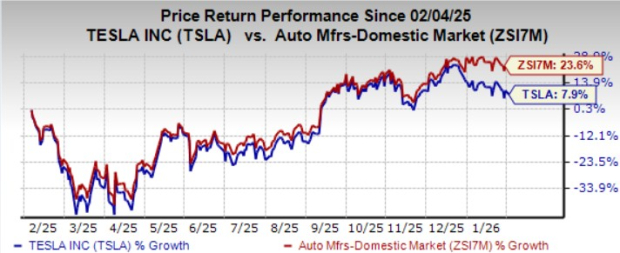
From a valuation standpoint, TSLA trades at a forward price-to-sales ratio of 15.07, above the industry and its own five-year average. It carries a Value Score of F.

See how the Zacks Consensus Estimate for TSLA’s earnings has been revised over the past 90 days.

Tesla stock currently carries a Zacks Rank #4 (Sell).
You can see the complete list of today’s Zacks #1 Rank (Strong Buy) stocks here.
Want the latest recommendations from Zacks Investment Research? Today, you can download 7 Best Stocks for the Next 30 Days. Click to get this free report
Amazon.com, Inc. (AMZN): Free Stock Analysis Report
Tesla, Inc. (TSLA): Free Stock Analysis Report
Alphabet Inc. (GOOGL): Free Stock Analysis Report
This article originally published on Zacks Investment Research (zacks.com).
Mentioned In This Article
Latest News
| 2 hours | |
| 3 hours | |
| 3 hours | |
| 4 hours | |
| 5 hours | |
| Oct-09 | |
| Oct-09 | |
| Oct-09 | |
| Oct-09 | |
| Oct-09 | |
| Oct-09 | |
| Oct-09 | |
| Oct-09 | |
| Oct-09 | |
| Oct-09 |
Tesla's China Retail Sales Fall 9% Even as Shanghai Exports Surge 58%
TSLA
Benzinga Prediction Markets
|
