Revisiting Hertz's Amazon Partnership 5 Months Later: The Good, the Bad, the Risk
It has been a rough ride for shareholders of Hertz Global Holdings (NASDAQ: HTZ). Over the past five years, shares are down more than 79%, including a nearly 43% loss since the stock’s one-year high on April 24, 2025.
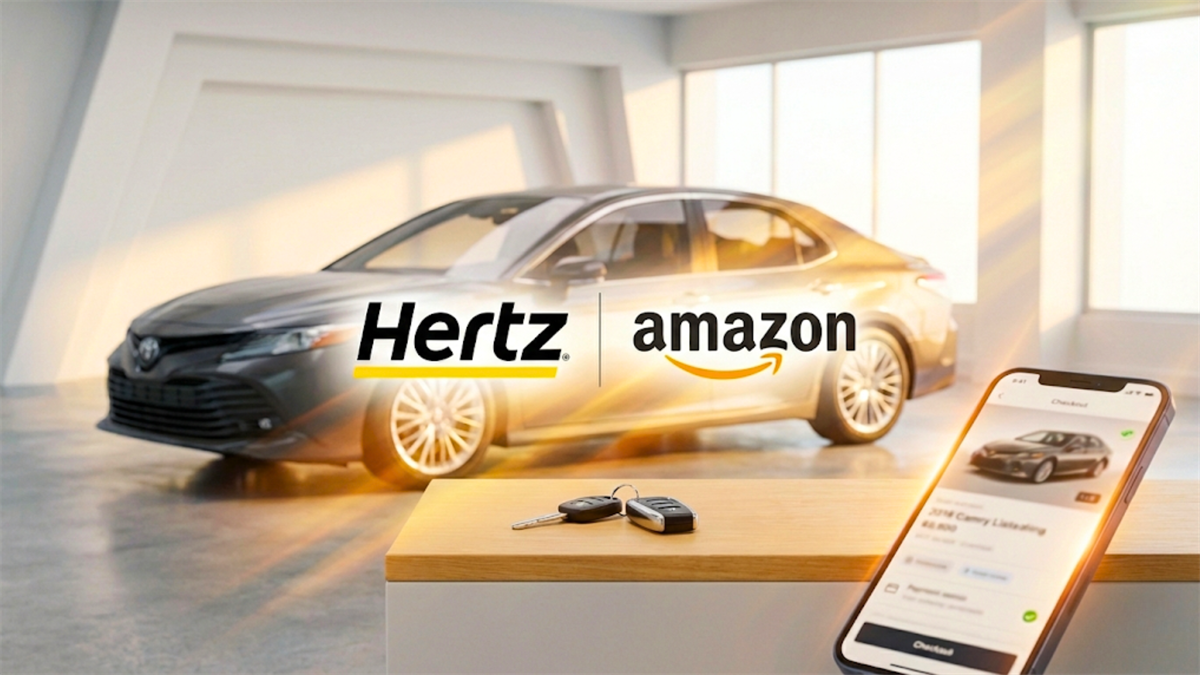
But last summer, the company—looking for a spark—signed a strategic partnership with Amazon (NASDAQ: AMZN) to offload some of its aging and unpopular inventory.
The deal with Amazon Autos aims to sell Hertz’s used cars by giving “customers a faster, more convenient way to buy their [pre-owned] car online,” providing access to thousands of listings eligible for online purchases and pick-up services provided in 45 locations nationwide.
Additionally, Hertz provides flexible financing options, a 12-month/12,000-mile limited powertrain warranty, 24-hour roadside assistance, and a 7-day/250-mile buyback guarantee.
The effort sought to help offset the impact of a massive multi-billion net loss in 2024 that Hertz experienced in part due to an aggressive pivot towards an EV-focused fleet, and the subsequent depreciation of those vehicles in light of price cuts from Tesla (NASDAQ: TSLA).
Here is how the stock has performed in the five months since inking that deal with Amazon.
Hertz’s Strategic Partnership With Amazon Aimed to Right the Ship
After the deal was announced on Aug. 20, 2025, outlets like CNBC called it a threat to auto dealers after shares of HTZ surged on the news.
But despite the success of online used car retailers like Carvana (NYSE: CVNA), Hertz’s strategic partnership with Amazon hinged on customers feeling comfortable turning to a platform where they buy toothpaste and toilet paper to purchase what is widely considered the second most expensive asset in most American households.
During the company’s Q3 2025 earnings call, CEO Gil West noted that “by scaling our direct-to-consumer and e-commerce channels, we're positioned to capture $2,000 or more incremental margin benefit per vehicle versus wholesale channels.”
However, total sales figures for vehicles sold exclusively through Amazon Autos are not publicly disclosed, leaving investors to turn to Hertz’s income statements and balance sheets to glean clues.
Hertz’s Financials Are Not Inspiring Hope
The first of those clues can be seen in the company’s accumulated depreciation, which has steadily increased every quarter from Q3 2024 to Q3 2025, rising from $308 million to $1.33 billion—a nearly 332% increase. Increasingly accumulated depreciation is generally seen as a negative indicator, as it entails aging assets that are losing value on the books.
Over the same period, Hertz’s plant, property, and equipment, or PP&E, decreased by more than 4% and its long-term debt increased by nearly 7%, while revenue growth contracted every quarter.
Perhaps most concerning, free cash flow growth was nearly -442% in Q3 2025. Since announcing the partnership with Amazon, shares of HTZ are down nearly 10%, while shares of AMZN are up nearly 9%.
Looking further back, after seeing annual EPS of $1.39 per share in 2023, Hertz wrapped up 2024 with a loss per share of $9.34. Those problems extended into 2025, with EPS losses of $1.44 and 95 cents in Q1 and Q2 before a surprise earnings beat of 59 cents in Q3.
Still, that momentary turnaround has done little to instill confidence in shareholders or analysts, as the faltering vehicle rental and transportation solutions company looks to convince investors otherwise.
Analysts’ Tale of 2 Companies
Amazon, which reports full-year and Q4 2025 earnings on Thursday, Feb. 5, remains in analysts’ favor; the same cannot be said about Hertz.
AMZN receives a consensus Moderate Buy rating, with 55 of 59 analysts covering the stock assigning it a Buy rating to go along an average 12-month price target that suggests nearly 22% upside.
Meanwhile, HTZ receives a consensus Reduce rating, with no analysts assigning it a Buy rating. Still, the average 12-month price target implies more than 8% potential upside, but that will do little to satisfy the losses of shareholders who endured brutal losses with no reprieve in sight.
Making matters worse, Wall Street’s bears smell blood in the water. Current short interest stands at a substantial 18.41%, or more than 51 million shares of the 311.6 million shares outstanding.
Hertz scores higher than just 23% of companies evaluated by MarketBeat, while ranking 109th out of the 130 stocks in the transportation sector alongside a middling financial health score that lands it in the Yellow Zone, according to TradeSmith, where HTZ has spent the better part of the past six months.
While the company does not report full-year and Q4 2025 earnings until Feb. 12, Hertz saw net income contract from $616 million in 2023 to -$2.8 billion in 2024, good for a decrease of nearly 565%.
Where Should You Invest $1,000 Right Now?
Before you make your next trade, you'll want to hear this.
MarketBeat keeps track of Wall Street's top-rated and best performing research analysts and the stocks they recommend to their clients on a daily basis.
Our team has identified the five stocks that top analysts are quietly whispering to their clients to buy now before the broader market catches on... and none of the big name stocks were on the list.
They believe these five stocks are the five best companies for investors to buy now...
The article "Revisiting Hertz’s Amazon Partnership 5 Months Later: The Good, the Bad, the Risk" first appeared on MarketBeat.
Mentioned In This Article
Latest News
| 24 min | |
| 57 min | |
| 1 hour | |
| 1 hour | |
| 1 hour | |
| 2 hours | |
| 3 hours |
Analyst Sees TSLA-SPCX Merger Coming By December, but Prediction Markets Arent Buying It
TSLA
Benzinga Prediction Markets
|
| 3 hours | |
| 4 hours | |
| 4 hours |
Elon Musk Sees Almost All Cars Going Electric as Gasoline-Only Vehicles Fall Below Half of Global Sales
TSLA
Benzinga Prediction Markets
|
| Oct-14 | |
| Oct-14 | |
| Oct-14 | |
| Oct-14 | |
| Oct-14 |
