Mastercard's Value-Added Services Boom in 2025: Buy, Hold or Sell?
Payments leader Mastercard Incorporated MA delivered a solid set of fourth-quarter 2025 results, driven by steady consumer spending, higher cross-border volumes, robust transaction growth and rising demand for its value-added services. Although gross dollar volume narrowly missed expectations, overall performance highlighted the durability of its business.
Shares have climbed 2.7% since the earnings release but still trade roughly 11% below the 52-week high of $601.77. The quarter revealed multiple long-term growth drivers, alongside renewed regulatory concerns, especially surrounding the resurfacing of the Credit Card Competition Act, or CCCA.
Let’s unpack.
Mastercard’s Q4 Highlights
Mastercard posted adjusted earnings per share of $4.76, beating the Zacks Consensus Estimate by 13.3% and rising 25% from the year-ago quarter. Revenue reached $8.8 billion, topping estimates by 0.8% and increasing 18% year over year. For a detailed analysis, read our blog here.
Gross dollar volume increased 7% on a local-currency basis to $2.82 trillion, modestly below the consensus estimate of $2.84 trillion. However, transaction trends remained healthy, with switched transactions rising 10%. Mastercard reported 3.7 billion Mastercard and Maestro-branded cards in circulation as of Dec. 31, 2025, underscoring the scale and stickiness of its global network.
Cross-border volumes, a key profitability lever, grew 14% in local currency basis. This performance signals resilient international travel and cross-border commerce, even amid uneven macro conditions. Rival Visa Inc. V is experiencing similar trends, although Mastercard’s greater exposure to emerging international markets offers a differentiated growth profile.
High-Margin Engine Gains Speed
Mastercard’s services segment delivered another standout quarter, reinforcing management’s strategy to diversify beyond traditional card processing. Value-added services (VAS) revenue jumped 26% year over year to $3.9 billion, supported by acquisitions and strong organic growth across cybersecurity, data analytics, digital authentication and customer engagement solutions. For 2025, net revenues from value-added services and solutions grew 23%.
The company continues to invest aggressively in fraud prevention, identity verification and analytics capabilities, embedding its platforms more deeply into enterprise workflows. This approach strengthens customer relationships, improves retention, and enhances pricing power. As digital commerce expands and fraud risks rise, demand for sophisticated security and analytics tools is expected to remain strong, giving Mastercard a durable growth runway.
Stablecoins, Agentic Commerce and Emerging Markets
Mastercard is positioning itself at the forefront of next-generation payment technologies, with a growing focus on stablecoins and agentic commerce. The company is expanding settlement capabilities through partnerships and infrastructure investments, aiming to integrate blockchain-based payments into its broader ecosystem. This is expected to lower the costs of cross-border transactions.
However, Visa recently tempered expectations for stablecoins as a mainstream consumer payment tool in highly developed digital markets, arguing that existing payment systems already provide speed and convenience. While Mastercard continues to explore use cases, stablecoins currently represent a longer-term opportunity rather than an immediate revenue driver.
In agentic commerce, Mastercard launched the Agent Pay framework to enable secure, automated digital transactions. Following an initial rollout with U.S. issuers, the company is working with its global issuer base, with broader participation expected by the first quarter-end. This initiative aims to support AI-driven commerce models, where trusted payment authentication becomes increasingly essential.
Geographically, Mastercard’s expanding footprint across Southeast Asia and Latin America positions it well to benefit from rising digital adoption. Large underbanked populations, improving mobile infrastructure, and growing e-commerce penetration provide a powerful long-term tailwind for transaction growth, card issuance and financial inclusion efforts.
Mastercard’s Commitment to Shareholders
Mastercard continues to return significant capital to shareholders, supported by strong free cash flow generation. During the fourth quarter of 2025, the company returned $684 million in dividends and repurchased $3.6 billion worth of shares. As of late January 2026, it retained $16.7 billion in remaining buyback authorization, following an additional $715 million in repurchases quarter to date. For full-year 2025, operating cash flow reached $17.6 billion, up from $14.8 billion in the prior year.
Strong Estimates for 2025 & 2026
The Zacks Consensus Estimate calls for earnings growth of 13.6% in 2026 and 15.7% in 2027, with revenues projected to rise 12.6% and 11.8%, respectively. Importantly, the stock has seen three upward earnings estimate revisions for 2026 over the past week, with no offsetting downward revisions.
Mastercard also beat earnings estimates in each of the last four quarters, with an average surprise of 5.5%.
Mastercard Incorporated Price, Consensus and EPS Surprise

Mastercard Incorporated price-consensus-eps-surprise-chart | Mastercard Incorporated Quote
MA’s Challenges & Risks
Despite its strengths, investors should keep an eye on some risks:
Adjusted operating expenses have accelerated steadily, rising 10.7% in 2022, 10.5% in 2023, 11% in 2024, and 14% in 2025. At the same time, rebates and incentives, classified as contra-revenue, increased 16.1% in 2024 and 16% in 2025, putting pressure on net revenue growth.
Potential competition from stablecoin initiatives by large retailers and technology firms could eventually divert transaction volumes away from traditional card networks. While adoption remains limited, the pace of innovation in digital payments warrants close monitoring.
Regulatory risk remains a significant overhang. In June 2025, the U.K.’s Competition Appeal Tribunal ruled against multilateral interchange fees, and proposed fee caps from the Payment Systems Regulator could weigh on regional profitability.
In the United States, the Department of Justice has accused Mastercard and Visa of leveraging market dominance to impose excessive merchant costs. MA settled a workplace pay-equity case in early 2025, committing to enhanced internal audits and oversight. Separately, a proposed settlement intended to bring closure to long-standing interchange fee litigation has faced opposition from multiple groups. Meanwhile, the resurrected Credit Card Competition Act proposal could introduce structural changes to routing rules, potentially pressuring network economics.
Mastercard’s Price Performance & Valuation
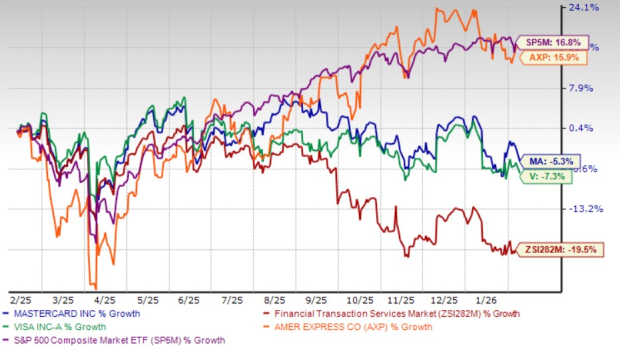
Over the past year, Mastercard shares have declined 5.3%, outperforming the industry’s 19.5% drop but trailing the S&P 500’s 16.8% growth. Visa has declined 7.3%, while American Express Company AXP has risen 15.9% during this time.
Price Performance – MA, V, AXP, Industry & S&P 500
From a valuation standpoint, Mastercard is trading at a forward P/E ratio of 27.24X, lower than its five-year median of 30.94X but well above the industry average of 18.95X. In comparison, Visa trades at 24.20X and American Express at 20.20X.

Final Verdict: Hold Mastercard for Now
Mastercard’s fourth-quarter performance reaffirmed the strength and resilience of its global payments franchise. Solid transaction growth, accelerating cross-border volumes and rapid expansion of high-margin value-added services continue to anchor a compelling long-term growth narrative. Strategic investments in emerging technologies like agentic commerce, along with deepening penetration in high-growth international markets, further enhance the company’s structural advantages. Robust cash generation and aggressive shareholder returns add to the stock’s appeal.
That said, near-term uncertainties around regulatory scrutiny, rising operating costs, and evolving competitive dynamics, particularly related to stablecoins and payment routing reforms, temper upside expectations. While Mastercard remains fundamentally strong, these overhangs suggest a more balanced approach at current valuations. It currently has a Zacks Rank #3 (Hold).
You can see the complete list of today’s Zacks #1 Rank (Strong Buy) stocks here.
Want the latest recommendations from Zacks Investment Research? Today, you can download 7 Best Stocks for the Next 30 Days. Click to get this free report
Mastercard Incorporated (MA): Free Stock Analysis Report
Visa Inc. (V): Free Stock Analysis Report
American Express Company (AXP): Free Stock Analysis Report
This article originally published on Zacks Investment Research (zacks.com).
Mentioned In This Article
Latest News
| 12 min | |
| 27 min | |
| 43 min | |
| 1 hour |
Dow Jones Payments Giant Visa In Buy Zone Following This Week's Breakout Move
V
Investor's Business Daily
|
| 2 hours | |
| 2 hours | |
| 2 hours | |
| 4 hours | |
| 4 hours | |
| 4 hours | |
| 5 hours | |
| 10 hours | |
| Oct-14 | |
| Oct-14 | |
| Oct-14 |
