Waiting for Walmart to Pull Back? Now's the Time to Buy

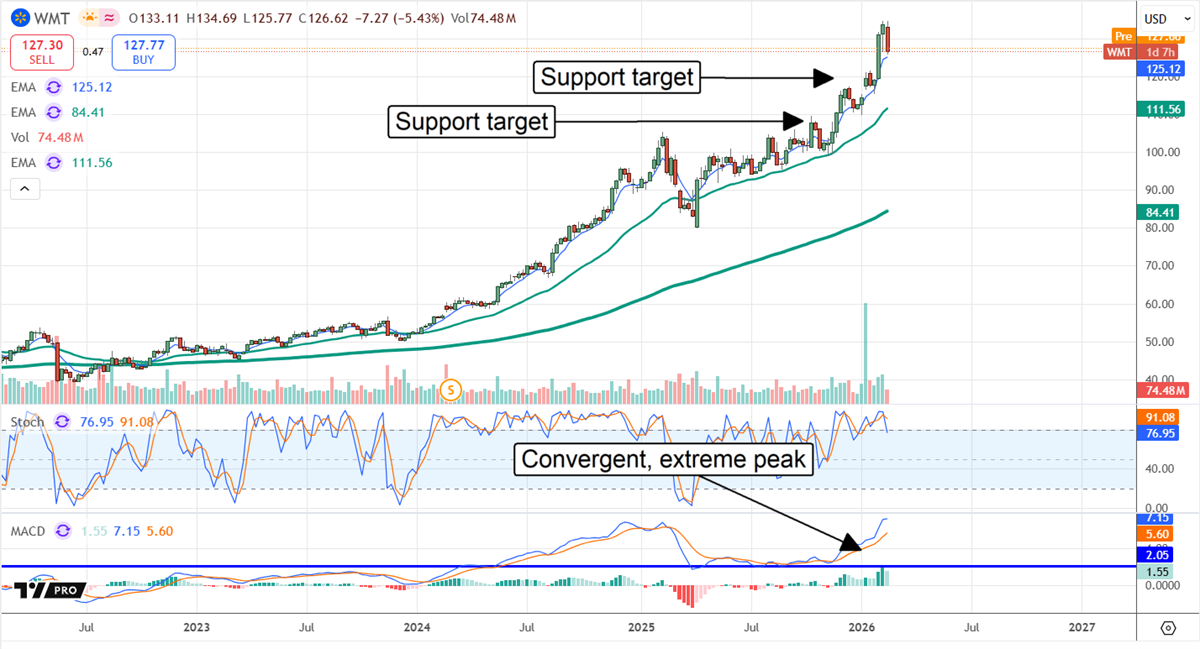
Investors waiting for Walmart (NASDAQ: WMT) shares to pull back into an entry point have been rewarded for their patience. The stock price peaked ahead of the Q4 2026 earnings report and has since begun to decline. The technical indicators are clear: this stock is in an uptrend but could pull back as deeply as the $120 to $110 range before hitting bottom and rebounding. When it does, the upside potential will be in the low-double-digit CAGR range, including dividends and share price gains, over the coming years.
Walmart’s stock price action is driven by cash flow as much as by company growth. The cash flow sustains balance sheet health alongside ample, reliable, and expected-to-increase-over-time capital returns and reinvestment. The dividend yield is below the market average at 0.8% as of mid-February 2026, but ultra-reliable at 35% of the earnings outlook and backed up by a 52-year history of consecutive increases. The buybacks are also reliable, reduce the count quarterly, and will continue in the upcoming years. The board authorized a new $30 billion allotment, equating to approximately 3% of the pre-release market cap.
Analysts Caution Doesn’t Mean Sell Walmart: Buying Opportunity Exposed
Analysts expressed some caution following Walmart’s Q4 release; however, they remain optimistic and underpin the stock price outlook. As it stands, MarketBeat tracks 35 current analyst reports (those less than 12 months old), with trends reflecting increased coverage, firming sentiment, and a 94% Buy-side bias. The price target trend is also supportive, as the consensus is up 30% on a trailing 12-month basis and rising right up to the report's release.
The latest updates include an Upgrade to Strong Buy by Argus and numerous price targets boosts or reiterations, which have pushed the range’s high to $150. A move to $150 would be significant because it would be about 10% above the stock's all-time high.
The technical setup is promising. While price action peaked before the report, it appears to be within a broader uptrend that remains intact.
The indicators align with the peaks, with MACD specifically revealing not only convergence with the latest high but also the strongest peak on record.
The combination suggests a strengthening market, one on track to at least retest the current high following the current pullback. In this scenario, a retest of the current high could be the minimum target; a move to new highs is likely.
MarketBeat data shows institutions owning only about 25% of the stock, but that is not the full picture. Institutions own approximately 25% of Walmart, while the Walton family owns an estimated 50% or more of the shares. Together, the group commands nearly 80% of the stock.
Additionally, the institutions are accumulating. Institutional data shows this group buying at a pace of more than $2 for each $1 sold over the trailing 12 months and ramping their activity in early Q1 2026. The balance in January and early February approached $2.50 for every $1 sold, providing a robust tailwind, coincidentally as Walmart shares spiked to record highs. This data suggests a solid support base waiting to buy shares near or just below the $120 support target.
Walmart Guidance: Caution in the Face of Bullish Trends
Walmart’s guidance is undeniably weak. The company guided Q1 and full-year 2027 revenue and earnings below consensus forecasts, though still expecting growth, margin strength, and ample cash flow. That guidance is likely to be cautious, given the Q4 outperformance and strength in critical consumer channels.
eCommerce was among the leaders, up by 24% systemwide, driven by same-day pickup and delivery services. The ad business also saw solid growth of 37% globally, and by 41% in the United States. Regarding the core businesses, Walmart U.S. comps grew by 4.6% underpinned by ticket size and traffic, while Sam’s Club grew by 4% on a 6.9% increase in membership fees, led by International, which grew comps by 7.5%.
The margin news was also good, with gross margins expanding slightly and compounded by expense control. The net result was an accelerated 10.5% growth in currency-neutral operating income (10.8% reported), a 12.1% increase in adjusted earnings, and 18% growth in free cash flow. Looking ahead, the company forecasts revenue growth of about 4.5%, a slight slowdown from this year. Reasons to believe the forecast is cautious also include this year’s tax refunds, which have been reported to be, on average, 10% larger than last year's.
Where Should You Invest $1,000 Right Now?
Before you make your next trade, you'll want to hear this.
MarketBeat keeps track of Wall Street's top-rated and best performing research analysts and the stocks they recommend to their clients on a daily basis.
Our team has identified the five stocks that top analysts are quietly whispering to their clients to buy now before the broader market catches on... and none of the big name stocks were on the list.
They believe these five stocks are the five best companies for investors to buy now...
The article "Waiting for Walmart to Pull Back? Now’s the Time to Buy" first appeared on MarketBeat.
Mentioned In This Article
Latest News
| Oct-10 | |
| Oct-10 | |
| Oct-09 | |
| Oct-09 |
Richest Americans Gained 19% in Wealth as Poorest Lost 56% Since 2022
WMT
Benzinga Prediction Markets
|
| Oct-09 | |
| Oct-09 | |
| Oct-08 |
For Walmart, Replacing Humans With Robots Is a Multibillion-Dollar Struggle
WMT
The Wall Street Journal
|
| Oct-08 | |
| Oct-08 | |
| Oct-08 | |
| Oct-08 | |
| Oct-08 | |
| Oct-08 | |
| Oct-08 | |
| Oct-08 |
