Bullish Case Losing Strength as Pressure to Cover Fades
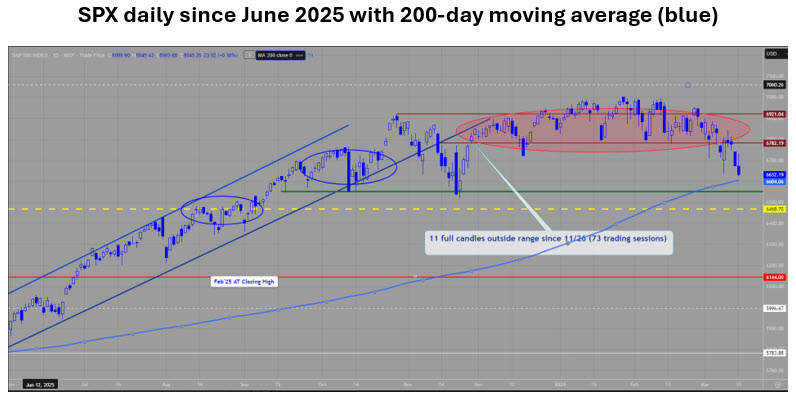
“For the first time in nearly a month, Friday’s S&P 500 Index (SPX—6,740.02) daily candle (high, low, and close) were below a range between 6,780 (the breakdown site of a bull channel in mid-November) and 6,920 (site of the late-October intraday high). It ..makes only nine full candles over the past 68 sessions outside the range…If a breakdown below the multi-month range is in store, the next potential area of chart resistance I see is in the 6,555-6,585 level, with 6,555 representing multiple lows from September into November, and 6,585 the site of the SPX’s rising 200-day moving average.”
-Monday Morning Outlook, March 9, 2026
Last Friday’s S&P 500 Index (SPX – 6,632.19) daily candle hinted that the bears were seizing control, as it was the index’s first full candle (high, low, and close) below the 6,782 level. This was the site of the breakdown below the lower boundary of a multi-month bull channel in mid-November.
Before last Friday, there was never a major threat of bears seizing control since the late November advance above the site of the breakdown level, even as investors weighed tariff uncertainties and the path of interest rates well into the first quarter of this year.
From last Monday through Wednesday, it looked like the previous Friday was a “one-day wonder” move below the range, as the SPX advanced and closed above or in the vicinity of the 6,782 level.
However, lingering uncertainties with respect to the U.S. and Israel war against Iran sent oil prices sharply higher again, after a sharp pullback from the March 9 intraday high. Plus, additional private credit concerns sent the SPX spiraling lower to end the week.
Entering this week’s trading, the SPX is situated just above the next area of potential support in the 6,555 to 6,610 area. The 6,555 level marks the low in October, after a one-day sharp selloff, and again in November after a three-week, 5% decline. The 6,610 level is the current site of the rising 200-day moving average, which was last breached around this time last year, around “Liberation Day” tariff announcements.
For what it is worth, while the 200-day moving average is popular, the last time it marked a major pivot was mid-August 2022, acting as resistance after a short-term rally before the last leg down in a 17% decline that persisted from December 2021 into October 2022.
In February 2022, Russia attacked Ukraine, sending oil prices sharply higher. Using the recent past as a guide and in the context of the Russia-Ukraine war causing a spike in oil prices, plus inflation lingering above the Fed’s targeted rate (as it was four years ago), one has to be open to the idea this war could last longer than expected and negatively impact equities, with investors also bracing for increased odds of stagflation.
“Geopolitics and trade: Geopolitical risk lurks as a latent but potent threat to equities. Tensions between the US and China, conflicts that ripple through energy markets, or disruptions to critical supply chains — including semiconductors and rare-earth minerals — could trigger abrupt risk-off moves. Trade policy is another wildcard, particularly if tariffs return to the political spotlight.”
Economic slowdown: The consensus is that US growth will prove robust, while hopes for Europe revolve around a spending spree among governments. But any cracks in this narrative will be closely watched. Questions around how consumers are coping with cost-of-living pressures and how bank balance sheets are handling credit risk will be top of mind.”
Geopolitical and credit risks were two of many flagged headed into this year. As such, the current realities now unfolding are not necessarily considered black swan events.
This could prove of significance to the degree that some investors hedged for or prepared in some other way for such risks to materialize this year. And if that is the case, there may be less selling potential related to such events blind-siding everyone. For example, for the past few years, investors have expressed credit risk through record put open interest (OI) in the options market on the iShares IBoxx $ Hight Yield Corporate Bond ETF (HYG – 79.20) exchange-traded fund (ETF).
The above is not to say the selling is over, as the technical backdrop is weakening. And as I have said in previous commentaries, while short covering can eventually provide a floor, this is not necessarily an environment where shorts are looking to cover.
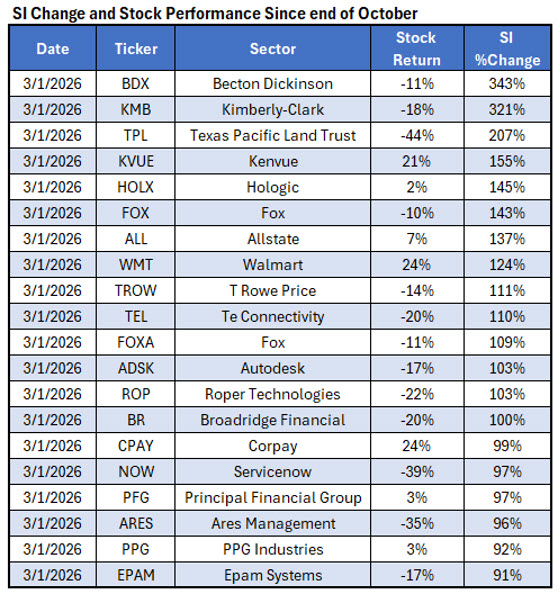
For example, since the late-October high that was used as the upper boundary for most of the range discussed above, short interest on SPX components has risen by 870 million shares. This increase in short interest, as the SPX lingered for months around all-time highs, was viewed as bullish.
But when analyzing the 20 stocks with the highest percentage of short interest changes since late October, those 20 stocks account for 215 million of the 870 million total short interest increase, or a disproportionate 25% of the total short interest expansion. Only six of those 20 stocks are higher through March 1 – the last short interest reporting period – and three of those are essentially flat.
This does not exactly set up a squeeze situation in the immediate days ahead. But bulls can rest assured that at some point shorts will cover, which will eventually establish a floor. But for now, the pressure to cover is not what it was in past few months, which means the bull case isn’t as strong, absent an immediate recovery in the broader market.
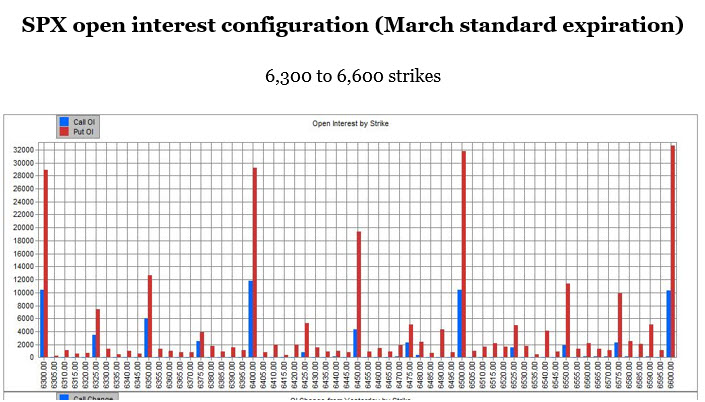
Finally, it is standard expiration week. While 0DTE options are very influential these days, we cannot forget about the standard Friday expiration OI. For the first time in a while, delta-hedge selling risk this week is something that could take investors by surprise. The tall red bar on the far right in the graph below is put OI for the March 20 expiration SPX 6,600-strike.
The big red bars to the left of the 6,600-strike represent lower strike put OI – capable of acting as magnets when put sellers are forced to sell SPX futures to hedge increasing losses from sold puts.
With the 200-day moving average currently situated above the 6,600-strike, a failure for this trendline to act as support would increase the odds of a delta-hedge decline this week. Such decline can be swift and severe, sometimes occurring overnight.
Todd Salamone is Schaeffer's Senior V.P. of Research
Continue reading:
Mentioned In This Article
Latest News
| Oct-09 | |
| Oct-09 | |
| Sep-29 | |
| Sep-29 | |
| Jul-13 | |
| Jul-13 | |
| Jun-13 | |
| May-29 | |
| Apr-30 | |
| Mar-16 | |
| Mar-02 | |
| Jan-12 | |
| Oct-09 | |
| Oct-02 | |
| Sep-12 |
