Upstart Faces A Macro Stress Test As Investors Question Whether Q2's Inflection Can Last
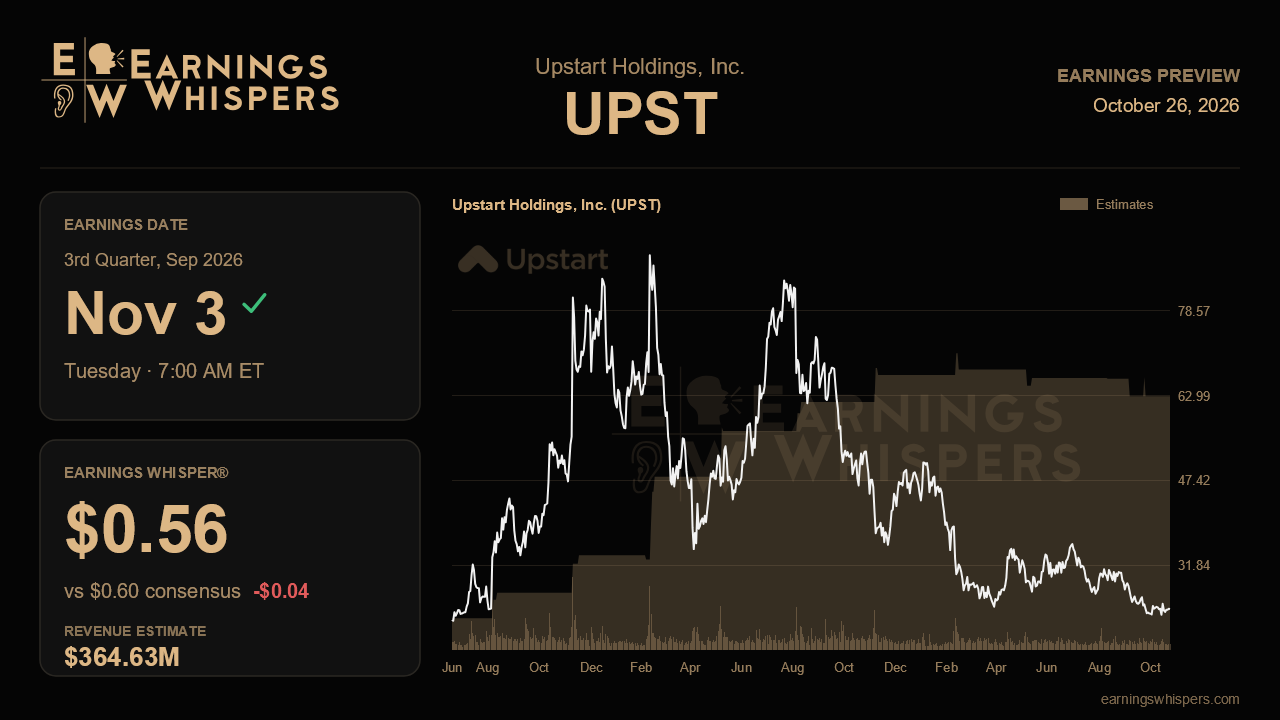
Three months ago, Upstart delivered the kind of quarter its new leadership team had promised: record contribution profit, a return to GAAP profitability and a sharp reacceleration in its core personal loan business. The market has since treated that performance as a peak rather than a launching pad. Shares have fallen about 31% since the last report while the S&P 500 slipped only 2%. That gap defines the setup for the third-quarter release on November 3. Either the operating momentum survives a tougher credit backdrop, or the selloff was right to doubt it.
Wall Street expects adjusted earnings of $0.60 per share on revenue of about $364.6 million. That revenue figure is essentially flat with the $364.7 million reported last quarter, though still up a healthy 31.6% from a year ago. Earnings would roughly triple the $0.20 posted in the year-ago period. The Earnings Whisper sits a bit lower at $0.56, which suggests the informal bar is modestly softer than the published consensus. Management has reaffirmed its full-year revenue outlook of roughly $1.4 billion, and the Street sits slightly above that at $1.43 billion. That small premium matters. Analysts are already leaning toward a company that beats its own conservative framework, so a merely in-line fourth-quarter implied outlook could disappoint.
The flat sequential revenue forecast reflects what management flagged last quarter. Its proprietary macro index, which tracks consumer credit stress, rose to 1.5. That is the top of the range underpinning 2026 guidance. July originations also stepped down modestly from June. Upstart's model tightens approvals when that index rises, so the first test is whether originations held near the second quarter's $4.2 billion or slid meaningfully. A small dip would support management's view that underlying demand can absorb the macro drag. A steeper decline would suggest the 27% sequential jump in core personal loans was partly a one-quarter burst. The same macro pressure hit fair value marks, cutting net interest income and fair value adjustments to about $17 million from $31 million. Further erosion there would weigh on total revenue even if fee income holds up.
Margins are the second pillar. Total contribution margin climbed to 55% from 50%, and management called the first quarter the year's low point. Holding that level would show that the improved unit economics are structural. The secured lending trajectory deserves particular scrutiny. Auto and home loans improved from a negative 96% contribution margin to negative 35%, and management guided to breakeven by the fourth quarter. Another large step toward zero would make that target credible. A stall would cast doubt on whether the product expansion is worth the capital, especially after the company sunset its auto refinance business. Adjusted EBITDA guidance of about $294 million, or a 21% margin, also implies that the second quarter's profitability is repeatable.
Funding and balance sheet discipline should be easier wins. Upstart signed up to $10.8 billion in committed capital this year and priced its largest asset-backed deal since 2021 at the tightest spreads in three years. Keeping loans on its own books near the recent 5.9% of outstanding balances would reinforce that partners still want the paper. Any update on the conditional national bank charter, targeted for an early 2027 launch, could also reshape the longer-term funding story.
Sentiment has flipped from mildly bullish to mildly bearish. The stock trades well below its 200-day moving average of $30.57, near the bottom of a post-earnings range whose lows sit beneath the prior quarter's. That leaves room for relief if originations and margins hold, but it also signals deep skepticism. Ultimately, the report hinges on one question. Can Upstart show that a credit environment at the edge of its planning assumptions slowed its growth only modestly, without breaking the margin gains that made last quarter an inflection?
This earnings preview was originally published on Earnings Whispers.
This article is for informational purposes only and is not investment advice. Earnings Whispers and its staff may hold positions in the securities mentioned. It is AI-assisted, based on proprietary Earnings Whispers data and company reports, and edited by Earnings Whispers staff.
Mentioned In This Article
Latest News
| Oct-26 | |
| Oct-26 | |
| Oct-26 | |
| Oct-26 | |
| Oct-26 | |
| Oct-21 | |
| Oct-11 | |
| Oct-07 | |
| Oct-06 | |
| Oct-05 | |
| Sep-23 | |
| Sep-23 | |
| Sep-16 | |
| Sep-03 | |
| Aug-28 |
