Mechanics Bancorp Beats On Cost Saves And Raises Dividend Outlook, But Rate Pressure Forces A Cut To 2027 Profitability Targets
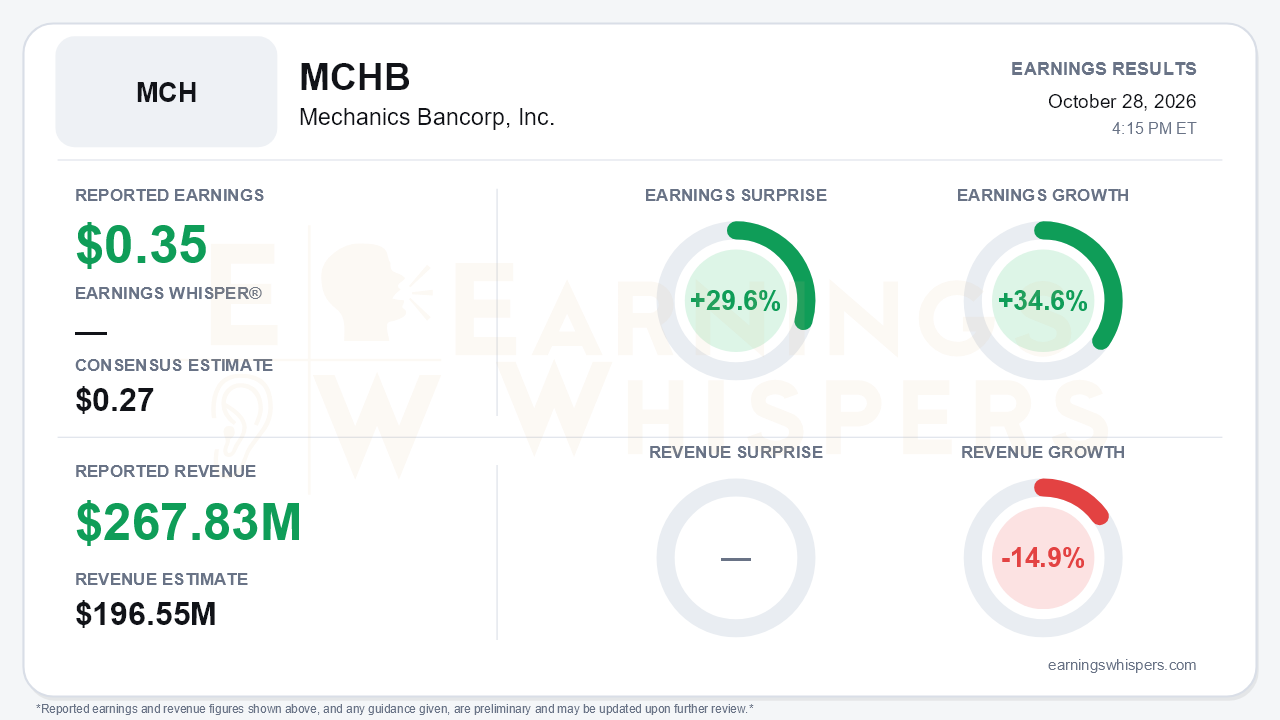
Mechanics Bancorp delivered a clear beat against the Street, but this was a quarter of competing forces: a cleaner balance sheet and better capital returns on one side, and a rate environment that is eroding the earnings path on the other. On Earnings Whispers' normalized basis, the company earned $0.35 per share, 29.6% above the $0.27 consensus and up 34.6% from a year ago. Revenue of $267.83 million beat the $196.55 million estimate by 36.3% but fell 14.9% year over year. That combination already signals a mixed quarter. Management then cut its 2027 return targets on the call, which tells investors more about the earnings trajectory than the size of the beat does.
The quality of the quarter needs some unpacking because the GAAP and adjusted pictures diverge sharply. GAAP net income fell to $46.0 million, or $0.20 per diluted Class A share, from $57.7 million, or $0.25, in the second quarter. The decline came almost entirely from deliberate repositioning. The company booked a $32.3 million loss restructuring $308 million of available-for-sale securities, swapping roughly 1.78% paper into mortgage-backed securities yielding about 5.5% with a four-to-five-year earn-back. It also took a $10.3 million loss selling $417 million of performing indirect auto loans to Bank of America, effectively completing its exit from that business. Core net income edged up to $60.6 million from $59.0 million in Q2 and $53.8 million in Q1. The bottom-line beat also had help from a $15.2 million reserve release, driven by lower expected multifamily and investor CRE losses and the auto sale. A $5.1 million equity-investment gain and a $2.9 million bargain purchase adjustment also contributed. Those are real dollars, but they are not recurring operating earnings.
The operating story beneath those items splits cleanly. Expenses are the bright spot. Noninterest expense fell $10.3 million sequentially to $114.2 million as HomeStreet integration costs faded and headcount reductions took hold. The core efficiency ratio improved to 54.4% from 56%, and management lowered its Q4 core expense run-rate target to about $420 million from about $430 million, with flat-to-down expenses expected in 2027. The revenue engine, however, is weakening. Net interest income declined for a third straight quarter, from $179.0 million in Q1 to $177.2 million in Q2 and $174.9 million in Q3. Net interest margin slipped 7 basis points to 3.55%. Total deposit costs rose 8 basis points to 1.33%, and management guided to a similar increase in Q4, with roughly $580 million of CDs repricing near 3.75% to 4%. Deposits fell $70 million when growth had been expected, and loans shrank by more than $560 million.
That is the central tension. The company is executing well on what it controls, but its liability-sensitive balance sheet is exposed to rising rates. Management cited an approximately 80 basis point backup in the 10-year yield and now assumes three more Fed hikes. Against a roughly $4.6 billion liability-sensitive gap, each 25 basis point hike costs about $5.2 million in net interest income. As a result, 2027 targets were cut to a 17% return on average tangible common equity and a 1.2% return on assets, from 17%-18% and 1.3%-1.4%. Near-term margin guidance moved to roughly flat from modest improvement. Management also expects deposit betas above the prior cycle's roughly 30% and acknowledged possible losses as multifamily loans reset from around 3.5% to 6.5%-7%. Rising rates also cut accumulated other comprehensive income by $112 million, and tangible book value per share fell to $7.05 from $7.56.
The counterweight is capital return. CET1 climbed to 14.73%, enabling a $100 million Q4 dividend, about $0.43 per Class A share. That puts 2026 distributions near $400 million, and the 2027 payout is now expected to exceed the prior $250 million guide, implying roughly an 8% yield. Some support may come from floating-rate asset repricing in Q4, a securities yield guided toward 4.5%, and Incline loans resetting to floating rates in 2027.
Investor sentiment remains negative but improved modestly, rising to -0.22 from -0.28. The stock tells a softer story: at $14.94, shares are down 7.0% since the open after the July report and sit just 1.9% below the 200-day moving average of $15.23. The Earnings Whispers AVWAP reading is negative, consistent with a stock that has drifted lower even as the integration story improved.
The bottom line is that Mechanics beat expectations and is becoming a leaner, better-capitalized bank, but the higher-rate outlook is compressing the earnings power that justified prior targets. The rising dividend gives income-focused holders a reason to stay. Bears, however, have legitimate ammunition in three straight quarters of falling net interest income, rising deposit costs, shrinking tangible book value and reduced 2027 profitability goals.
Read our earnings preview for Mechanics Bancorp, Inc.: https://www.earningswhispers.com/article/MCHB/20956
This earnings review was originally published on Earnings Whispers.
This article is for informational purposes only and is not investment advice. Earnings Whispers and its staff may hold positions in the securities mentioned. It is AI-assisted, based on proprietary Earnings Whispers data and company reports, and edited by Earnings Whispers staff.
Mentioned In This Article
Latest News
| Oct-29 | |
| Oct-28 | |
| Oct-28 | |
| Oct-20 | |
| Oct-14 | |
| Sep-16 | |
| Aug-19 | |
| Aug-06 | |
| Jul-29 | |
| Jul-15 | |
| May-13 | |
| May-07 | |
| May-01 | |
| Apr-30 | |
| Apr-30 |
