Wabash Misses Badly And Pushes Out Profitability, But A Swelling 2027 Backlog Keeps The Recovery Story Intact
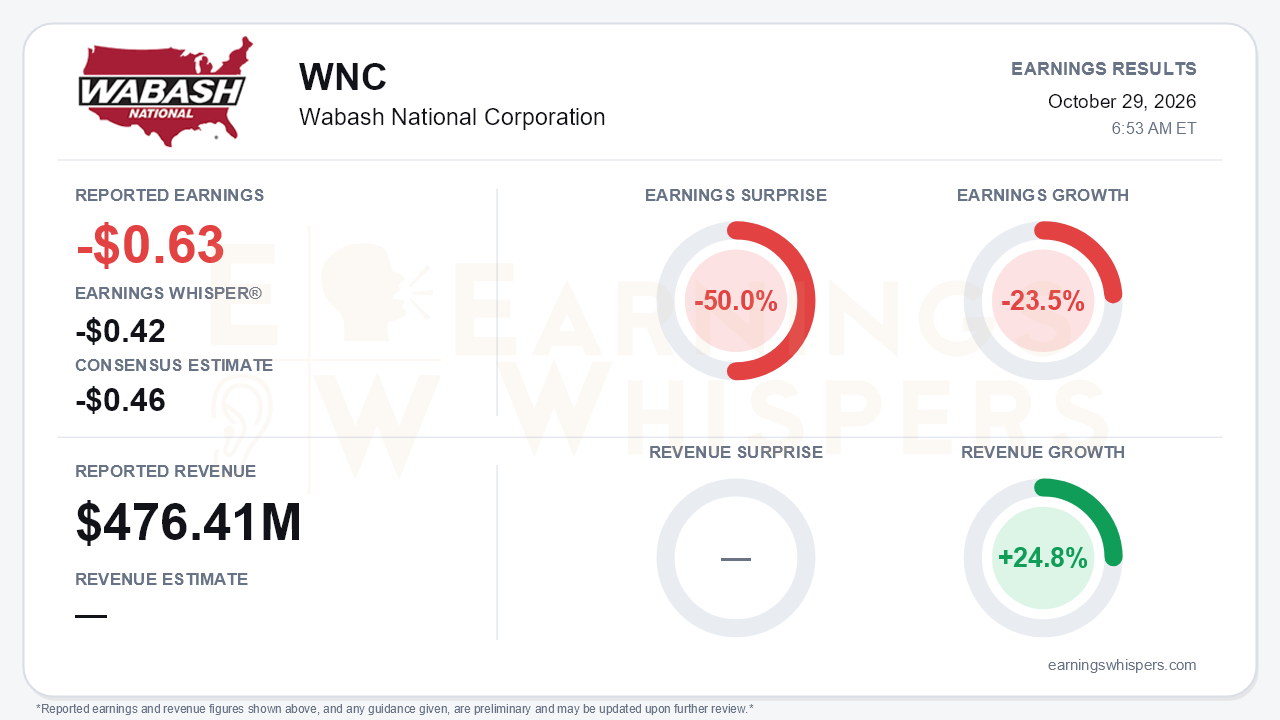
Wabash National delivered a quarter that was weak on earnings and strong on order evidence. The company reported an adjusted loss of $0.63 per share. That was well below the -$0.46 consensus and the -$0.42 Earnings Whisper number, a 50.0% miss. Earnings fell 23.5% year over year, and the result also missed management's own -$0.50 to -$0.40 guide. Revenue went the other way, rising 24.8% to $476.4 million and topping the company's $440-460 million outlook. Higher volume, deeper losses and a much larger backlog: that is the central tension. Management chose to sacrifice near-term profitability to prepare for a 2027 ramp it now sees as larger and arriving sooner.
The quality of the quarter deserves scrutiny. GAAP EPS of -$0.51 looks better than the adjusted figure only because it includes a $7.5 million gain on the sale of a manufacturing facility. New trailer shipments rose to 9,563 from 6,675 a year ago. Even so, Transportation Solutions gross margin slipped to 1.0% from 1.5%, and the segment's adjusted operating loss widened to $14.4 million from $13.1 million despite 21.9% sales growth. Consolidated adjusted gross margin fell to 3.2% from 4.1% in the second quarter. The adjusted operating margin of -5.7% compared with roughly -4% guided. Truck body shipments nearly halved to 1,685 units, and management sees no green shoots there, with any recovery lagging dry vans by six to nine months. Parts & Services grew revenue 13.8%, but margins compressed on upfit startup costs. Free cash flow swung to -$41 million from +$3.1 million in Q2 as the working-capital build began.
The call explained why management is accepting that pain. Total backlog reached $1.198 billion at quarter end, up 25% sequentially and ahead of normal seasonal patterns, and climbed to about $1.3 billion by mid-October. That compares with $837 million at the end of Q1. Units in the 2027 dry van backlog rose from about 12,000 shortly before quarter end to roughly 16,000 at September 30 and about 20,000 by mid-October. Pricing appears to be following volume: 2027 backlog material margin is now more than 600 basis points above Q2 2026 levels, up from the 500 basis points cited earlier. Management also said Wabash has gained share since the June/July order book opened. In response, it pulled capacity additions planned for the first half of 2027 into the current half, including a 15% increase in the dry van hourly workforce and all second shifts running by year-end. Tone shifted from cautious confidence to full mobilization.
That ramp reset the near-term outlook. Fourth-quarter guidance calls for revenue of $420-450 million, an operating margin of -8% to -5% and adjusted EPS of -$0.75 to -$0.55. EBITDA is expected to be negative. Management withdrew the positive second-half EBITDA expectation it had repeated on prior calls, and the Q4 guide reverses the sequential EPS improvement discussed in July. The forward case is now concentrated in 2027:
- 35,000-38,000 Wabash dry van units, with an unmodeled upside case in the low 40,000s.
- An industry dry van baseline of 135,000-140,000 units.
- A $150-170 million annualized EBITDA run rate targeted by Q2 2027 rather than the second half.
Trade protection also firmed. The ITC's final affirmative ruling implies roughly a 290% effective rate on Chinese van trailers. Bears still have legitimate ammunition. Ramp inefficiencies are expected to linger into the first half of 2027. Management concedes current pricing supports only mid-single-digit operating margins. High-yield bonds go current in October 2027 and still need refinancing. Stockholders' equity has also fallen to $271 million from $367 million at year-end, and long-term debt rose to $540 million. Liquidity did improve 44% to $277 million, helped by the $150 million convertible issue and an undrawn ABL.
Investors were leaning into the recovery story before the print. Earnings Whispers sentiment became noticeably more positive, rising to 0.65 from 0.47. Shares closed at $13.82 the day before the report, 27.5% above the 200-day moving average and about 5% below the 52-week high of $14.55 set on October 5. The stock was 21% above its September low, so it entered earnings near the top of its inter-earnings range. That makes a 50% miss and a weaker guide harder to absorb, even though the price was up only 2.4% since the post-July open. Momentum and AVWAP trend readings were positive, while sequential growth remained negative, which fits a market rewarding orders over current earnings.
The bottom line is that Wabash traded a disappointing quarter and a deferred profit inflection for stronger evidence of a 2027 cycle. The backlog, pricing and share commentary make that recovery more credible than it was three months ago. Investors now have to fund two more loss-making quarters, a cash-consuming ramp and a looming refinancing before the payoff shows up in reported earnings.
Read our earnings preview for Wabash National Corporation: https://www.earningswhispers.com/article/WNC/21151
This earnings review was originally published on Earnings Whispers.
This article is for informational purposes only and is not investment advice. Earnings Whispers and its staff may hold positions in the securities mentioned. It is AI-assisted, based on proprietary Earnings Whispers data and company reports, and edited by Earnings Whispers staff.
Mentioned In This Article
Latest News
| Oct-29 | |
| Oct-29 | |
| Oct-29 | |
| Oct-21 | |
| Oct-06 | |
| Oct-05 | |
| Sep-24 | |
| Aug-19 | |
| Aug-04 | |
| Jul-29 | |
| Jul-29 | |
| Jul-22 | |
| Jul-16 | |
| Jul-15 | |
| Jul-14 |
