Wayfair Beats On Volume-Led U.S. Share Gains, But Q4 Guide Signals Much Of The Ad Leverage Was Timing
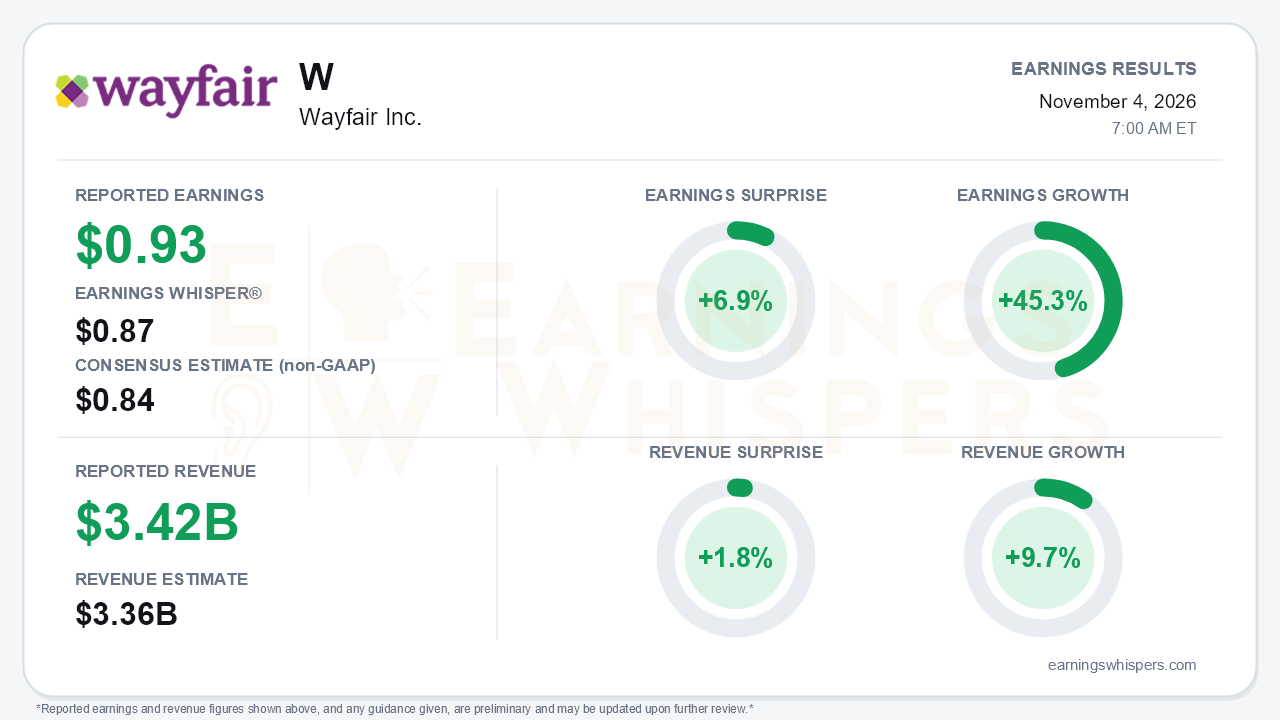
Wayfair delivered its strongest growth quarter of the post-pandemic cycle. Adjusted EPS of $0.93 beat the $0.84 consensus by 6.9% and cleared the $0.87 Earnings Whisper number. Earnings grew 45.3% year over year. Revenue of $3.42 billion topped the $3.36 billion estimate by 1.8% and grew 9.7%, up from 7.4% in Q1 and 7.5% in Q2. U.S. revenue rose 11.4% against what management described as a roughly flat category, which delivers the double-digit share spread the company promised at the start of the year. That is the central takeaway: acceleration was real and driven by volume. The central tension is that the Q4 outlook implies some of Q3's margin outperformance will not carry forward.
The quality of the beat deserves a closer look. On a GAAP basis, Wayfair swung to net income of $62 million, or $0.45 per share, from a loss of $99 million, or $0.76 per share, a year earlier. That improvement flatters the trend because last year's quarter absorbed a $99 million loss on debt extinguishment. Operating income is the cleaner read, and it nearly tripled to $106 million from $38 million.
Two items also helped the adjusted per-share figure:
- Equity-based compensation, which is added back, fell to $66 million from $92 million.
- The adjusted diluted share count dropped to 143 million from 156 million as convertible dilution shrank.
Adjusted EBITDA rose to $236 million, a 6.9% margin and the best Q3 since 2020. Free cash flow climbed to $136 million from $93 million.
Beneath the headline, the mix of drivers shifted meaningfully:
- Orders delivered rose 12.2%, versus 3% growth in Q1 and 6% in Q2.
- New customer orders grew 14%, a post-pandemic record.
- Active customers increased 4.7% to 22.2 million.
- Average order value slipped to $311 from $317 as mix moved toward frequency categories.
Advertising fell to 9.9% of revenue, the first single-digit reading since 2021, helped by 17% growth in branded search visits. That lifted contribution margin to 16.1% from 15.0% to 15.3% earlier in the year.
The offset is gross margin, which has slipped every quarter: 30.3% in Q4 FY25, then 30.1%, 30.0%, and now 29.6%, as loyalty investment rises. Selling, operations, technology, general and administrative expense of $378 million also overshot the $360 million to $370 million guide because of one-time costs, including a UK Competition and Markets Authority (CMA) settlement.
The forward guidance is where bears have legitimate ammunition. Management reaffirmed high-single-digit growth for Q4, the same language it used ahead of Q3, which implies deceleration from 9.7%. It also guided advertising back up to 10.5% to 11.5% of revenue and contribution margin back to about 15%, which suggests Q3's ad leverage was partly timing.
International is a deteriorating sore spot:
- Revenue went from +6% in Q1 to -1.3% in Q2 and -2.3% in Q3.
- The segment's adjusted EBITDA loss widened to $25 million from $1 million a year ago.
- U.S. segment EBITDA, by contrast, jumped to $261 million from $209 million.
The category itself shows no recovery, and management cited election noise and higher gas prices as macro friction.
The catalyst list is longer than the risk list. Wayfair said:
- It is a co-developer of Google's Universal Commerce Protocol, an early ChatGPT advertiser with its own shopping agent, and has its catalog live in Meta's Muse. AI-referred visits doubled quarter over quarter to about 1% of traffic.
- The Perigold Insider loyalty program launched with a strong start.
- New stores in Atlanta and Columbus are tracking a sales lift similar to Chicago, and five openings are planned for 2027.
- S&P and Moody's issued double credit upgrades, following Fitch's upgrade in the spring.
The balance sheet is improving but still stretched. Long-term debt fell to $2.57 billion from $3.23 billion at year-end, but cash dropped to $1.04 billion and the stockholders' deficit remains about $2.8 billion.
Investor sentiment became modestly more positive heading into the report, rising to 0.24 from 0.20, an incremental improvement rather than a surge. The price action tells a more complicated story. Shares hit a 52-week high of $122.13 on November 2, then entered the report at $111.32, 8.9% below that peak and only 1.3% above the open following the August report. The stock remains about 25% above its 200-day moving average and nearly 20% above its September low of $93. In other words, the market has already rewarded the acceleration narrative, and some enthusiasm was coming out right before the print. The Earnings Whispers trend signals are mostly positive, with sequential growth reading neutral.
The bottom line is that Wayfair proved its U.S. share-gain story is gaining speed, with order-driven growth, record new-customer activity, and a clean GAAP profit. However, the beat leaned on advertising leverage that management expects to partly reverse in Q4. Persistent gross margin erosion, a worsening international business, and a reaffirmed guide that implies slower growth leave the stock, priced well above its long-term average, needing continued evidence that this acceleration is structural rather than a peak.
Read our earnings preview for Wayfair Inc.: https://www.earningswhispers.com/article/W/21760
This earnings review was originally published on Earnings Whispers.
This article is for informational purposes only and is not investment advice. Earnings Whispers and its staff may hold positions in the securities mentioned. It is AI-assisted, based on proprietary Earnings Whispers data and company reports, and edited by Earnings Whispers staff.
Mentioned In This Article
Latest News
| 1 hour | |
| 2 hours | |
| 3 hours | |
| 4 hours | |
| 4 hours | |
| 4 hours | |
| 4 hours | |
| Oct-27 | |
| Oct-15 | |
| Oct-15 |
UK watchdog fines Wayfair and Appliances Direct over misleading sales
W +6.82%
Retail Insight Network
|
| Oct-14 | |
| Oct-10 | |
| Oct-01 | |
| Sep-24 | |
| Sep-24 |
