Cogent Beats On A Narrower Loss, But A Stalled 2027 Refinancing And Dividend Suspension Overshadow Margin Gains
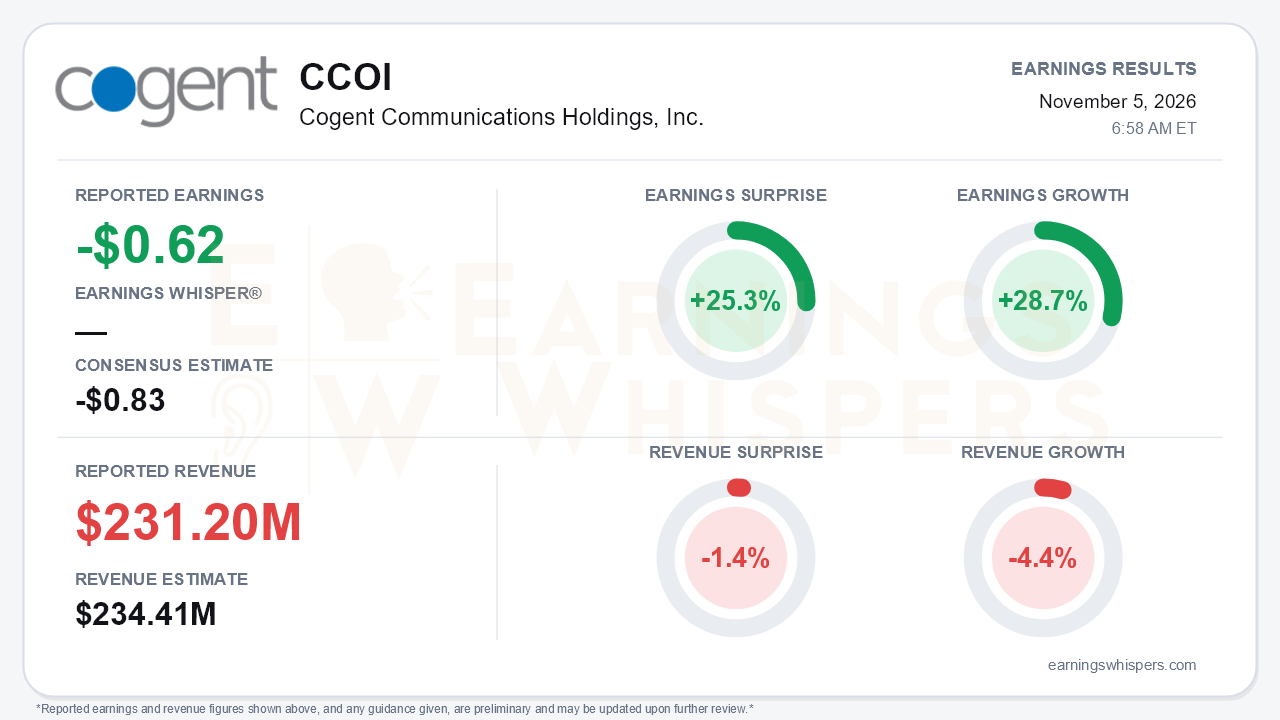
Cogent Communications (NASDAQ: CCOI) reported a third-quarter loss of $0.62 per share, well ahead of the -$0.83 consensus for a 25.3% earnings surprise. Earnings improved 28.7% from the year-ago loss of $0.87. Revenue was weaker: $231.2 million missed the $234.41 million consensus by 1.4% and fell 4.4% year over year. The earnings beat is not the story. The quarter's defining development is balance-sheet risk. Cogent has not refinanced its $700 million of 2027 unsecured notes, which come due June 15, 2027, even though management had expected to close that refinancing in the third quarter. The board also suspended the dividend.
The beat itself deserves scrutiny. Cogent recorded an $11.3 million gain from repurchasing 2032 secured notes at about 90 cents on the dollar. On a pre-tax basis, that gain alone exceeds the roughly 21-cent gap between reported EPS and consensus. Smaller gains on asset sales ($2.3 million) and finance-lease terminations ($2.9 million) also helped. The operating loss did narrow to $6.9 million from $18.1 million a year ago, and lower depreciation explains part of that improvement. Still, a meaningful share of the bottom-line upside came from financial and one-time items rather than from the core business.
Beneath the headline, there are two opposing trends. Revenue is getting worse. Service revenue fell 1.8% sequentially, after declines of 1.5% in Q2 and 0.6% in Q1. That runs directly against management's earlier claim that sequential growth would resume. The pressure points remain off-net revenue, down 9.3% sequentially, and enterprise revenue, down 8.7% sequentially and 26.1% year over year. Net-centric revenue went flat after several quarters of growth, and IPv4 leasing growth slowed to 5.4% year over year from 18% in Q2. Profitability, by contrast, is improving. EBITDA as adjusted for T-Mobile payments rose to $73.9 million from $71.1 million, and its margin widened to 32.0% from 30.2%. Non-GAAP gross margin reached 47.6%, up 180 basis points from a year ago. Network operations costs fell 3.1% and SG&A fell 5.1%. Headcount dropped to 1,603 employees, and management expects about $50 million in annualized savings to start flowing through. On-net revenue, including wavelengths, rose to 66.6% of the mix.
Wavelengths remain the credible growth engine. Revenue rose 57% year over year to $16.0 million, and net adds accelerated to 277 from 182 in Q2. Yearly growth is decelerating from the 90% pace seen in Q1, but the unit trend improved. Churn also improved, with on-net churn at 1.1% and off-net at 2.0%. The concern is the sales force. Quota-bearing reps fell to 471 from 568 in Q1, and monthly turnover was 7.7%. That leaves open whether the cost discipline is quietly eroding the company's future capacity to grow.
The forward story now centers on the 2027 maturity. Cogent has hired Evercore and Latham and offers no timeline beyond "before June 15, 2027." The options under review include converting unsecured debt to secured, adding collateral, and changing principal. Bears have legitimate ammunition here, including the risk of a higher interest rate or equity dilution. Analysts pressed hard on liquidity. Cogent ended the quarter with $181.3 million in total cash, including restricted cash, against a roughly $100 million minimum operating need, and it has no revolver. Free cash flow is negative once the T-Mobile payments are excluded, and those payments end in February 2028. The offsets are real. Cogent has signed non-binding letters of intent to sell four more former Sprint data centers for about $100 million, targeted for early 2027. The note repurchases also cut adjusted gross leverage to 6.94x from 7.50x.
The market was already pricing in distress. Shares fell 49.2% from the $13.37 open after the August report to $6.79. The stock hit a 52-week low of $5.90 on November 3 and sits 56% below its 200-day moving average. Investor sentiment, measured before the release, became sharply more negative, falling to -0.86 from -0.40. Sequential growth and AVWAP trends remain negative. With expectations this depressed, the margin progress may get some credit. The dividend suspension, however, removes a key reason many holders owned the stock.
The bottom line is that Cogent's cost restructuring is working at the margin line, and wavelengths are still gaining share. Neither matters as much as the unresolved $700 million maturity. Revenue declines widened rather than stabilized, and the beat leaned heavily on debt-repurchase gains. Until refinancing terms are set, the equity story will be driven by its capital structure, not its operations.
Read our earnings preview for Cogent Communications Holdings, Inc.: https://www.earningswhispers.com/article/CCOI/22062
This earnings review was originally published on Earnings Whispers.
This article is for informational purposes only and is not investment advice. Earnings Whispers and its staff may hold positions in the securities mentioned. It is AI-assisted, based on proprietary Earnings Whispers data and company reports, and edited by Earnings Whispers staff.
Mentioned In This Article
Latest News
| Nov-05 | |
| Nov-05 | |
| Oct-28 | |
| Oct-28 | |
| Oct-14 | |
| Sep-21 | |
| Sep-04 | |
| Sep-01 | |
| Sep-01 | |
| Aug-19 | |
| Aug-19 | |
| Aug-13 | |
| Aug-07 | |
| Aug-07 | |
| Aug-06 |
