Universal Misses Badly As The Tobacco Year Shifts To The Back Half; Inventory Progress Is Real, But So Is The Leverage
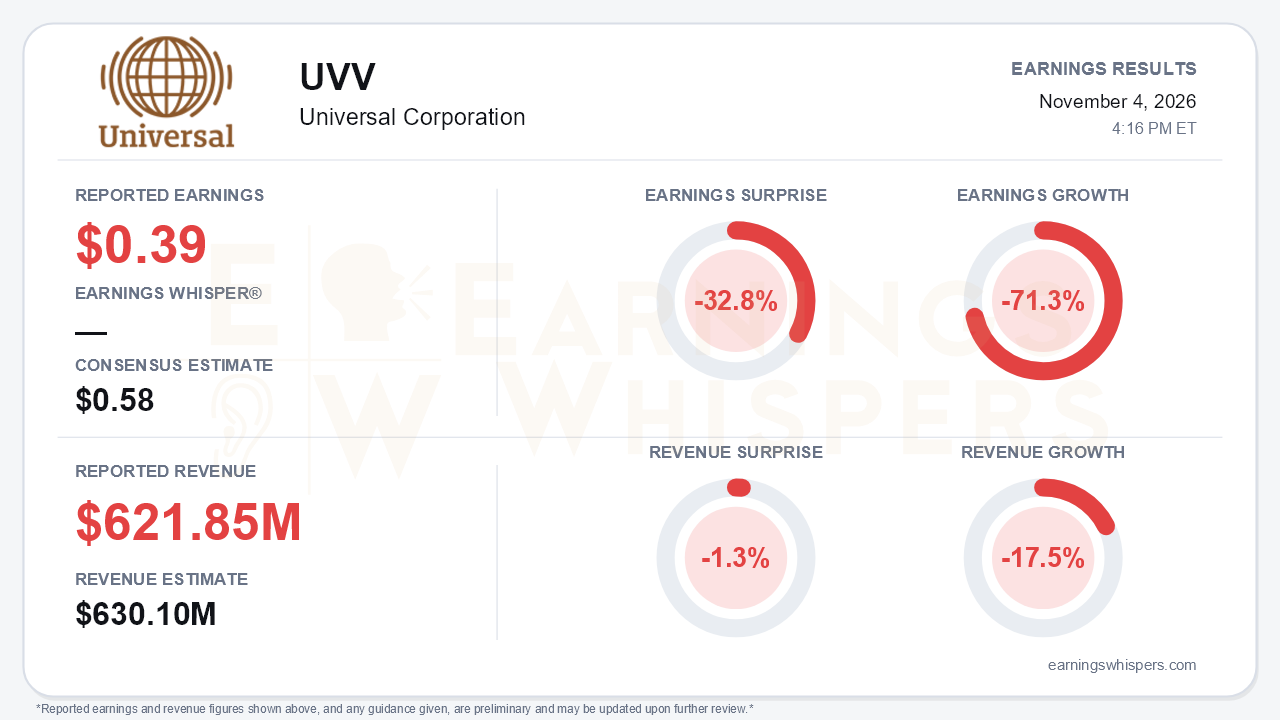
Universal Corporation (NYSE: UVV) reported adjusted earnings of $0.39 per share for its fiscal second quarter, well short of the $0.58 consensus estimate, a miss of 32.8%. Revenue of $621.85 million fell 1.3% short of the $630.1 million consensus. Earnings fell 71.3% from a year ago and revenue declined 17.5%. Management's explanation is consistent: a delayed oversupply cycle in flue-cured and burley tobacco has pushed buying, commitments and shipments later in the year. The central tension is that the forward indicators management controls, inventory and customer commitments, are moving in the right direction. Reported earnings, cash flow and the balance sheet are all moving the wrong way, and the full-year case now rests almost entirely on third- and fourth-quarter execution.
The quality of the quarter deserves scrutiny. GAAP EPS of $0.50 includes a $2.7 million gain from selling a previously closed plant, which is why the adjusted figure is lower. The adjusted $0.39 still contains a $4 million Mozambique insurance recovery that did not come from operations. Below the operating line, the effective tax rate rose to 35%, driven partly by the expired Mozambique tax holiday. Noncontrolling interests also took $4.8 million versus $0.6 million a year earlier. Gross margin narrowed to 17.3% from 18.5%. The top line did not improve as the half progressed. Tobacco volumes fell about 23% in the quarter, compared with an 18% decline for the full first half. A 3% mix-driven price increase did little to offset that. First-half adjusted EPS of $0.19 compares with $1.74 a year ago, which implies the June quarter was a loss. The CFO pointed to a historical first-half average of roughly $1, and Universal is far below it.
The call did supply evidence that the cycle is turning:
- Uncommitted tobacco inventory fell to 19% at September 30, inside the 10-20% target range. It had been 27% at fiscal year-end and still elevated at the first quarter.
- Management said worldwide unsold flue-cured and burley stocks dropped to 134 million kilograms from 180 million in June. That suggests the industry supply build may have peaked.
- Customer commitments remain in line with the sales plan.
- El Niño weather concerns are generating what management called emerging customer interest in additional volumes. That would be upside to the plan, though it was not quantified.
Margin guidance was reaffirmed. Gross margin is expected within 17-19% and SG&A at $300-310 million, and management expects tobacco operating margin to improve in the second half toward fiscal 2026 levels.
Bears have legitimate ammunition elsewhere. Net debt reached $1.15 billion, up $82 million year over year and from $845 million in March. Net debt-to-capitalization rose to 45% from 42%, and liquidity of about $945 million is down from more than $1.2 billion at year-end. Operating cash outflow for the half was $214 million, compared with $172 million a year earlier. Interest-expense guidance also softened, from the first quarter's "down a little" to tracking the year-to-date trend. Management said it intends to delever as working-capital needs ease, but that depends on the heavily back-loaded shipment schedule landing on time. The call flagged port congestion and container availability as risks to that schedule.
Ingredients offers no offset. Segment revenue fell 8% to $87.5 million and the operating loss widened to $2.1 million, with results also down sequentially. Weak consumer-packaged-goods demand, tight Pacific Northwest apple supplies and high raw material costs all weighed on the segment. Utilization at the new Lancaster/Shank's facility is "not moving higher." This follows last quarter's $41 million goodwill impairment and leadership change. The restructuring into fruit, dry and taste platforms is expected to run through next fiscal year, and management gave no recovery timeline.
Investor sentiment improved modestly, rising from 0.03 to 0.13. Expectations are mildly positive but far from enthusiastic. Price action has been considerably harsher. Shares at $39.75 are down 24.3% since the open following the August report and sit 20.7% below the $50.15 200-day moving average. Price and AVWAP trend readings are negative, while sequential growth and momentum are neutral, so the market has already discounted a weak first half.
The bottom line is that Universal's quarter was weak on almost every reported measure. The real debate is whether this is a timing problem or something worse. The fall in uncommitted inventory, shrinking industry stockpiles and stable customer commitments make the delayed-cycle explanation credible. Rising leverage, a deteriorating Ingredients business and a heavily back-loaded shipment calendar leave little room for second-half slippage.
Read our earnings preview for Universal Corporation: https://www.earningswhispers.com/article/UVV/22434
This earnings review was originally published on Earnings Whispers.
This article is for informational purposes only and is not investment advice. Earnings Whispers and its staff may hold positions in the securities mentioned. It is AI-assisted, based on proprietary Earnings Whispers data and company reports, and edited by Earnings Whispers staff.
Mentioned In This Article
Latest News
| 9 hours | |
| Nov-04 | |
| Nov-04 | |
| Nov-04 | |
| Nov-04 | |
| Oct-30 | |
| Oct-28 | |
| Oct-28 | |
| Oct-10 | |
| Aug-30 | |
| Aug-06 | |
| Aug-05 | |
| Aug-05 | |
| Aug-05 | |
| Aug-04 |
