T1 Energy Locks In 2027 Demand, But A Collapsing Margin, Tight Cash And Another G2 Financing Delay Dominate The Quarter
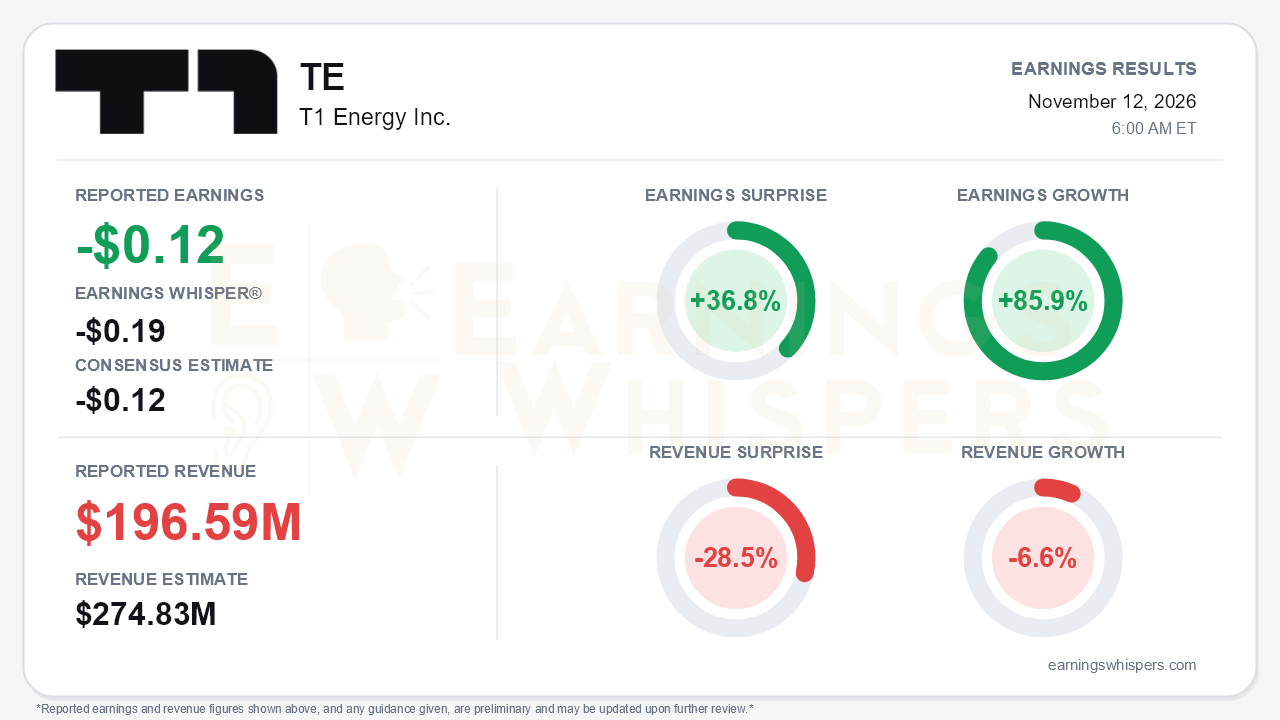
T1 Energy (NYSE: TE) reported a third-quarter loss of $0.12 per share, matching the consensus estimate and beating the Earnings Whisper number of -$0.19 by 36.8%. Earnings improved 85.9% from a year earlier, when the company lost $0.87 per share. Revenue of $196.59 million missed consensus by 28.5% and fell 6.6% year over year. The EPS figure looks like progress, but it is not the story of the quarter. The central tension is that commercial demand has clearly improved since the Section 232 polysilicon proclamation, while the financing for the G2_Austin cell fab has slipped again. That fab underpins the company's integrated thesis, and liquidity has grown thinner in the meantime.
The quality of the earnings line deserves scrutiny. Gross margin fell to 8.5%, down from roughly 19.5% in Q2 and 17% in Q1. Adjusted EBITDA swung to a loss of $16.4 million. On the Q2 call, management had expected third- and fourth-quarter run rates to exceed Q2's $10.7 million, so this result fell short of that expectation. The operating loss from continuing operations was $54.5 million. GAAP results were cushioned by a $21.6 million gain on the fair value of derivative liabilities, a non-operating item that flattered the bottom line. SG&A rose to $71.2 million on technical headcount additions plus financing, transaction and legal costs. Management attributes much of the margin pressure to its choice to produce 1,056 MW at G1_Dallas, the second-highest run rate in company history, while building 326 MW of inventory for 2027 deliveries. That explanation is plausible, but the cost shows up on the balance sheet. Inventory rose to $335 million from $116 million at year-end. Nine-month operating cash flow was an outflow of $175.8 million, alongside $250 million of capital spending. Nearly all quarterly sales came from a related party.
The forward commercial picture is genuinely stronger. T1 signed nearly 1.6 GW of new offtake contracts, including with Avantus, which lifts 2027 contracted G1 capacity above 3.5 GW. That compares with 3 GW contracted for 2026. Management also:
- narrowed 2026 production guidance to the high end, 4.0-4.2 GW;
- introduced a 2027 plan of 5.3 GW premised on G1 selling out;
- said post-232 module pricing is about 5 cents per watt higher year over year, in the mid-30s cents for imported-cell modules and mid-40s cents for domestic-cell modules;
- cited a 2027-2029 backlog plus pipeline above 22.8 GW.
A Commerce Department waiver to import up to 1.725 GW of cells secures G1 supply while G2 is built. Run-rate integrated EBITDA targets of $375-450 million for Phase 1 were reaffirmed. On demand, the call preserved a credible growth story.
Bears have legitimate ammunition on execution and funding. The G2 debt financing has moved from an April target, to the second quarter, to past August, and is now in exclusive negotiations with year-end assumed. First-cell timing has moved from Q4 2026 to March-April 2027, with full ramp around mid-2027 contingent on that close. The release warns that any deal may require additional equity or equity-linked securities. The share count has already risen to roughly 299.5 million from 266.3 million at year-end. Unrestricted cash stood at just $59.5 million, and total cash was $137 million versus $149 million at Q2. That required another $50 million convertible bridge after $120 million in Q2 and $176 million in Q1. Meanwhile, $155.3 million of Section 45X credits remain unmonetized in a slow market for non-investment-grade sellers. Management is deliberately limiting G2-cell contracting until financing and onshoring terms are clearer, and some 2027 G2 volumes have been pushed to 2028. The Nordic data center LOI is non-binding and is optionality rather than near-term cash. Management's tone turned defensive, and the call opened by acknowledging stock-price pressure.
The market had already delivered its verdict going into the print. Shares fell 62.6% from the $5.70 open after the August report to $2.13. That leaves them about 64% below the 200-day moving average and only 6% above a 52-week low of $2.01 set on November 10, two days before results. Investor sentiment reversed sharply, from a positive 0.38 after the prior report to -0.13. That is a meaningful swing that reflects growing concern about financing and dilution rather than demand. The Earnings Whispers trend readings are mixed, with momentum positive while AVWAP remains negative. They add little beyond the plain fact that the stock has been sold hard.
The setup is more complicated than an in-line EPS print implies. Section 232 has handed T1 pricing power and a nearly sold-out 2027 at G1. However, converting that demand into the integrated, high-margin model depends on closing G2 financing on terms that do not swamp existing holders. Until that happens, strong offtake headlines are likely to be weighed against cash burn and the risk of further dilution.
The bottom line is that T1's quarter showed improved demand and pricing but deteriorating near-term economics and a liquidity position with little room for further delay. The stock sits near its lows with sentiment turned negative, so the investment case now hinges almost entirely on whether the long-promised G2 financing closes by year-end.
Read our earnings preview for T1 Energy Inc.: https://www.earningswhispers.com/article/TE/22899
This earnings review was originally published on Earnings Whispers.
This article is for informational purposes only and is not investment advice. Earnings Whispers and its staff may hold positions in the securities mentioned. It is AI-assisted, based on proprietary Earnings Whispers data and company reports, and edited by Earnings Whispers staff.
Mentioned In This Article
Latest News
| Nov-12 | |
| Nov-12 | |
| Nov-04 | |
| Oct-30 | |
| Oct-27 | |
| Oct-22 | |
| Oct-21 | |
| Sep-25 | |
| Aug-27 | |
| Aug-27 | |
| Aug-13 | |
| Aug-12 | |
| Aug-12 | |
| Aug-12 | |
| Aug-07 |
