|
|
|

|
|||||
|
|
|
Investors got solid earnings reports from Dollar Tree (NASDAQ: DLTR) and Five Below, Inc. (NASDAQ: FIVE) on Dec. 3. The reports were similar, with both companies beating on revenue and adjusted earnings per share (EPS) in the third quarter.
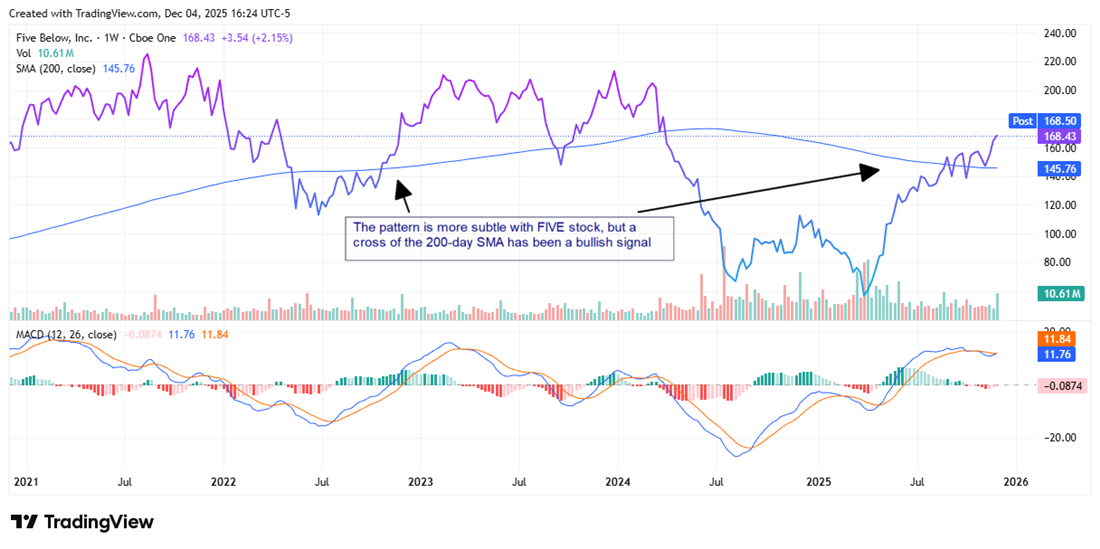
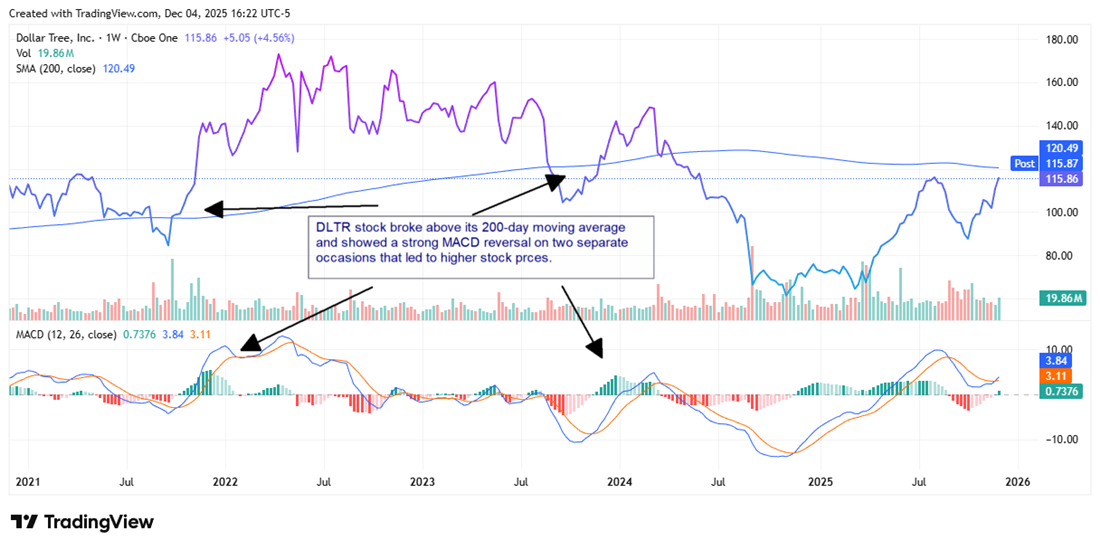
Notably, both stocks are breaking out in a pattern that looks eerily similar to 2022, when inflation peaked, and consumers shifted sharply toward value chains.
The common analysis has centered on a more “choiceful” customer—a fancy way to say consumers are bargain hunting. For investors, the renewed strength in discount retail stocks may reflect more than price sensitivity—it could signal a broader economic shift.
As the old saying goes: history doesn’t repeat, but it often rhymes. Are these earnings results just a reflection of consumer resilience? Or are they a prelude to another round of inflationary pressure?
Five Below delivered exactly what momentum traders wanted via its Q3 earnings. Double-digit revenue growth, a 14.3% jump in comparable sales, and an EPS beat were all supported by increased store traffic and higher sales tickets.
The company also added 49 net new stores in the quarter and raised full-year guidance, signaling confidence heading into the holiday spending season.
In contrast to big-box retail stocks that are struggling with slowing discretionary spending, Five Below continues to prove that small luxuries at low price points are sticky in almost every market.
Its formula of providing trend-right goods at “why not?” prices helps capture the consumer who won’t splurge at mall prices but also hasn’t abandoned fun.
That positioning matters. In 2022’s inflation surge, Five Below thrived because consumers didn’t just trade down—they traded down with intent to keep spending. The current setup suggests a similar behavioral trend: inflation concerns aren’t destroying demand; they’re reshaping where it goes.
Dollar Tree also delivered a strong earnings report with solid beats on the top and bottom lines—but its story is more nuanced. After divesting Family Dollar, consolidated revenue declined year-over-year (YOY), and operating margins compressed.
At the same time, comparable sales rose 4.2% on stronger average tickets, while traffic dipped slightly.
Diving into the report, consumables and discretionary sales grew by 3.5% and 4.8% respectively. However, the mix continues to lean structurally towards essentials over multiple years.
That’s a classic signal—when budgets tighten, households don’t shop less, they shop cheaper, shifting spending into necessities at fixed-price stores.
In short, while Five Below reveals a consumer still embracing small joys, Dollar Tree illustrates one guarding their grocery budgets. That is precisely the bifurcation that marked late-2021 and 2022: resilient spending, but reshaped toward value, clearance racks and $1-to-$5 baskets.
Five Below’s results suggest that consumers are still making discretionary purchases while trading down from traditional retailers. This is consistent with consumers who are managing inflation by seeking value rather than cutting out non-essentials entirely.
Dollar Tree’s report paints a more defensive picture. Its growth is being driven by traffic and small basket inflation. However, the company is experiencing margin pressure, higher selling, general, and administrative (SG&A) expenses, and lower consolidated revenue from the absence of Family Dollar, reflecting inflation and suggesting a low-end consumer that is under stress.
Over the past five years, both FIVE stock and DLTR stock have traced a similar pattern: post‑pandemic rallies, sharp resets as stimulus faded, and now renewed breakouts on the back of better‑than‑expected earnings. This isn’t coincidence—discount retail stocks often lead when inflation expectations rise.
These breakouts suggest that markets are anticipating:
Importantly, the 2022 narrative wasn’t just based on Consumer Price Index (CPI) data. It was behavioral: consumers re-priced the meaning of value. The breakouts we’re seeing today suggest a similar narrative will affect consumer sentiment going forward.
Investors will gain more clarity on Dec. 5 when the belated September Personal Consumption Expenditures Price Index (PCE) reading is released. Consensus expectations for the release sit near 2.8%. A print at or below expectations would confirm muted but persistent inflation. And if the number resets higher toward 3% or above, 2022’s pattern would look less like a coincidence and more like foreshadowing.
But here’s the more important point: discount chains are rallying before that data hits. Markets trade on anticipation, not confirmation.
Five Below reflects a consumer choosing value without sacrificing discretionary identity. Dollar Tree reflects the consumer tightening at the pantry level. Together, they sketch the same macro portrait that preceded last cycle’s inflation peak: a consumer who is still spending—but is shopping smarter.
Before you make your next trade, you'll want to hear this.
MarketBeat keeps track of Wall Street's top-rated and best performing research analysts and the stocks they recommend to their clients on a daily basis.
Our team has identified the five stocks that top analysts are quietly whispering to their clients to buy now before the broader market catches on... and none of the big name stocks were on the list.
They believe these five stocks are the five best companies for investors to buy now...
The article "Five Below and Dollar Tree Earnings Signal a Shopper Shift" first appeared on MarketBeat.
| Mar-31 | |
| Mar-30 | |
| Mar-27 |
How Five Below, Up 200% In A Year, Rode Squishy Dumplings To Defy Tariffs, Oil Prices
FIVE
Investor's Business Daily
|
| Mar-24 |
Dow Jones Discount Retailer Walmart Offers Latest Buy Point Amid Market Weakness
FIVE
Investor's Business Daily
|
| Mar-22 | |
| Mar-20 | |
| Mar-19 | |
| Mar-19 |
Stock Of The Day Adds To 350% Surge On Earnings But Sees 'Challenging' Road Ahead
FIVE +10.68%
Investor's Business Daily
|
| Mar-19 | |
| Mar-19 |
New bank capital requirements, Five Below surges over Q4 holiday results
FIVE +10.68%
Yahoo Finance Video
|
| Mar-19 | |
| Mar-19 | |
| Mar-19 | |
| Mar-19 | |
| Mar-19 |
Five Below Comparable Sales Accelerate, Shares Rally On Q4 Beat
FIVE +10.68%
Investor's Business Daily
|

Join thousands of traders who make more informed decisions with our premium features. Real-time quotes, advanced visualizations, alerts, and much more.
Learn more about Finviz Elite