Can Carnival Sustain Yield Gains Amid Heavier Caribbean Supply?
Carnival Corporation & plc CCL is entering a more disciplined phase of commercial execution, with pricing integrity becoming a clearer focal point of its yield strategy. During the fourth-quarter fiscal 2025 earnings call, management indicated that revenue optimization — rather than absolute occupancy maximization — is increasingly guiding deployment and pricing decisions. It noted that brands are not required to sail at full occupancy in all cases, reflecting a shift away from volume-driven tactics that have historically characterized periods of excess industry capacity.
This approach comes as Carnival heads into 2026 amid a meaningful increase in Caribbean supply. Management highlighted that non-Carnival industry capacity in the region is expected to rise approximately 14% in 2026, bringing cumulative growth to about 27% over two years. Historically, such expansions have pressured industry pricing and led to elevated promotional activity. However, in this cycle, Carnival emphasized that its diversified itinerary mix, bundled pricing structures and improved revenue management tools provide greater flexibility to prioritize yield quality over marginal occupancy gains.
Recent results suggest the strategy has so far been effective. In the fiscal fourth quarter, net yields increased 5.4% year over year, exceeding prior guidance by 110 basis points, despite the early stages of elevated Caribbean capacity. Management attributed the outperformance to sustained close-in demand and a more measured promotional environment.
Carnival’s fiscal 2026 yield guidance explicitly incorporates elevated Caribbean capacity, with management forecasting net yields in constant currency to rise approximately 2.5% compared with the 2025 levels. This outlook reflects an emphasis on balancing ticket pricing, onboard spending and guest mix. If sustained, this approach could represent a meaningful evolution in how Carnival manages supply-driven volatility, with potential implications for yield stability in a more competitive regional environment.
How CCL Stacks Up to Competitors
Within the cruise industry, Royal Caribbean Cruises Ltd. RCL and Norwegian Cruise Line Holdings Ltd. NCLH remain Carnival’s closest comparables as operators position their businesses for a period of heavier Caribbean supply. Both peers are leaning more visibly on capacity and occupancy levers, creating a contrast with Carnival’s increasingly yield-focused posture.
Royal Caribbean continues to demonstrate strong demand and pricing resilience, supported by record booked load factors and steady yield growth. Management has emphasized the role of differentiated assets — including exclusive destinations and premium hardware — in sustaining pricing power even as Caribbean capacity expands. With capacity expected to grow in 2026, Royal Caribbean is pairing moderate yield gains with a larger revenue base, relying on its destination ecosystem to absorb incremental supply while maintaining overall yield momentum.
Meanwhile, Norwegian Cruise has been more explicit about trading pricing for volume. Management has highlighted a significant increase in short Caribbean itineraries aimed at attracting families, a strategy that is lifting load factors but diluting blended pricing due to a higher mix of third and fourth guests per cabin. Norwegian Cruise continues to target low- to mid-single-digit yield growth over time.
Against this backdrop, Carnival’s approach appears closer to Royal Caribbean’s emphasis on yield quality than to Norwegian Cruise’s volume-led strategy. By signaling tolerance for modestly lower occupancy to protect pricing, Carnival is positioning itself to manage Caribbean supply growth with a sharper focus on revenue optimization rather than load-factor maximization, setting its competitive response apart as industry capacity increases.
CCL’s Price Performance, Valuation & Estimates
Shares of Carnival have gained 3.8% in the past three months compared with the industry’s rise of 0.2%.
CCL Stock’s Three-Month Price Performance

Image Source: Zacks Investment Research
From a valuation standpoint, CCL stock trades at a forward price-to-earnings ratio of 13.13, significantly below the industry’s average of 17.83.
CCL’s P/E Ratio (Forward 12-Month) vs. Industry
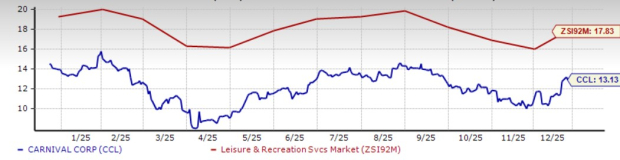
Image Source: Zacks Investment Research
EPS Trend of CCL Stock

Image Source: Zacks Investment Research
The Zacks Consensus Estimate for CCL’s fiscal 2026 earnings implies a year-over-year uptick of 7.6%. The EPS estimates for fiscal 2026 have increased in the past 60 days.
CCL stock currently has a Zacks Rank #3 (Hold). You can see the complete list of today’s Zacks #1 Rank (Strong Buy) stocks here.
Want the latest recommendations from Zacks Investment Research? Today, you can download 7 Best Stocks for the Next 30 Days. Click to get this free report
Carnival Corporation (CCL): Free Stock Analysis Report
Royal Caribbean Cruises Ltd. (RCL): Free Stock Analysis Report
Norwegian Cruise Line Holdings Ltd. (NCLH): Free Stock Analysis Report
This article originally published on Zacks Investment Research (zacks.com).
Mentioned In This Article
Latest News
| Oct-09 | |
| Oct-09 | |
| Oct-08 | |
| Oct-08 | |
| Oct-08 | |
| Oct-08 | |
| Oct-08 | |
| Oct-07 | |
| Oct-07 | |
| Oct-06 | |
| Oct-06 | |
| Oct-06 | |
| Oct-06 | |
| Oct-06 | |
| Oct-05 |
