|
|
|

|
|||||
|
|
|
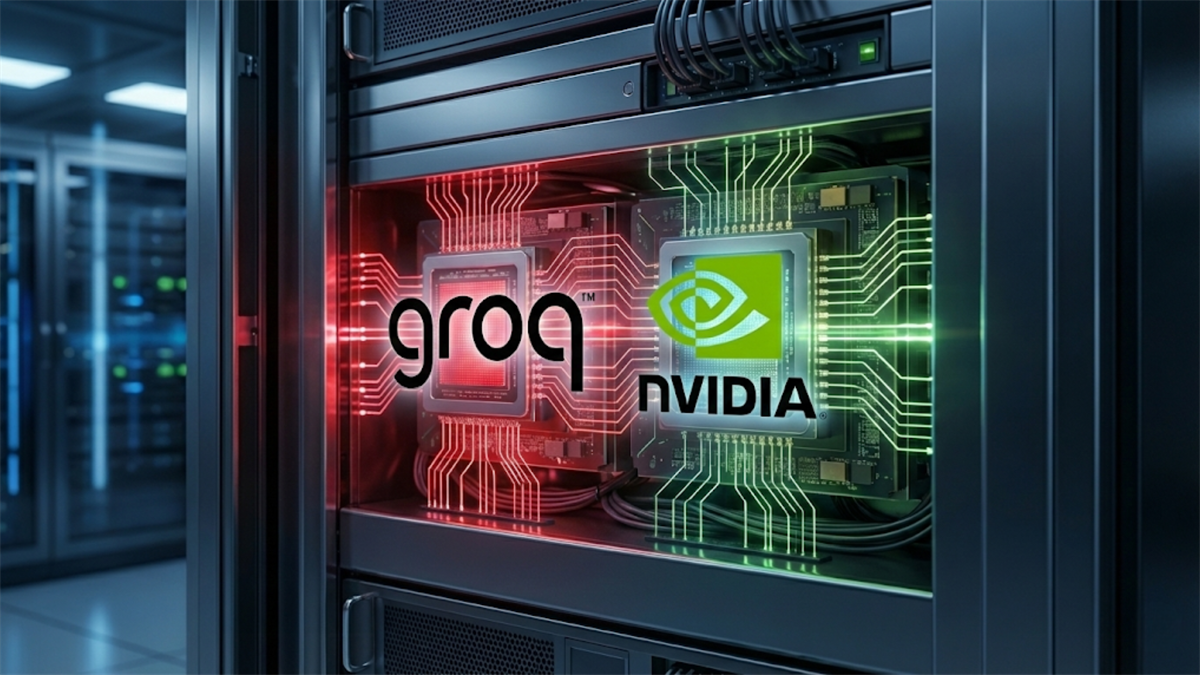
While the markets were quiet for the post-Christmas trading session, NVIDIA (NASDAQ: NVDA) made a noise that will echo for years. The company announced a definitive agreement to pay approximately $20 billion in cash to license the technology and hire the core engineering team of AI chip startup Groq.
The timing of this announcement is poetic. On the very day NVIDIA is distributing its quarterly dividend of $0.01 per share to loyal shareholders, it is aggressively reinvesting its massive cash pile to secure its future dominance. The market reaction has been swift and bullish. NVIDIA shares climbed roughly 1.5% following the news, trading in the $188 to $191 range. This move pushes the company’s market capitalization firmly past the $4.6 trillion milestone.
Wall Street’s reaction reflects a clear consensus: this is not just a purchase; it is a fortification. By securing the fastest chip technology in the market, NVIDIA is widening its competitive moat against rivals like Alphabet (NASDAQ: GOOGL) and AMD (NASDAQ: AMD). This deal helps ensure that NVIDIA remains the only game in town for the next phase of the artificial intelligence (AI) boom.
To understand why NVIDIA would spend $20 billion on a startup, investors must first understand how the AI market changed in 2025. For the last three years, the industry focused on Training. This is the process of teaching an AI model, which requires massive amounts of raw computing power to crunch data. NVIDIA’s Blackwell and Hopper GPUs were perfect for this heavy lifting.
However, late in 2025, the market reached a tipping point known as the Inference Flip. Global revenue from using AI models (Inference) officially surpassed the revenue from building them (Training). While training is a one-time event, inference is a continuous, 24/7 utility, much like electricity. Every time a user asks a chatbot a question or a robot moves, that is an inference event.
As AI moves into real-time applications like voice assistants and humanoid robotics, speed becomes the critical metric. This created a vulnerability for NVIDIA because its chips were designed for size rather than speed.
Data shows that Groq’s LPUs can process between 300 and 500 tokens per second on standard models like Llama 2. In comparison, a standard GPU setup typically manages around 100 tokens per second. By absorbing this technology, NVIDIA ensures it owns the fastest solution for the fastest-growing segment of the market. This also addresses a total cost of ownership risk; because Groq chips are faster, they use less energy per task, which appeals to cost-conscious data centers.
In today's strict regulatory environment, a standard merger between a $4.6 trillion giant and a rising competitor would likely be blocked by the Federal Trade Commission (FTC). Regulators are wary of monopolies buying up their rivals. NVIDIA’s management navigated this risk by structuring the deal as a reverse acqui-hire and a non-exclusive licensing agreement rather than a traditional corporate acquisition.
This structure mirrors successful strategies recently employed by Microsoft (NASDAQ: MSFT) and Amazon (NASDAQ: AMZN). It allows NVIDIA to integrate the technology immediately without getting bogged down in 18 to 24 months of litigation. This speed of execution is a major bullish signal for the stock, as it prevents competitors from catching up while the deal is stuck in court.
Perhaps the most valuable asset in this deal is the human capital. NVIDIA has hired Jonathan Ross, the founder of Groq. Before starting Groq, Ross invented the Tensor Processing Unit (TPU) at Google. By bringing Ross into the fold, NVIDIA has effectively neutralized a key competitor and deprived Google, its biggest rival in custom silicon, of the talent that built its foundation.
A $20 billion price tag is massive for most companies, but for NVIDIA, it represents a highly efficient use of capital. Investors should view this through the lens of buy vs. build. Could NVIDIA have built this technology itself? Likely yes. But it would have taken three to four years of research and development. In the fast-moving world of AI, three years is an eternity. By spending cash now, NVIDIA buys time.
Despite the stock trading near all-time highs, analysts argue that the valuation is reasonable given the growth potential. The stock currently trades at a forward price-to-earnings ratio (P/E) of approximately 23x. This is significantly lower than its trailing P/E of around 52x, suggesting that earnings are growing fast enough to justify NVIDIA’s current stock price. By securing the Groq technology, NVIDIA protects these future earnings from competitive erosion.
This transaction serves as a powerful reminder that NVIDIA is evolving. It is no longer just a hardware vendor; it is becoming the inevitable operating system for the entire AI economy.
Looking ahead, investors can expect NVIDIA to integrate Groq’s low-latency technology into its upcoming Rubin architecture and its robotics initiative, Project GR00T. With fourth-quarter revenue guidance projected at $65 billion, the company’s fundamentals remain flawless. This deal silences the bear case that competitors would eventually catch up in speed. For investors, the thesis remains intact: NVIDIA is building the foundation for the future of artificial intelligence.
Before you make your next trade, you'll want to hear this.
MarketBeat keeps track of Wall Street's top-rated and best performing research analysts and the stocks they recommend to their clients on a daily basis.
Our team has identified the five stocks that top analysts are quietly whispering to their clients to buy now before the broader market catches on... and none of the big name stocks were on the list.
They believe these five stocks are the five best companies for investors to buy now...
The article "NVIDIA’s $20B Groq Deal Is a Warning Shot to AI Rivals" first appeared on MarketBeat.
| Aug-21 | |
| Aug-21 | |
| Aug-21 | |
| Aug-21 | |
| Aug-21 | |
| Aug-21 | |
| Aug-21 | |
| Aug-21 | |
| Aug-21 | |
| Aug-21 | |
| Aug-21 | |
| Aug-21 | |
| Aug-21 |
Dow Jones Futures: Market Rally Repairs Some Damage; Nvidia, CrowdStrike, Warsh In Focus
NVDA
Investor's Business Daily
|
| Aug-21 | |
| Aug-21 |

Join thousands of traders who make more informed decisions with our premium features. Real-time quotes, advanced visualizations, alerts, and much more.
Learn more about Finviz Elite