|
|
|

|
|||||
|
|
|
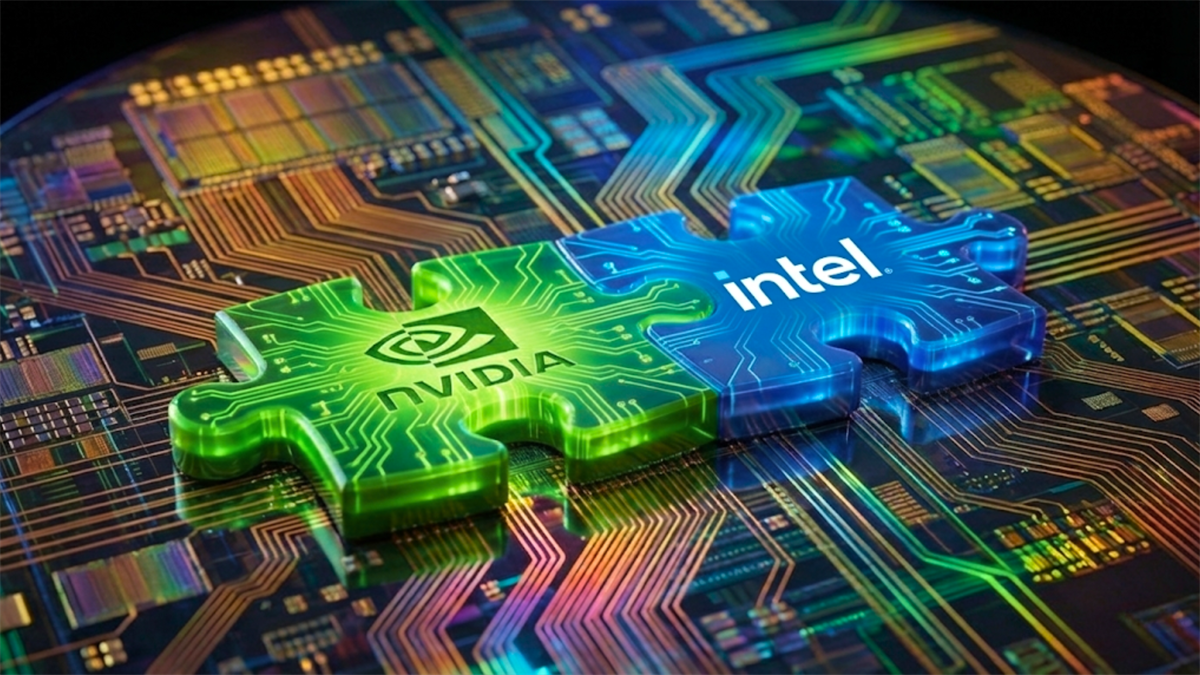
For over a decade, the semiconductor industry was defined by a rivalry between Intel (NASDAQ: INTC) and NVIDIA (NASDAQ: NVDA). One company dominated the Central Processing Unit (CPU) market that powered personal computers, while the other quietly built an empire in Graphics Processing Units (GPUs) for gaming and eventually artificial intelligence (AI). However, December 2025 marked the definitive end of that era of opposition. The geopolitical landscape of Silicon Valley was dramatically reshaped by a move that stunned Wall Street: NVIDIA finalized a $5 billion private placement investment in Intel, following regulatory approval for the deal.
This transaction is not a financial lifeline for a legacy giant that has struggled to find its footing; it represents a pragmatic armistice driven by the harsh realities of the AI supply chain. For investors, this deal fundamentally changes the risk profile of Intel stock.
Throughout 2024 and the first half of 2025, Intel traded at a significant discount due to bankruptcy risk. The company faced a perfect storm: removal from the Dow Jones Industrial Average, the suspension of its dividend, and massive capital expenditures that drained its cash reserves. The stock price plummeted more than 50% from its historical highs as the market questioned whether the company could survive its own restructuring.
NVIDIA’s capital injection answers that question definitively. By taking an equity stake, the world’s most valuable semiconductor company has signaled that Intel’s survival is necessary for the health of the entire industry. This creates a psychological and financial floor for Intel’s stock price, suggesting that the worst of the volatility may finally be in the rearview mirror.
To understand why this deal is a catalyst for Intel’s stock, investors must look past the headline dollar amount and focus on the underlying technology. NVIDIA did not invest $5 billion to own a piece of Intel’s legacy CPU business. It invested because it desperately needs Intel’s Advanced Packaging capacity.
In early 2025, NVIDIA faced a crisis that threatened its growth trajectory. Its flagship Blackwell AI chips encountered thermal management issues; essentially, the chips were generating too much heat when packed tightly into data center racks. This problem was exacerbated by severe supply constraints at Taiwan Semiconductor Manufacturing Company (NYSE: TSM) (TSMC). TSMC struggled to expand its CoWoS (Chip-on-Wafer-on-Substrate) capacity fast enough to meet global demand.
NVIDIA needed a release valve, and Intel was the only company with the infrastructure to provide it. Intel possesses two critical packaging technologies that solve these specific physical limitations:
By securing access to Intel’s packaging facilities in Arizona and Ohio, NVIDIA is hedging against future bottlenecks. For Intel shareholders, this is the ultimate proof of concept. If Intel’s manufacturing standards are rigorous enough to satisfy NVIDIA, the world's most demanding hardware client, it validates the quality of Intel Foundry Services (IFS) for the broader market. This endorsement is a marketing win, likely attracting other fabless chip designers who were previously hesitant to leave TSMC.
While the NVIDIA deal provides the external validation, the fundamental recovery of Intel’s operations is being driven internally by CEO Lip-Bu Tan. Since taking the helm, Tan has shifted the company’s culture from one of technological optimism to data-driven realism.
Under the previous leadership regime, Intel often over-promised and under-delivered on its manufacturing milestones, eroding investor trust. Tan’s strategy, dubbed Radical Simplification, has focused on cutting bloated middle management and focusing entirely on factory execution.
The most critical metric for investors to watch is the yield rate, the percentage of functional chips produced on a silicon wafer. Poor yields burn cash; high yields print money.
Furthermore, the downside risk for the stock has been capped by the US government. In August 2025, the US Treasury finalized a 9.9% equity stake in Intel as part of the CHIPS Act stipulations. This is not free money; it comes with strict oversight on executive pay and stock buybacks. However, for a recovering company, this oversight is a positive factor. It ensures capital is spent on factories, not perks.
Between the US government (focused on national security) and NVIDIA (focused on supply chain security), Intel has secured two of the most powerful backers on the planet. This dual support structure drastically reduces the likelihood of a liquidity crisis.
As we look toward 2026, the narrative for Intel has shifted from survival to utilization. The factories are built, the technology is validated, and the order book is beginning to fill. The upcoming Panther Lake consumer processors are set to ramp up production in early 2026, and NVIDIA’s packaging orders will start to significantly impact revenue shortly thereafter.
The semiconductor industry has bifurcated into a clear structure: NVIDIA designs the brains of the AI revolution, and Intel has pivoted to building the physical infrastructure required to produce them. By accepting its role as a service provider to its former rival, Intel has secured its future.
For investors, the current valuation represents a rare opportunity. The company has transitioned from a distressed asset with bankruptcy fears to a piece of critical infrastructure backed by the state and the industry leader. While the explosive, high-beta growth of the early AI boom may belong to NVIDIA, the steady, stabilized recovery trade belongs to Intel. With the armistice signed and the factory floors humming, the foundation for a long-term rebound is officially in place.
Before you make your next trade, you'll want to hear this.
MarketBeat keeps track of Wall Street's top-rated and best performing research analysts and the stocks they recommend to their clients on a daily basis.
Our team has identified the five stocks that top analysts are quietly whispering to their clients to buy now before the broader market catches on... and none of the big name stocks were on the list.
They believe these five stocks are the five best companies for investors to buy now...
The article "Sleeping With the Enemy: Inside the NVIDIA-Intel Deal" first appeared on MarketBeat.
| 1 hour | |
| 1 hour | |
| 2 hours | |
| 2 hours | |
| 3 hours | |
| 3 hours | |
| 4 hours | |
| 4 hours | |
| 4 hours | |
| 5 hours | |
| 5 hours | |
| 5 hours | |
| 6 hours | |
| 6 hours | |
| 7 hours |

Join thousands of traders who make more informed decisions with our premium features. Real-time quotes, advanced visualizations, alerts, and much more.
Learn more about Finviz Elite