|
|
|

|
|||||
|
|
|
Qualcomm Incorporated (QCOM) and Hyundai Mobis have signed a comprehensive agreement to co-develop next-generation solutions for Software-Defined Vehicles (SDVs) and Advanced Driver Assistance Systems (ADAS). The deal will allow Qualcomm to develop an integrated automotive solution designed to meet the needs of emerging markets and expand its reach in the global automotive supply chain.
Qualcomm’s Snapdragon Ride Flex SoC is a powerful automotive chip designed to support ADAS and autonomous driving, offering high-performance AI processing, real-time sensor fusion, and advanced safety features. It enables vehicles to handle complex driving and parking tasks efficiently while reducing power consumption and system complexity. Riding on this chip, Qualcomm and Hyundai Mobis will jointly develop advanced driving and parking solutions that support multiple vehicle functions on a single chip, helping automakers reduce costs, improve efficiency, and simplify system design.
The two companies further plan to combine their software and chip technologies in the near future to build a scalable, high-performance SDV architecture that is more efficient, stable, and upgradeable over the air.
Qualcomm recently strengthened its long-standing partnership with Google to advance AI-powered and software-defined vehicle technologies. The company has also teamed up with Garmin to launch the Nexus automotive compute platform, which integrates infotainment and ADAS into a single high-performance system. With ongoing innovation and strong partnerships across the automotive industry, Qualcomm is well-positioned to capitalize on the growing automotive technology market.
Qualcomm faces competition from NXP Semiconductors N.V. (NXPI) and NVIDIA Corporation (NVDA). NVIDIA is expanding its DRIVE platform to support Level 4 self-driving vehicles, working with partners like Uber to power AI-driven robotaxi and autonomous fleets worldwide. NVIDIA recently introduced its Alpamayo AI technology, designed to give autonomous vehicles more human-like reasoning capabilities, which could improve decision-making in complex driving environments.
NXP is strengthening its move toward software-defined vehicles by improving its CoreRide platform and acquiring TTTech Auto to boost safety-critical automotive software functions. The company introduced its S32N7 processors to combine multiple vehicle functions, support AI features, and improve efficiency while lowering costs for automakers. NXP is working with partners like Rimac Technology and Wistron to develop centralized vehicle systems and speed up software-defined vehicle innovation.
Qualcomm shares have gained 15.9% over the past year compared with the industry’s growth of 39.5%.

Going by the price/earnings ratio, the company's shares currently trade at 14.82 forward earnings, lower than 33.24 for the industry.
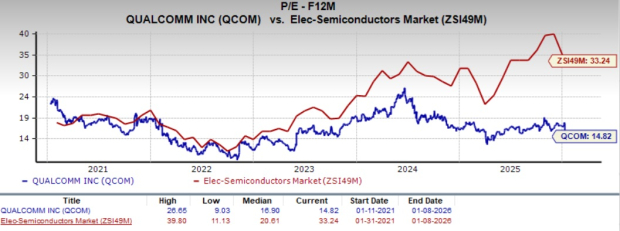
Earnings estimates for 2025 have increased 0.3% to $12.15 over the past 60 days, while those for 2026 have declined 1% to $12.58.

Qualcomm stock currently carries a Zacks Rank #3 (Hold). You can see the complete list of today’s Zacks #1 Rank (Strong Buy) stocks here.
Want the latest recommendations from Zacks Investment Research? Today, you can download 7 Best Stocks for the Next 30 Days. Click to get this free report
This article originally published on Zacks Investment Research (zacks.com).
| 28 min | |
| 1 hour | |
| Apr-02 | |
| Apr-02 | |
| Apr-02 | |
| Apr-02 | |
| Apr-02 | |
| Apr-02 | |
| Apr-02 | |
| Apr-02 | |
| Apr-02 | |
| Apr-02 | |
| Apr-02 | |
| Apr-02 | |
| Apr-02 |

Join thousands of traders who make more informed decisions with our premium features. Real-time quotes, advanced visualizations, alerts, and much more.
Learn more about Finviz Elite