RCL's Yield Momentum Holds Up: Can Pricing Stay Firm in 2026?
Royal Caribbean Cruises Ltd. RCL continues to demonstrate notable pricing resilience, even as comparisons normalize and consumers face broader macro uncertainty. In the third quarter of 2025, the company reported that net yields remained well above historical levels, supported by strong close-in demand, higher onboard spending and disciplined capacity deployment.
Management highlighted that close-in bookings were the strongest on record, allowing RCL to capture premium pricing without relying on early discounting. This dynamic helped drive net yield growth that exceeded internal expectations in the third quarter, supported by broad-based strength across itineraries. Also, the emphasis on premium products and newer ships aided pricing performance.
Unlike prior cycles where yield growth leaned heavily on fare increases alone, RCL is now benefiting from higher onboard and pre-cruise spending, much of which is being booked digitally ahead of sailings. Pre-cruise purchases tend to carry higher margins and improve revenue visibility while also easing onboard execution. This mix shift supported adjusted EBITDA margin expansion despite ongoing volatility in fuel and operating costs.
Management expressed confidence in sustaining elevated yield levels into 2026, pointing to healthy booking curves, continued strength in premium demand and improving revenue management capabilities. While growth rates are expected to moderate, pricing appears better supported by booking visibility and mix, suggesting yields could remain an important earnings driver.
How RCL Stacks Up to Competitors
Royal Caribbean’s yield performance continues to stand apart as industry pricing growth cools. While Carnival Corporation & plc CCL and Norwegian Cruise Line Holdings Ltd. NCLH are still seeing solid demand and healthy onboard spending, signals point to a more tempered pricing environment in 2026.
Carnival is increasingly leaning on onboard revenues and itinerary mix to support yields, as ticket price momentum normalizes alongside a more balanced supply-demand setup. Norwegian Cruise has also pointed to strength in onboard and pre-cruise spend, but mix-driven pricing dynamics in select markets have resulted in a more measured pricing posture.
Against this backdrop, RCL distinguishes itself by maintaining firm pricing without a heavier reliance on discounting. Strong close-in demand and outsized performance from newer ships highlight tighter capacity control and more refined revenue management. While Carnival and Norwegian Cruise are leaning more heavily on ancillary revenues to defend yields, RCL’s pricing profile appears better positioned to hold up as growth across the sector moderates.
RCL’s Price Performance, Valuation & Estimates
Shares of Royal Caribbean have declined 6.2% in the past three months against the industry’s 6.1% growth.
RCL Stock’s Three-Month Price Performance

Image Source: Zacks Investment Research
From a valuation standpoint, RCL trades at a forward price-to-earnings ratio of 16.26, below the industry’s average of 17.76.
RCL’s P/E Ratio (Forward 12-Month) vs. Industry
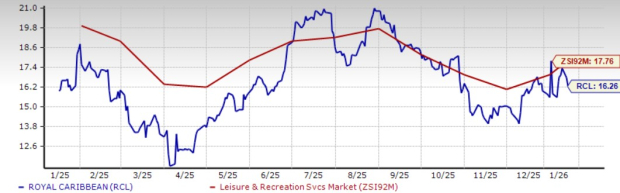
Image Source: Zacks Investment Research
The Zacks Consensus Estimate for RCL’s 2026 earnings implies a year-over-year uptick of 14.1%. The EPS estimates for 2026 have declined in the past 30 days.
EPS Trend of RCL Stock

Image Source: Zacks Investment Research
RCL stock currently carries a Zacks Rank #3 (Hold). You can see the complete list of today’s Zacks #1 Rank (Strong Buy) stocks here.
Want the latest recommendations from Zacks Investment Research? Today, you can download 7 Best Stocks for the Next 30 Days. Click to get this free report
Carnival Corporation (CCL): Free Stock Analysis Report
Royal Caribbean Cruises Ltd. (RCL): Free Stock Analysis Report
Norwegian Cruise Line Holdings Ltd. (NCLH): Free Stock Analysis Report
This article originally published on Zacks Investment Research (zacks.com).
Mentioned In This Article
Latest News
| Oct-09 | |
| Oct-09 | |
| Oct-08 | |
| Oct-08 | |
| Oct-08 | |
| Oct-08 | |
| Oct-08 | |
| Oct-07 | |
| Oct-07 | |
| Oct-06 | |
| Oct-06 | |
| Oct-06 | |
| Oct-06 | |
| Oct-06 | |
| Oct-05 |
