Why 'Cheap' Software Stocks Could Be The Next Big AI Value Trap
Enterprise software stocks are starting to look tempting again, at least on a chart.
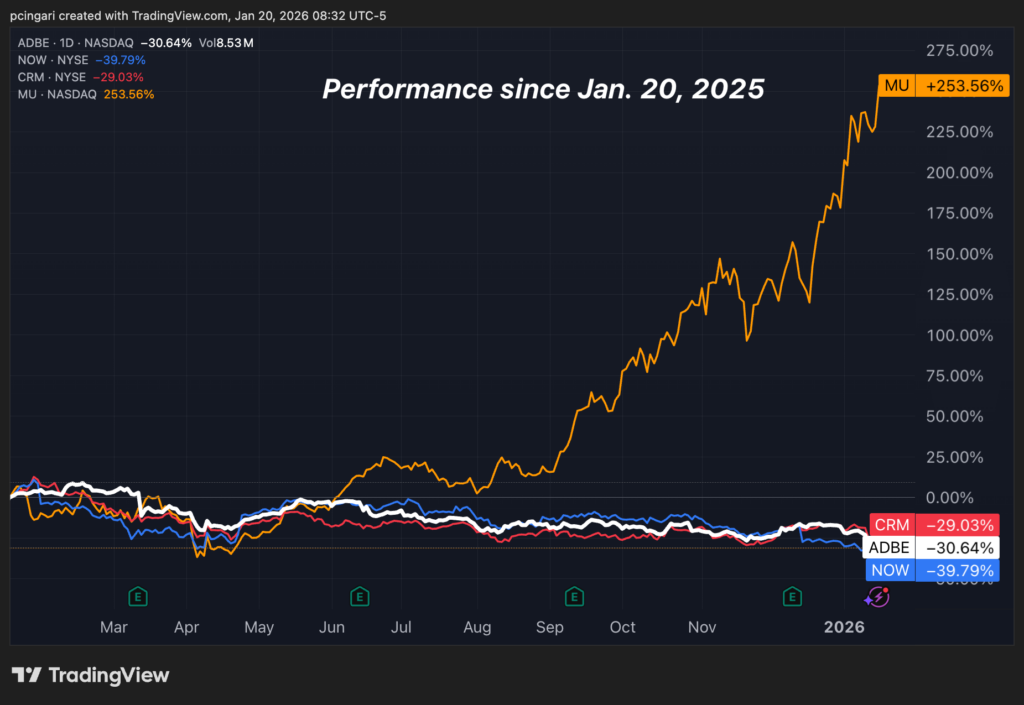
Adobe Inc. (NASDAQ:ADBE) is trading at November 2022 lows and has lost 55% of its value since its February 2024 peak.
Salesforce Inc. (NYSE:CRM) sits near May 2024 levels, down about 40% from its January 2025 high. ServiceNow Inc. (NYSE:NOW) is at its lowest since November 2023, off roughly 45% from its January 2025 peak.
To many investors, that looks like classic mean reversion. AI hardware stocks like Micron Technology Inc. (NASDAQ:MU) and Nvida Corp. (NASDAQ:NVDA) have run, software has lagged, and the trade is to rotate.
But according to 22V Research's analyst Jordi Visser, that instinct may be exactly backward.
Visser indicates that this is not a cyclical selloff, but the early stages of something structural: AI-driven demand suppression.
Chart: Hardware Stocks Win, Software Loses As AI Reshape Tech Leadership
Not A Rotation — A Demand Problem
"This isn't a typical sector rotation or a buying opportunity in beaten-down software names."
Instead, Visser frames the move as something structural — rooted in how AI changes the economics of building, buying, and using software itself.
For decades, enterprise software adoption was shaped by one central constraint: building software internally was expensive, slow, and risky. That friction made buying SaaS the default decision.
Over time, this dynamic enabled sprawl. Each workflow justified a new vendor. Each department accumulated its own stack. Administrative surface area expanded quietly alongside revenue.
“When software can be generated, modified, and orchestrated by agents at near-zero marginal cost, ‘build’ stops being a strategic project and becomes an everyday action. At that point, the entire buy-side market for software isn't disrupted, it's suppressed,” Visser said.
Why Low Multiples May Be a Mirage
The market often treats 40% to 60% drawdowns as an opportunity. Visser sees a trap. He compares the ‘cheap software’ trade to buying snack companies after appetite-suppressing drugs like Ozempic went mainstream.
“GLP-1 medications are eliminating food noise. Agentic AI is eliminating software noise. Both are appetite suppressants. Both are liquidating the middleman, whether that is the biological craving or the digital interface,” he said.
The implication is critical. When hunger noise disappears, consumption falls. When administrative friction disappears, software usage contracts.
That helps explain why stocks like ADBE, CRM and NOW are under pressure. These business models are still tied to seat‑based pricing, subscription layers and administrative interfaces — all things agents are steadily eroding.
This is why Visser cautions against reading falling software prices as value.
"They are confusing the suppressant for the bubble and the bloat for the value."
Another force accelerating the pressure on legacy software is organizational mismatch. AI improves in step functions. Large software companies move in quarters, roadmaps, and release cycles.
By the time incumbents ship new AI features, entire workflows may already be automated away.
Visser indicates legacy software companies are no longer competing with each other — they are competing with the pace of AI capability improvement itself, a race they are structurally ill-equipped to win.
Why ‘Cheap' May Stay Cheap
This framework reframes how investors should interpret current price action. The drawdowns in Adobe, Salesforce, and ServiceNow may not represent cyclical lows, but reflections of a contracting economic surface area, the analyst said.
Buying beaten-down software stocks today often amounts to a bet on inertia — that procurement habits, organizational resistance, and human interfaces will outlast exponential AI progress.
History suggests the opposite.
“The real divide now is not between "AI winners" and "AI losers," but between organizations positioned for the old appetite and those built for the new one,” he said.
“The only remaining question is whether capital is aligned with that reality, or anchored to the one that just ended,” he added.
Photo by wee dezign on Shutterstock
Mentioned In This Article
Latest News
| 54 min | |
| 2 hours | |
| 2 hours | |
| 3 hours | |
| 5 hours | |
| 5 hours | |
| 5 hours | |
| 6 hours | |
| 6 hours | |
| 6 hours | |
| 6 hours | |
| 7 hours | |
| 7 hours | |
| 7 hours | |
| 7 hours |
