The Top 3 Artificial Intelligence (AI) Chip Stocks to Buy With $50,000 in 2026
Key Points
Nvidia is the market leader in general-purpose graphics processing units (GPUs).
Taiwan Semiconductor is the largest chip foundry in the world, partnering with semiconductor leaders like Nvidia, AMD, and Broadcom.
Micron Technology could be on the cusp of breaking out as memory and storage chips become a necessity for powering artificial intelligence (AI) workloads.
Over the last few years, technology investors have witnessed unprecedented sums poured into artificial intelligence (AI) infrastructure. Hyperscalers such as Microsoft, Amazon, Alphabet, Meta Platforms, Oracle, and OpenAI are collectively spending hundreds of billions of dollars to build data centers and equip these facilities with clusters of AI chips and networking gear.
I'll reveal my top three semiconductor stocks to buy in 2026 as investment along the chip value chain continues to accelerate. For investors with available capital, a $50,000 investment spread across these three stocks could become a multibagger in the long run.
Where to invest $1,000 right now? Our analyst team just revealed what they believe are the 10 best stocks to buy right now, when you join Stock Advisor. See the stocks »
1. Nvidia
While it may be the most obvious choice, it's just too hard to pass on Nvidia (NASDAQ: NVDA). Nvidia's lineup of graphics processing units (GPUs) and CUDA software stack have become the default platform on which generative AI is built and trained.
According to research from Gartner, revenue from AI processing semiconductors exceeded $200 billion last year. That said, Bloomberg Intelligence (BI) is forecasting the AI GPU market to grow at a compound annual growth rate (CAGR) of 14% through 2033 -- ultimately reaching a total addressable market (TAM) of $486 billion. What's even more encouraging is that BI suggests Nvidia could maintain up to 75% market share through 2030.
While this is good news for Nvidia's GPU empire, the company is already laying the groundwork for new business lines as well.
For example, Nvidia is complementing its training expertise with new inference capabilities -- striking a $20 billion partnership with inference specialist Groq. As this relationship matures, Nvidia could surprise investors and potentially expand its leadership position in the AI chip landscape as developers rely on the company for a full-stack infrastructure approach.
Despite its tight grip on the AI data center market, Nvidia stock is trading at its cheapest levels in over a year based on forward price-to-earnings (P/E) trends. This could suggest that investors are beginning to view Nvidia as a maturing business -- one threatened by rising competition from Advanced Micro Devices and Broadcom.
While the competitive landscape is intensifying, new chip architectures are entering a market that is still expanding. In other words, the AI chip opportunity has room for multiple winners.
I think Nvidia stock is a no-brainer at its current valuation. Investors with a long-run time horizon should consider Nvidia a buy-and-hold position throughout the AI infrastructure chapter.
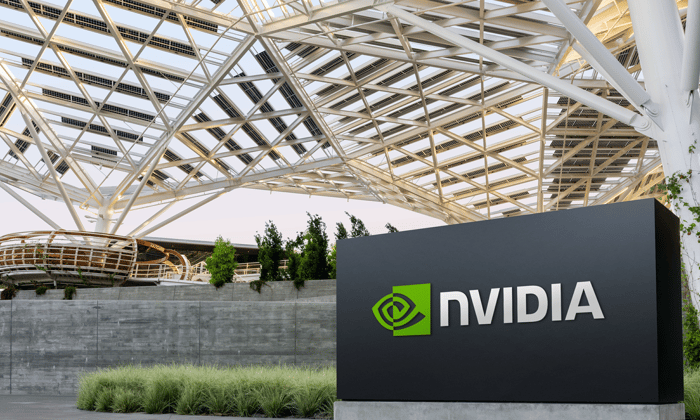
Image source: Nvidia.
2. Taiwan Semiconductor Manufacturing
A natural complement to a position in Nvidia is an allocation in Taiwan Semiconductor Manufacturing (NYSE: TSM). The reason is simple: Chip designers like Nvidia, AMD, Broadcom, and many more outsource their manufacturing needs to Taiwan Semi.
While the company faces some competition in the foundry market from Intel and Samsung, TSMC is the largest chip manufacturer in the world in terms of revenue -- holding nearly 70% market share. At a high level, TSMC's role in the AI chip industry in one of a pick-and-shovel business.
But what makes Taiwan Semi so unique is that the company's foundry is used to manufacture different types of chips -- from general-purpose GPUs to custom silicon solutions. This puts the company in a position to sustain its growth profile no matter whose chips are in demand.
Against this backdrop, the company appears well-positioned to capture a meaningful portion of the expanding AI chip market. As hyperscalers double down on AI capital expenditures (capex), TSMC can use these infrastructure tailwinds as a proxy for future business.
With revenue and profit margins soaring, Taiwan Semi's leadership has made it clear that the company will continue investing in additional manufacturing facilities and expand its geographic footprint over the coming years -- suggesting further upside from the ongoing chip supercycle is on the horizon.
3. Micron Technology
The proliferation of large language models (LLMs) and generative AI services has created a bottleneck as it relates to AI workloads. To ensure data flows efficiently across GPU clusters, companies are now required to invest heavily in high-bandwidth memory (HBM) and storage solutions.
Micron Technology (NASDAQ: MU) has been a clear beneficiary of this trend. For the company's fiscal first quarter of 2026 (period ended Nov. 27), Micron's revenue in its dynamic random access memory (DRAM) division soared 69% year over year, while NAND sales rose by 22%.
While this is impressive, the real story around Micron is its profitability profile versus its valuation. Over the last year, Micron has generated earnings per share (EPS) of roughly $10. But for this year, Wall Street is calling for EPS to triple. These unit economics suggest that Micron is able to command lucrative pricing power in light of memory and storage becoming a necessity in the broader chip stack.
While its outlook is strong, it would appear that growth investors have not yet woken up to the sleeping giant that is Micron. The company is still valued at a rather modest forward P/E of 11, steeply discounted to other leaders in the chip realm.
I think 2026 could be Micron's breakout year. Now looks like an interesting time to consider scooping up shares of Micron at a reasonable price.
Should you buy stock in Nvidia right now?
Before you buy stock in Nvidia, consider this:
The Motley Fool Stock Advisor analyst team just identified what they believe are the 10 best stocks for investors to buy now… and Nvidia wasn’t one of them. The 10 stocks that made the cut could produce monster returns in the coming years.
Consider when Netflix made this list on December 17, 2004... if you invested $1,000 at the time of our recommendation, you’d have $462,174!* Or when Nvidia made this list on April 15, 2005... if you invested $1,000 at the time of our recommendation, you’d have $1,143,099!*
Now, it’s worth noting Stock Advisor’s total average return is 946% — a market-crushing outperformance compared to 196% for the S&P 500. Don't miss the latest top 10 list, available with Stock Advisor, and join an investing community built by individual investors for individual investors.
*Stock Advisor returns as of January 28, 2026.
Adam Spatacco has positions in Alphabet, Amazon, Meta Platforms, Microsoft, and Nvidia. The Motley Fool has positions in and recommends Advanced Micro Devices, Alphabet, Amazon, Intel, Meta Platforms, Micron Technology, Microsoft, Nvidia, Oracle, and Taiwan Semiconductor Manufacturing. The Motley Fool recommends Broadcom and Gartner. The Motley Fool has a disclosure policy.
Mentioned In This Article
Latest News
| 12 min | |
| 24 min | |
| 27 min | |
| 27 min | |
| 40 min | |
| 42 min | |
| 1 hour | |
| 1 hour | |
| 1 hour | |
| 1 hour | |
| 1 hour | |
| 1 hour | |
| 2 hours | |
| 2 hours | |
| 3 hours |
