Trump Says The Dollar Is 'Great' - Gold And Silver Are Proving It Isn't
The U.S. dollar weakened to more than four-year lows on Tuesday after President Donald Trump said he is "not concerned" about the greenback's recent decline, adding that its value is "great."
The remarks added fuel to a dollar selloff that has been building for weeks — and sent shockwaves through commodity markets, where gold and silver are now posting some of the steepest moves on record.
What Happened To The Dollar?
Speaking to reporters late Tuesday, Trump dismissed concerns that the dollar had fallen too far.
"No, the dollar is doing great," Trump said when asked about the greenback's weakness.
"If you look at China and Japan, I used to fight like hell with them because they always wanted to devalue their currencies," he added. "It's hard to compete when they devalue."
Following those comments, the U.S. dollar index (DXY) — closely tracked by the Invesco DB US Dollar Bullish Fund (NYSE:UUP) — slid to as low as 95.5, its weakest level since February 2022.

Gold And Silver Explode Higher
A weaker dollar is turbocharging commodities, especially precious metals.
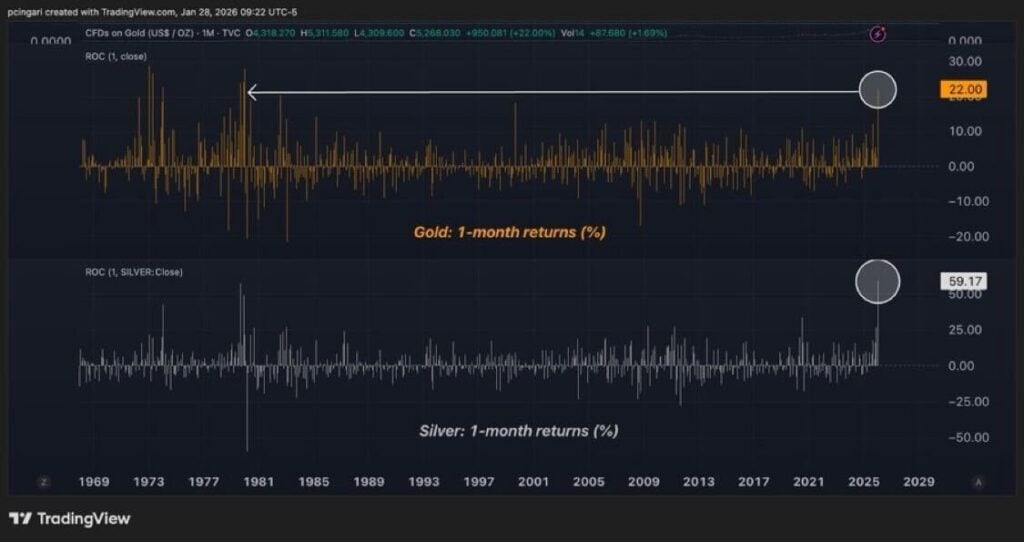
Gold, tracked by the SPDR Gold Shares (NYSE:GLD), spiked above $5,300 per ounce. Prices are now up 22% this month. January 2026 is on pace to become gold's best month since January 1980.
Silver's move has been even more dramatic.
Silver, tracked by the iShares Silver Trust (NYSE:SLV), blasted through $110 per ounce. Prices are up 58% this month, putting silver on track for its strongest monthly rally ever.
What Wall Street Analysts Are Saying
ING analyst Chris Turner said markets are increasingly focused on whether U.S. officials are implicitly encouraging dollar weakness.
"The ramifications of the Fed potentially participating in USD/JPY intervention continue to seep through the market," Turner said.
"Does the U.S. administration just want a stronger yen to help stabilize the JGB and U.S. Treasury market? Or does the U.S. want a broadly weaker dollar for competitive purposes?"
Turner highlighted that historically, Republican administrations have often favored a weaker dollar — and Trump's lack of concern reinforces that narrative. He added that renewed scrutiny is now likely to fall on Treasury Secretary Scott Bessent regarding U.S. dollar policy.
Alejandro Cuadrado, chief strategist at BBVA, said sentiment around the greenback remains fragile amid elevated U.S. political uncertainty and de‑dollarization concerns, and that Trump's remarks "reinforced market perceptions that a weaker dollar would not be viewed negatively by the U.S. administration."
Is This Becoming A ‘Sell America' Trade?
Some analysts see rising risks from a weaker greenback. David Morrison, senior market analyst at Trade Nation, said Trump's stance fits a familiar pattern.
"It has been no secret that Mr Trump sees a lower dollar as very good for U.S. exports," Morrison said.
But he warned the narrative could spiral. "His comment is being dressed up as something akin to malign neglect which could set the stage for an unstoppable slide," Morrison said.
Yet, on precious metals, Morrison urged caution.
"There is plenty of talk about ‘new paradigms', ‘Sell America' and how gold is on its way to $10,000 per ounce," he said.
"Maybe. But it's unlikely to get there without a significant pullback first."
He also flagged risk in silver. "Silver is in the process of a blow-off top, which can precede a sudden reversal," Morrison said.
"This market is stuffed full of risk. Be careful."
What About The Fed?
The Federal Reserve announces its policy decision at 2 p.m. Wednesday. Some analysts think dollar weakness raises the odds of a hawkish tone from Chair Jerome Powell.
"The USD weakness into the meeting increases the odds Powell makes hawkish rates comments," said Dennis Debuschere, analyst at 22V Research.
Debuschere said Powell may argue that a weaker dollar eases financial conditions at a time when the Fed doesn’t want them to ease too much.
"All else equal, the lower the USD, the higher interest rates need to be — or the lower stocks need to be — to keep financial conditions neutral," he said.
With the dollar, commodities and monetary policy now tightly intertwined, markets appear braced for another bout of volatility.
Photo: RomanR from Shutterstock
Mentioned In This Article
Latest News
| Oct-05 |
EXCLUSIVE: US May Need AI Boom to Grow Out of Debt Crisis, American Hartford Gold President Says
GLD
Benzinga Prediction Markets
|
| Sep-24 | |
| Sep-23 | |
| Sep-23 | |
| Sep-22 | |
| Sep-21 | |
| Sep-21 | |
| Sep-17 | |
| Sep-17 | |
| Sep-15 | |
| Sep-15 | |
| Sep-14 | |
| Sep-09 | |
| Sep-03 | |
| Sep-02 |
