AT&T's Lumen Deal Hides an Opportunity Most Investors Are Missing
Key Points
AT&T agreed last year to buy Lumen's fiber assets in a $5.75 billion deal.
There will be significant integration costs, but a low penetration rate and cross-selling opportunities make the deal a slam dunk.
The fiber business will help drive free cash flow growth over the next few years.
Telecom giant AT&T (NYSE: T) agreed to pay $5.75 billion last year to acquire Lumen's fiber business. The deal, which is expected to close early this year, will add 4 million passed locations and 1 million subscribers to AT&T's growing fiber network.
Once the deal is closed, AT&T plans to sell a partial ownership stake in the newly created subsidiary that will hold these assets. The subsidiary will then operate as a commercial open-access platform, with AT&T as the anchor tenant. This approach will help AT&T keep its debt levels down.
Where to invest $1,000 right now? Our analyst team just revealed what they believe are the 10 best stocks to buy right now, when you join Stock Advisor. See the stocks »
What AT&T won't be able to avoid are meaningful integration costs, with earnings taking a hit in the near term. However, the company expects the long-term opportunity to be more than worth the cost.
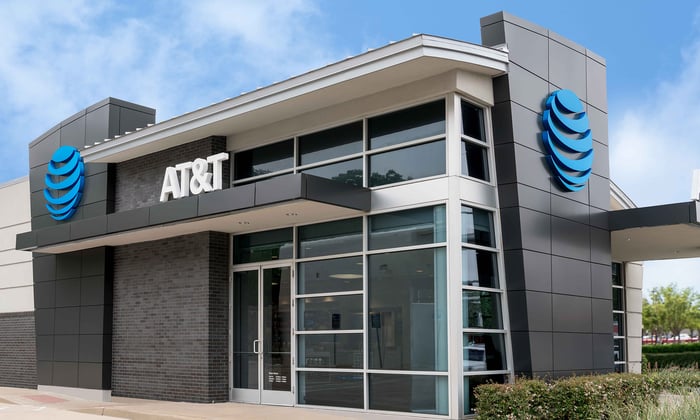
Image source: AT&T.
A costly integration
AT&T expects its adjusted earnings per share in 2026 to be negatively impacted by about $0.05 by integration costs and additional interest expenses related to the Lumen deal and its agreement to buy spectrum licenses from EchoStar. In the first quarter of 2026, there will be some additional costs related to integrating and scaling Lumen's retail operations.
Much of the cost associated with integrating Lumen will be incurred this year, but there will also be an impact over the next few years. AT&T CFO Pasal Desroches noted in the earnings call that "We're going to incur pretty significant acquisition initial cost to integrate those assets. And to build this and to add to the distribution behind them." However, he expects those costs to moderate over the next two to three years.
In the first quarter of 2026, EBITDA and free cash flow are expected to be weak, partly due to the necessary Lumen-related investments. EBITDA is expected to expand by 3% to 4% in 2026, with growth accelerating to 5% or better in 2028.
The opportunity makes the price worth paying
While near-term financial results will come under some pressure from the Lumen deal, AT&T has outlined a significant opportunity to boost fiber revenues. The Lumen fiber network being acquired has a 25% customer penetration rate, meaning that just 25% of locations passed by the network are paying subscribers. Meanwhile, AT&T's fiber penetration rate is 40%.
That 15-percentage-point gap represents about 600,000 potential new customers based on the current size of Lumen's network, assuming AT&T can close that gap over time. That's on top of the 1 million customers Lumen already has that AT&T will acquire. AT&T had about 10.4 million fiber subscribers at the end of 2025, so these figures are meaningful.
The opportunity gets even better. Fewer than 20% of Lumen's subscriber base are AT&T wireless customers. AT&T's convergence rate, or the percentage of fiber customers who are also wireless customers, is currently 42%. Within the existing Lumen customer base, there is an opportunity to win a couple of hundred thousand new 5G wireless customers.
Setting the stage for long-term growth
The Lumen deal will contribute to AT&T's growing earnings and free cash flow over the next few years, despite the initial upfront costs. Adjusted EPS will only grow slightly this year, up from $2.12 in 2025 to a range of $2.25 to $2.30. However, AT&T expects double-digit compound annual growth through 2028, implying acceleration in 2027 and 2028. Free cash flow is also set to expand. AT&T expects to deliver at least $18 billion in free cash flow this year, at least $19 billion in 2027, and at least $21 billion in 2028.
With the Lumen deal, AT&T is taking its winning strategy of cross-selling fiber and wireless services and applying it to an underpenetrated fiber network. It's a smart move, and based on the company's long-term outlook, it should pay off in the long run.
Should you buy stock in AT&T right now?
Before you buy stock in AT&T, consider this:
The Motley Fool Stock Advisor analyst team just identified what they believe are the 10 best stocks for investors to buy now… and AT&T wasn’t one of them. The 10 stocks that made the cut could produce monster returns in the coming years.
Consider when Netflix made this list on December 17, 2004... if you invested $1,000 at the time of our recommendation, you’d have $456,457!* Or when Nvidia made this list on April 15, 2005... if you invested $1,000 at the time of our recommendation, you’d have $1,174,057!*
Now, it’s worth noting Stock Advisor’s total average return is 950% — a market-crushing outperformance compared to 197% for the S&P 500. Don't miss the latest top 10 list, available with Stock Advisor, and join an investing community built by individual investors for individual investors.
*Stock Advisor returns as of January 29, 2026.
Timothy Green has positions in AT&T. The Motley Fool has no position in any of the stocks mentioned. The Motley Fool has a disclosure policy.
Mentioned In This Article
Latest News
| Oct-10 | |
| Oct-10 | |
| Oct-10 | |
| Oct-09 | |
| Oct-09 | |
| Oct-09 | |
| Oct-09 | |
| Oct-09 | |
| Oct-09 | |
| Oct-09 | |
| Oct-09 | |
| Oct-09 | |
| Oct-09 | |
| Oct-09 | |
| Oct-09 |
