|
|
|

|
|||||
|
|
|
Amazon.com, Inc. (NASDAQ:AMZN) is asking U.S. regulators for more time to meet a key satellite deployment milestone, arguing that launch bottlenecks and industry-wide disruptions are slowing the rollout of its Starlink rival, Amazon Leo.
Amazon has formally requested a two-year extension from the Federal Communications Commission to meet a deadline requiring the company to deploy roughly 1,600 internet satellites by July 2026, according to a filing made public Friday.
The company said delays beyond its control — including a near-term shortage of available rockets, manufacturing disruptions, and setbacks involving new launch vehicles — have hindered progress on its low Earth orbit satellite network, rebranded as Amazon Leo.
Leo, formerly Project Kuiper, is "producing satellites considerably faster than others can launch them," Amazon wrote in the filing, pointing to grounded rockets, extended development timelines, and limited spaceport capacity as key constraints.
Amazon is asking the FCC to either extend the deadline to July 2028 or waive the requirement that roughly half of its planned 3,236-satellite constellation be deployed by 2026.
Unveiled in 2019, Amazon Leo is designed to deliver high-speed, low-latency broadband to consumers, businesses, and governments using square-shaped user terminals.
Amazon has committed at least $10 billion to the project.
While the company has booked more than 100 launches — including additional missions with SpaceX, Blue Origin, and Arianespace — it said many next-generation rockets have taken longer than expected to reach full operational readiness.
Amazon has launched more than 150 satellites since April. In the filing, it said that Amazon expects to have about 700 in orbit by July 30.
Its next launch, scheduled for Feb. 12, will carry 32 satellites aboard an Arianespace rocket.
The company said that milestone would make Leo the world's second-largest satellite constellation, behind SpaceX's Starlink, which operates more than 9,000 satellites and serves roughly 9 million customers.
France-based OneWeb has more than 600 satellites in orbit, the report said.
Amazon warned that denying an extension would "undermine" the FCC's goals of expanding broadband access and accelerating deployment, noting that the agency has granted similar requests in the past.
"Amazon Leo is engaged in full-scale deployment and stands on the doorstep of offering U.S. customers a competitive and innovative new service," the company said.
Price Action: On Friday, Amazon closed at $239.30, down 1.01% and slipped lower in after-hours trading at $239.29, according to Benzinga Pro.
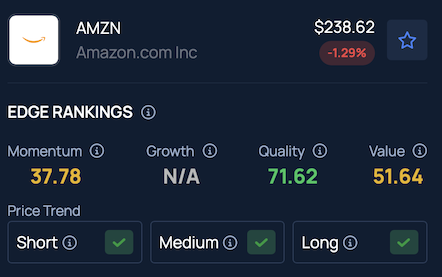
AMZN stock scores high on Quality in Benzinga's Edge Stock Rankings, with a favorable price trend in the short, medium, and long terms.
Disclaimer: This content was partially produced with the help of AI tools and was reviewed and published by Benzinga editors.
Image via Shutterstock
| 15 min | |
| 33 min | |
| 46 min | |
| 53 min | |
| 58 min | |
| 1 hour | |
| 1 hour | |
| 1 hour | |
| 1 hour | |
| 1 hour | |
| 1 hour | |
| 1 hour | |
| 2 hours | |
| 2 hours | |
| 2 hours |

Join thousands of traders who make more informed decisions with our premium features. Real-time quotes, advanced visualizations, alerts, and much more.
Learn more about Finviz Elite