Salesforce Stock Down 17% in Six Months: Should Investors Buy the Dip?
Salesforce, Inc. CRM shares have plunged 16.8% over the past six months, underperforming the broader Zacks Computer and Technology sector’s gain of 10.8%.
The sharp contrast raises a tough question: Should investors consider this decline as a buying opportunity, or is it time to move on from Salesforce stock? While near-term issues are weighing on the stock, there’s still a strong fundamental case for investing in CRM.
Salesforce Six-Month Price Return Performance
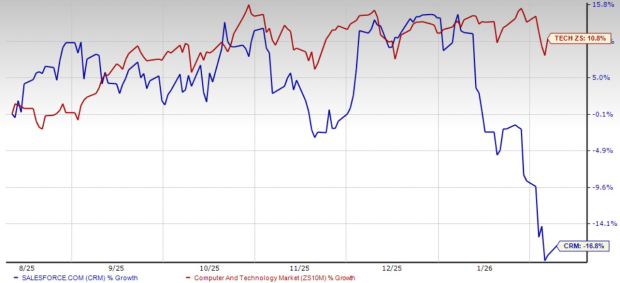
Image Source: Zacks Investment Research
What’s Behind Salesforce’s Weak Performance?
A decelerating growth trend has turned investors cautious about Salesforce’s near-term prospects. For years, it has delivered strong double-digit revenue increases. That pace has now cooled down to single digits. In the first nine months of fiscal 2026, revenues rose just 8.7% year over year.
This slowdown reflects cautious enterprise spending amid economic uncertainty and geopolitical pressures. Analysts’ revenue projections indicate no significant improvement in the years ahead. The Zacks Consensus Estimate for fiscal 2026 and 2027 revenues indicates growth of 9.5% and 10.9%, respectively, year over year.
The impact is also visible in profit forecasts. Salesforce’s earnings per share (EPS) is now expected to witness a CAGR of 15% over the next five years, which is a big drop from the 27.8% CAGR it posted over the previous five years. Fiscal 2026 and 2027 EPS forecasts indicate a year-over-year improvement of 15.3% and 10.5%, respectively.
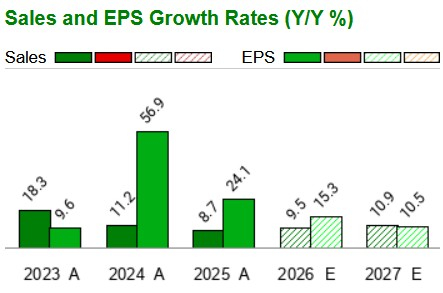
Image Source: Zacks Investment Research
This changing growth profile shows how businesses are adjusting their IT budgets. Instead of large digital transformation projects, many are opting for smaller, lower-risk investments. For Salesforce, this means it has to use strategies to stay competitive and relevant.
Salesforce is now focusing on enhancing its portfolio in the enterprise software market and integrating artificial intelligence (AI) across its product lines, which could help it return to its robust growth trajectory.
Can Salesforce Make a Turnaround?
Salesforce has long held the top position in the customer relationship management market, according to Gartner. The company’s vision now goes beyond customer management, and it is building a broader ecosystem focused on AI, data and collaboration. Acquisitions such as Waii, Bluebirds, Informatica and Slack highlight Salesforce’s push to evolve into a more comprehensive enterprise platform.
AI is now central to Salesforce’s growth story. Since the 2023 rollout of Einstein GPT, Salesforce has been embedding generative AI across its offerings to help companies automate processes, improve decision-making and strengthen customer relationships.
Its latest innovation, Agentforce, is gaining momentum. Combined with Data Cloud, these AI-driven offerings brought in $1.4 billion in recurring revenues in the third quarter of fiscal 2026, representing a 114% year-over-year increase. Agentforce alone generated $540 million in recurring revenues, up 330% year over year. More than 50% of Agentforce deals came from existing clients, showing Salesforce’s success in cross-selling AI features to its user base.
Another tailwind is rising IT spending. Gartner estimates that worldwide IT spending will increase 9.8% year over year to $6.08 trillion in 2026. Software, a key segment for Salesforce, is expected to grow even faster, with a projected increase of 15.2% to $1.43 trillion. Even if economic conditions slow down spending in the short term, digital transformation remains a top priority for businesses, ensuring steady demand for Salesforce’s solutions.
Valuation: Is Salesforce Now a Bargain?
One of the silver linings of stock underperformance is that Salesforce’s valuation has become more reasonable. The stock currently trades at a forward 12-month price-to-earnings (P/E) multiple of 14.89, significantly below the sector average of 25.91. This undervaluation suggests that much of the near-term pessimism is already priced in.
Salesforce Forward 12-Month P/E Ratio
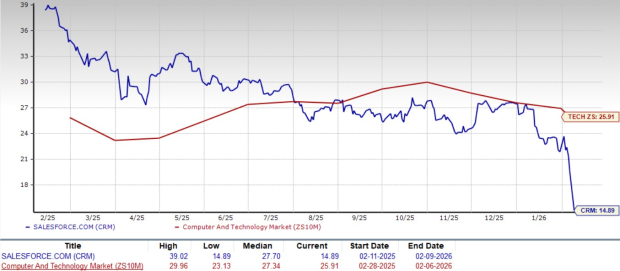
Image Source: Zacks Investment Research
Compared to major competitors in the enterprise software space like SAP SE SAP, Microsoft Corporation MSFT and Oracle Corporation ORCL, Salesforce stock is cheaper on a P/E basis. At present, SAP, Microsoft and Oracle trade at P/E multiples of 23.36, 22.27 and 18.06, respectively.
Shares of Salesforce have fared better than its rivals in the enterprise software space, including Microsoft, SAP and Oracle. Over the past six months, Microsoft, SAP and Oracle stocks have plunged 23.1%, 29.2% and 43.5%, respectively.
Conclusion: Buy CRM Stock for Now
Salesforce’s slowing growth is real and has weighed on its stock price. Its leadership in the customer relationship management software space, focus on AI, strategic acquisitions and reasonable valuations provide reasons to invest in the stock right now.
Salesforce carries a Zacks Rank #2 (Buy) at present. You can see the complete list of today’s Zacks #1 Rank (Strong Buy) stocks here.
Want the latest recommendations from Zacks Investment Research? Today, you can download 7 Best Stocks for the Next 30 Days. Click to get this free report
Microsoft Corporation (MSFT): Free Stock Analysis Report
Salesforce Inc. (CRM): Free Stock Analysis Report
SAP SE (SAP): Free Stock Analysis Report
Oracle Corporation (ORCL): Free Stock Analysis Report
This article originally published on Zacks Investment Research (zacks.com).
Mentioned In This Article
Latest News
| 30 min | |
| 1 hour | |
| 3 hours | |
| 3 hours | |
| 4 hours |
Neoclouds: Goldman Sachs Upgrades CoreWeave. Microsoft Shelves Nscale Project.
MSFT
Investor's Business Daily
|
| 4 hours | |
| 5 hours | |
| 5 hours | |
| 5 hours | |
| 5 hours | |
| 6 hours | |
| 6 hours |
Microsoft Pulls out of Nscale U.K. Data-Center Deal Over Power-Supply Issues
MSFT
The Wall Street Journal
|
| 9 hours | |
| 9 hours | |
| 9 hours |
