PepsiCo vs. Coca-Cola: Which Beverage Giant Wins the Cola War?
The rivalry between PepsiCo Inc. PEP and The Coca-Cola Company KO stands among the most enduring, globally influential and strategically complex battles in corporate history. Both companies command immense global reach, powerful brand portfolios and entrenched distribution systems, yet their paths to market leadership differ meaningfully.
Coca-Cola stands as the world’s leading pure-play beverage company, dominating the carbonated soft drink category while steadily expanding in water, sports drinks and zero-sugar offerings. Its asset-light, concentrate-driven model emphasizes brand equity, marketing scale and global bottling partnerships, reinforcing its strong international market share.
PepsiCo, meanwhile, operates a more diversified model. In addition to competing aggressively in beverages, it controls a leading position in convenient foods, giving it broader shelf presence and stronger negotiating leverage with retailers. This dual-engine structure shapes its revenue mix and resilience across cycles.
In this face-off, we explore how market share strength, competitive positioning and business model differences influence long-term growth potential and defensive appeal.
The Case for PEP
PepsiCo’s investment thesis is anchored in its scale, category leadership and diversified operating model. Management underscored the company’s strong global footprint across both beverages and convenient foods, enabling it to capture share across multiple consumption occasions. In beverages, PepsiCo maintains a meaningful position in carbonated soft drinks, sports drinks and zero-sugar offerings, while snacks continue to hold leading market share positions in several regions. This dual-engine structure enhances shelf dominance and strengthens retailer partnerships, reinforcing its competitive moat within the broader beverage industry.
PepsiCo is leaning into disciplined revenue management, premium innovation and geographic expansion. Ongoing investments in digital tools are improving demand forecasting, supply-chain visibility and consumer engagement, particularly through data-driven marketing and e-commerce capabilities. PepsiCo’s portfolio strategy balances legacy powerhouse brands with innovation in health-forward and functional products, allowing it to target younger consumers while retaining core loyal demographics. International markets remain a key growth lever, supported by localized innovation and distribution expansion.
Productivity initiatives and disciplined capital allocation continue to support margins and cash flow resilience. However, management acknowledged headwinds from input-cost volatility, foreign exchange pressure and cautious consumer spending, which may temper near-term performance despite solid underlying fundamentals.
The Case for KO
Coca-Cola’s investment appeal rests on its commanding global scale and enduring brand leadership across the non-alcoholic ready-to-drink beverage industry. Management emphasized continued value share gains and broad-based momentum, reinforcing its position as the category leader in sparkling soft drinks while expanding in water, sports drinks, coffee and zero-sugar offerings. The company commands a meaningful share of the global beverage market, supported by an unmatched distribution system and a portfolio anchored by iconic trademarks that appeal across age groups and income segments. Its strong brand positioning enables pricing power and consistent consumer loyalty.
Coca-Cola continues to leverage its asset-light, concentrate-driven model to drive profitable growth. The company is advancing premiumization, pack innovation and reformulation efforts to align with health-conscious trends. Digital investments in data analytics, marketing precision and customer tools are strengthening retailer partnerships and route-to-market execution, particularly in emerging markets where per-capita consumption remains underpenetrated.
Management highlighted resilient organic growth and disciplined margin management. Still, headwinds from currency volatility, commodity inflation, regulatory scrutiny and cautious consumer spending may weigh on the company’s near-term performance despite solid long-term fundamentals.
Price Performance & Valuation of PEP & KO
In the past year, shares of PepsiCo have risen 11.9% compared with Coca-Cola’s rally of 14%. Both companies have demonstrated resilience amid a challenging consumer backdrop, reflecting investor confidence in their defensive business models and global brand strength.

Image Source: Zacks Investment Research
From a valuation standpoint, PEP currently trades at a lower forward price-to-earnings (P/E) multiple of 19.61X compared with Coca-Cola’s 24.74X, making it more attractively priced, driven by its earnings and diversified revenue stream.

Image Source: Zacks Investment Research
PepsiCo trades at a more modest forward earnings multiple compared with Coca-Cola. This relatively lower valuation suggests the market is assigning a premium to Coca-Cola’s pure-play beverage focus and recent momentum, while PepsiCo’s diversified food and beverage portfolio offers investors exposure at a comparatively more attractive price point.
How Does Zacks Consensus Estimate Compare for PEP & KO?
PepsiCo’s EPS estimate for 2026 declined 0.3% in the last seven days, while that for 2027 edged down 0.7% in the same period. PEP’s 2026 revenues and EPS are projected to increase 4.3% and 5% year over year to $98 billion and $8.55 per share, respectively.
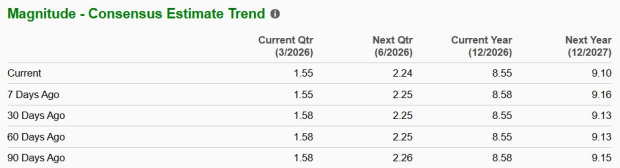
Image Source: Zacks Investment Research
Coca-Cola’s EPS estimates for 2026 have moved up 0.3% in the past seven days, while that for 2027 has been unchanged in the past 30 days. KO’s 2026 revenues and EPS are expected to increase 4.3% and 8% year over year to $49.9 billion and $3.24 per share, respectively.

Image Source: Zacks Investment Research
PEP vs. KO: Which Has the Edge?
In this beverage face-off, Coca-Cola moves ahead, supported by stronger recent share performance and firmer growth momentum. The company’s focused beverage model, steady market share gains and positive estimate revisions signal improving earnings visibility and sustained investor confidence. With disciplined execution and expanding presence in premium and zero-sugar categories, Coca-Cola appears well-positioned to build on its leadership.
That said, PepsiCo remains a compelling contender. Its diversified food and beverage portfolio provides resilience, and its comparatively lower valuation suggests optimism around long-term earnings potential. For investors seeking momentum and earnings visibility, Coca-Cola takes the lead. However, for value and diversification, PepsiCo still makes a strong case. Both PEP and KO currently carry a Zacks Rank #3 (Hold).
You can see the complete list of today’s Zacks #1 Rank (Strong Buy) stocks here.
Want the latest recommendations from Zacks Investment Research? Today, you can download 7 Best Stocks for the Next 30 Days. Click to get this free report
CocaCola Company (The) (KO): Free Stock Analysis Report
PepsiCo, Inc. (PEP): Free Stock Analysis Report
This article originally published on Zacks Investment Research (zacks.com).
Mentioned In This Article
Latest News
| Oct-10 | |
| Oct-09 | |
| Oct-09 | |
| Oct-09 | |
| Oct-09 | |
| Oct-09 | |
| Oct-09 | |
| Oct-09 | |
| Oct-09 | |
| Oct-09 | |
| Oct-08 | |
| Oct-08 | |
| Oct-08 | |
| Oct-08 | |
| Oct-08 |
