|
|
|

|
|||||
|
|
|
Alphabet and Microsoft are well-funded competitors.
Nvidia is playing a supporting role in the quantum computing realm.
IonQ leads the world in quantum computing error reduction.
Quantum computing is a cutting-edge technology that has yet to be proven out, but numerous companies are working on producing commercially viable systems. While 2026 won't be the year that it reaches the mainstream, it's likely that there will be several impressive breakthroughs in the field.
I think that these four quantum computing stocks will do well in 2026, and each one has its own set of circumstances that will drive its success.
Where to invest $1,000 right now? Our analyst team just revealed what they believe are the 10 best stocks to buy right now. Continue »
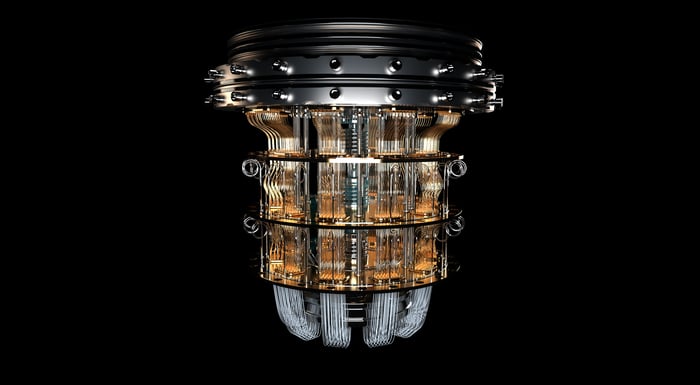
Image source: Getty Images.
Alphabet (NASDAQ: GOOG) (NASDAQ: GOOGL) and Microsoft (NASDAQ: MSFT) are two of my top picks in the quantum computing realm. These tech behemoths have nearly unlimited resources to throw at developing quantum computing, making them forces to be reckoned with.
Each also has a massive cloud computing division, which gives them another incentive to develop quantum computing technology in-house. By developing their own viable quantum computing hardware, they can control the costs and earn better margins when they eventually rent out capacity on those systems. Furthermore, it's also a hedge against competitors developing viable quantum computing technology first.
If a pure-play quantum computing company does bring a commercially viable quantum computer to market ahead of the giants, that still wouldn't be too problematic for Alphabet and Microsoft; the hyperscalers could simply buy those systems, install them in their data centers, and rent capacity on them much as they do today with graphics processing units (GPUs). While this wouldn't be the best scenario for their margins, it would maintain the current status quo in the cloud computing industry. However, if Alphabet were to develop a viable quantum computing option while Microsoft's efforts lagged, for example, some Azure clients might choose to move to Google Cloud to gain access to its revolutionary computing technology.
The possibility of their rival gaining a significant competitive advantage will keep both companies engaged in the quantum computing realm until the technology is developed and deployed. Still, quantum computing won't be a critical part of either company's business in 2026. Artificial intelligence will be what drives these two higher, and each has an excellent AI strategy boosting its finances. An investment in either or both of these companies would be a good way to capitalize on current tech trends while maintaining exposure to future ones. As a result, I think both are excellent buys.
Nvidia (NASDAQ: NVDA) is another way to play the theme of AI-focused companies with quantum computing side bets. Nvidia is the leader in GPUs, which are the most advanced traditional parallel processors available. Nvidia has stated that it isn't developing a quantum computing unit, but it has developed its NVQLink.
This system creates a high-speed bridge between quantum computers and traditional supercomputers -- resulting in a hybrid system that will help make large-scale quantum computing and quantum error correction possible. This should ensure that Nvidia's hardware will continue to be used in the hybrid use case. It also gives the company exposure to several quantum computing start-ups that could be the next big thing.
While Nvidia's finances won't meaningfully benefit from quantum computing in the short term, by providing this key supporting technology, it ensures that its future will stay intact even if quantum computing technology is everything the optimists hope for and more.
IonQ (NYSE: IONQ) is a pure-play quantum computing start-up, and its only shot at being a long-term success story is to bring leading quantum computing technology to market before everyone else does. This is a long shot, so the risks of investing in IonQ are high.
However, IonQ has one advantage that may propel it to victory: accuracy. All current quantum computing systems are vastly more prone to errors than classical machines, which is one of the primary issues preventing the technology from being broadly usable. In fact, quantum error correction and mitigation are widely viewed as the entire industry's chief challenges, so any company that can reduce its error rate to a low enough level to make its machines useful should ultimately be a winner.
IonQ holds the world record for two-qubit gate fidelity at 99.99%. No other company has crossed the 99.9% two-qubit gate fidelity threshold, placing IonQ in a league of its own. IonQ surpassed the 99.9% fidelity market in September 2024, compared to the 99.99% mark in October 2025.
If other companies follow similar developmental timelines, that gives IonQ a one-year head start, which may or may not be enough for it to fend off well-funded competitors like Microsoft or Alphabet. While IonQ is a long shot, it's still my top pick among the pure plays. If it continues to make progress in improving its systems, I won't be surprised to see the stock skyrocket throughout 2026.
Before you buy stock in Alphabet, consider this:
The Motley Fool Stock Advisor analyst team just identified what they believe are the 10 best stocks for investors to buy now… and Alphabet wasn’t one of them. The 10 stocks that made the cut could produce monster returns in the coming years.
Consider when Netflix made this list on December 17, 2004... if you invested $1,000 at the time of our recommendation, you’d have $493,290!* Or when Nvidia made this list on April 15, 2005... if you invested $1,000 at the time of our recommendation, you’d have $1,153,214!*
Now, it’s worth noting Stock Advisor’s total average return is 973% — a market-crushing outperformance compared to 195% for the S&P 500. Don't miss the latest top 10 list, available with Stock Advisor, and join an investing community built by individual investors for individual investors.
*Stock Advisor returns as of January 6, 2026.
Keithen Drury has positions in Alphabet and Nvidia. The Motley Fool has positions in and recommends Alphabet, IonQ, Microsoft, and Nvidia. The Motley Fool recommends the following options: long January 2026 $395 calls on Microsoft and short January 2026 $405 calls on Microsoft. The Motley Fool has a disclosure policy.
| 2 hours | |
| 2 hours | |
| 2 hours | |
| 2 hours | |
| 2 hours | |
| 2 hours | |
| 2 hours | |
| 2 hours | |
| 3 hours | |
| 3 hours | |
| 4 hours | |
| 4 hours | |
| 4 hours | |
| 4 hours | |
| 5 hours |

Join thousands of traders who make more informed decisions with our premium features. Real-time quotes, advanced visualizations, alerts, and much more.
Learn more about Finviz Elite