The Tesla Bear Case That Few Are Talking About
Key Points
Tesla's vehicle sales have been weak, making the investment thesis more reliant on a successful Robotaxi rollout.
The electric carmakers' deliveries fell about 9% year-over-year in 2025.
Management said it expects a big step up in capital expenditures in 2026.
Last week, electric vehicle company Tesla (NASDAQ: TSLA) announced that its fourth-quarter deliveries fell almost 16% year-over-year to about 418,000 vehicles. This put full-year 2025 deliveries at 1.64 million, down 8.6% year over year. Even more, the company's vehicle production fell sequentially in Q4. The company produced about 434,000 cars in the fourth quarter of 2025 -- down from approximately 447,000 vehicles in Q3.
In short, Tesla's vehicle business is struggling. Sure, there's some noise in the fourth quarter specifically. Sales in the period suffered because there was a pull-forward in demand at Q3, when customers rushed to place their orders before the federal electric vehicle credit expired. Still, the fact that annual deliveries fell almost 9% year over year in 2025 shows that Tesla is struggling to get back to the big sales growth it was delivering for shareholders years ago.
Where to invest $1,000 right now? Our analyst team just revealed what they believe are the 10 best stocks to buy right now, when you join Stock Advisor. See the stocks »
Yet somehow the growth stock commands a price-to-earnings ratio of nearly 300 as of this writing. Even its forward price-to-earnings ratio, which measures the stock's price as a multiple of analysts' consensus forecast for earnings per share over the next 12 months, stands at 192.
So, what explains the stock's euphoric valuation in the face of underwhelming, if not disappointing, deliveries? Investor excitement about Tesla's autonomous ride-sharing service, called Robotaxi.
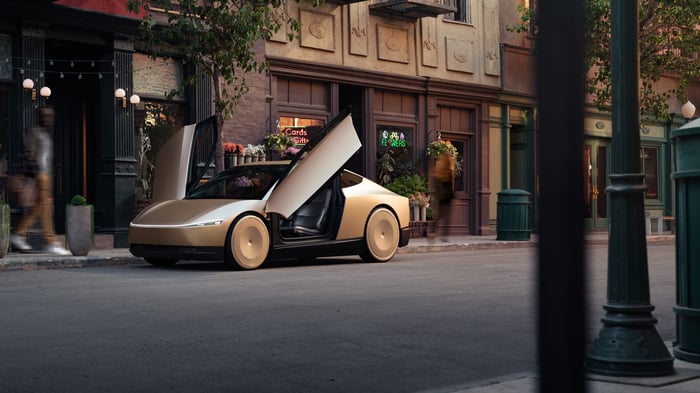
Tesla's Cybercab, which isn't available to purchase yet, is purpose-built for autonomous driving and ride-sharing. Image source: Tesla.
But what if this service doesn't pan out as expected? Even worse, what if it ends up being a low-margin business segment that drags on Tesla's business?
This is the bear case I want to explore.
Big expenditures are on the horizon
There are really two parts to the bear case for Tesla's Robotaxi service. First, there's the possibility that the capital expenditures required to fund this business are significantly higher than expected. The second part of the bear case for Tesla's autonomous ride-sharing service is the potential for the service to morph into a highly competitive commodity (we'll cover this second part in the next section).
Regarding the risk that Tesla's capital expenditures supporting Robotaxi may exceed investors' expectations, consider an example from a different industry: the once capital-light business of social media. Meta Platforms' (NASDAQ: META) appetite for AI (artificial intelligence) computing to support its business is completely changing its financial profile. Meta's capital expenditures in 2024 were $39.2 billion, or 7% of total revenue -- a manageable level that allowed the parent of Facebook, Instagram, and other social media platforms to maintain its status as a capital-light business. But as the company began investing heavily in data centers, this profile has been shifting; Meta's 2025 capital expenditures are now expected to come in between $70 billion and $72 billion, implying year-over-year growth of about $30 billion.
And here's where things get really bonkers. The dollar growth and capital expenditures between 2026 and 2025 will be significantly greater than it was last year, management said in Meta's third-quarter earnings call. This would put Meta's capital expenditures above $100 billion this year. For context, the company's trailing-12-month revenue is $189.5 billion.
While Tesla may approach the compute behind its Robotaxi service in a more capital-light way than Meta is, perhaps opting to rent out some of its compute power from cloud providers, we already know that Tesla's capital expenditures are going to increase substantially this year, in part due to AI investments.
"On the [capital expenditures] front, while we are expecting to be around $9 billion for the current year," explained Tesla chief financial officer Vaibhav Taneja in the company's most recent earnings call, "we're projecting the numbers to increase substantially in 2026 as we prepare the company for the next phase of growth in terms of not just our existing businesses, but our bets around AI initiatives, including [investments in our humanoid robot Optimus].
So, while it's not clear yet just how capital-intensive Robotaxi will be, management is already forecasting a big jump in capital expenditures in 2026.
An untested and highly competitive model
The other part of the bear case for Tesla's Robotaxi service is the possibility of the autonomous ride-sharing space evolving into a highly competitive, price-sensitive market. Indeed, it's already looking crowded. Tech giants Alphabet and Amazon both already have self-driving ride-sharing services in some markets -- and they're expanding quickly. Meanwhile, numerous electric vehicle companies, including Rivian, Lucid, and BYD, are all working hard on full self-driving technology that could be used for autonomous ride-sharing services. And let's not forget about ride-sharing companies Uber and Lyft, which are both working with a number of partners as they race toward bringing to market more autonomous ride-sharing technology.
And, intuitively, a taxi service boils down to price when customers select their rides. So, it may be difficult for one company to differentiate itself on any factor other than price.
When you combine both parts of the bear case for Tesla's Robotaxi service (its capital intensity and potential commoditization of ride-sharing services), it's easy to imagine a prolonged period in which the new segment's capital expenditures and costs exceed its revenue.
Of course, the bull case is that since Tesla is building every vehicle it ships with the hardware it believes will eventually be sufficient for unsupervised self-driving technology, Tesla's Robotaxi service may roll out far faster than the competition, giving it a first-mover advantage. In addition, there's a possibility that Tesla licenses its full self-driving technology to other manufacturers, ultimately helping it achieve sufficient scale to create a truly lucrative recurring revenue stream for the company.
Unfortunately, with Tesla shares trading at about 300 times earnings, I believe the bull case for Robotaxi is largely priced in, and the bear case is mostly ignored.
Don’t miss this second chance at a potentially lucrative opportunity
Ever feel like you missed the boat in buying the most successful stocks? Then you’ll want to hear this.
On rare occasions, our expert team of analysts issues a “Double Down” stock recommendation for companies that they think are about to pop. If you’re worried you’ve already missed your chance to invest, now is the best time to buy before it’s too late. And the numbers speak for themselves:
- Nvidia: if you invested $1,000 when we doubled down in 2009, you’d have $490,499!*
- Apple: if you invested $1,000 when we doubled down in 2008, you’d have $49,525!*
- Netflix: if you invested $1,000 when we doubled down in 2004, you’d have $489,300!*
Right now, we’re issuing “Double Down” alerts for three incredible companies, available when you join Stock Advisor, and there may not be another chance like this anytime soon.
*Stock Advisor returns as of January 8, 2026.
Daniel Sparks and/or his clients have positions in Tesla. The Motley Fool has positions in and recommends Alphabet, Amazon, Lyft, Meta Platforms, Tesla, and Uber Technologies. The Motley Fool recommends BYD Company. The Motley Fool has a disclosure policy.
Mentioned In This Article
Latest News
| 9 min | |
| 11 min | |
| 36 min | |
| 52 min | |
| 1 hour | |
| 1 hour |
S&P 500 Profits Set to Surge More Than 30% in Q3 With AI Giants Dominating Growth
META GOOG GOOGL AMZN
International Business Times
|
| 1 hour | |
| 1 hour | |
| 1 hour | |
| 1 hour |
AI Agents Are a Threat to Travel Businesses. Airbnb Could Still Be a Winner.
META
The Wall Street Journal
|
| 1 hour | |
| 2 hours | |
| 2 hours | |
| 2 hours | |
| 4 hours |
