Billionaire Chase Coleman Has Nearly 40% of His Fund's Capital Invested in 5 "Magnificent Seven" Stocks
Key Points
Chase Coleman is a heavy investor in tech stocks.
Despite what many deem to be high valuations, Coleman is heavily concentrated in the "Magnificent Seven."
Five of Tiger Global Management's top six equity holdings are components of that megacap group.
Billionaire Chase Coleman is part of an elite group of investors who worked in the 1990s for Julian Robertson's Tiger Management, an iconic hedge fund that generated stellar returns for much of its two-decade stint. The fund's legacy lives on through Robertson's mentorship and funding of those who worked for it and eventually launched their own funds -- a group of investors known as the "Tiger Cubs."
Coleman founded Tiger Global Management, a fund with a stock portfolio valued at over $32 billion as of the end of the third quarter of 2025. He's a clear believer in big tech: Nearly 40% of the firm's portfolio is invested in five "Magnificent Seven" stocks.
Where to invest $1,000 right now? Our analyst team just revealed what they believe are the 10 best stocks to buy right now. Continue »
Image source: Getty Images.
Microsoft: 11% of the fund
The largest position in Coleman's portfolio is Microsoft (NASDAQ: MSFT). It's one of the largest companies in the world, operates several incredible businesses, and is likely to be a significant beneficiary of the artificial intelligence (AI) trend. Its operations span its suite of productivity programs, such as Word and Excel, which help power the business world; gaming; social media; and cloud computing, among other businesses.
The company is poised to benefit from AI through its Azure cloud business, and also aims to capitalize on monetizing tools such as its Copilot AI assistant. On a forward price-to-earnings basis, the stock's ratio of around 29 puts it in the middle of the pack among its Magnificent Seven peers, but it is also one of the safest stocks in the group due to its diverse array of strong businesses.
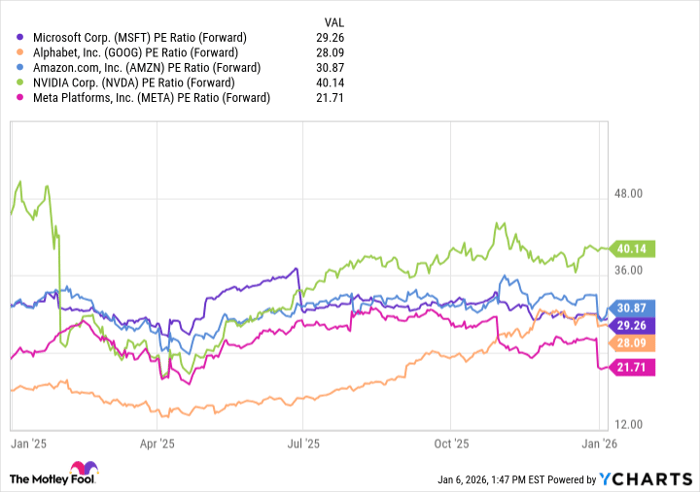
MSFT PE Ratio (Forward), data by YCharts; PE = price to earnings.
Alphabet: 8%
Alphabet (NASDAQ: GOOG)(NASDAQ: GOOGL) entered 2025 as the value stock among the Magnificent Seven. The company was in the midst of a Department of Justice lawsuit over its monopolistic and anticompetitive practices that could have resulted in the judge compelling it to sell its Chrome browser, an important component of its all-important search business. It was also facing a fresh challenge, as more people were using AI chatbots like ChatGPT to get answers to their questions, which investors feared would cut into its Google search traffic and the ad sales that rely on it.
However, things ultimately went the company's way. The federal judge in the antitrust case agreed with the Justice Department that Alphabet had employed monopolistic practices in its search and digital advertising businesses, but stopped short of issuing punishments that could have significantly harmed it.
Furthermore, investors became more comfortable and were impressed with Google's AI offerings, leading the market to conclude that it could maintain its dominance in traditional search. The stock rose nearly 65% in 2025. However, it remains relatively inexpensive within the Magnificent Seven.
Amazon: 7.5%
Amazon (NASDAQ: AMZN) struggled in 2025, largely due to President Donald Trump's tariffs, which heavily affected its e-commerce business. Many of its products and those of third-party sellers are sourced internationally.
However, Amazon is the largest cloud infrastructure player in the world, which sets it up as a likely beneficiary of the AI trend. It's also positioned to benefit from the further integration of robotics into its business, a development that the market may be underestimating.
Analysts at Morgan Stanley previously estimated that Amazon could save $4 billion annually by expanding its use of robotics in its warehouses. Given its superb logistics network, it's easy to see how it would be ahead of the game on robotics and automation.
Nvidia: 6.8%
Nvidia (NASDAQ: NVDA) is the ultimate pick-and-shovel play for AI and perhaps the most disruptive technology company since the internet boom.
It has also been the ultimate stock to own in recent years, but in recent months, it has faced more questions about its dominant market position and its margins. Its hyperscaler customers have begun rolling out their own custom application-specific integrated circuits (ASICs) -- highly specialized AI accelerators that may erode the market for Nvidia's more general-purpose graphics processing units (GPUs).
Still, even if Nvidia loses some market share in the AI accelerator space, it is still likely to be one of the most influential companies in the economy's hottest industry. And this year, it could potentially relaunch its business in China, which had been a significant source of revenue until the U.S. government restricted it from selling its chips to customers there due to geopolitical conflicts and national security concerns.
Meta Platforms: 6.4%
Meta Platforms (NASDAQ: META) started 2025 as an AI darling. Investors saw Meta's advertising and social media businesses as offering the clearest path to AI monetization, and that theme did play out somewhat.
However, the company -- led by CEO Mark Zuckerberg -- has pledged to spend $600 billion on AI infrastructure and jobs over the next three years. The prospect of that much spending apparently has begun to concern investors, who are now questioning how quickly adoption of the company's AI technologies will occur and what kind of returns these investments will yield.
Trading at 21 times forward earnings, Meta is now the discount play among the Magnificent Seven. If all of its planned spending pays off and AI adoption and monetization occur faster and more effectively than anticipated, then investors who buy the stock now will likely do well. However, those outlays will also make the stock a riskier and more pronounced bet on AI than some of the other tech megacaps.
Should you buy stock in Microsoft right now?
Before you buy stock in Microsoft, consider this:
The Motley Fool Stock Advisor analyst team just identified what they believe are the 10 best stocks for investors to buy now… and Microsoft wasn’t one of them. The 10 stocks that made the cut could produce monster returns in the coming years.
Consider when Netflix made this list on December 17, 2004... if you invested $1,000 at the time of our recommendation, you’d have $488,222!* Or when Nvidia made this list on April 15, 2005... if you invested $1,000 at the time of our recommendation, you’d have $1,134,333!*
Now, it’s worth noting Stock Advisor’s total average return is 969% — a market-crushing outperformance compared to 196% for the S&P 500. Don't miss the latest top 10 list, available with Stock Advisor, and join an investing community built by individual investors for individual investors.
*Stock Advisor returns as of January 9, 2026.
Bram Berkowitz has no position in any of the stocks mentioned. The Motley Fool has positions in and recommends Alphabet, Amazon, Meta Platforms, Microsoft, and Nvidia. The Motley Fool recommends the following options: long January 2026 $395 calls on Microsoft and short January 2026 $405 calls on Microsoft. The Motley Fool has a disclosure policy.
Mentioned In This Article
Latest News
| 12 min | |
| 16 min | |
| 25 min | |
| 33 min | |
| 36 min | |
| 41 min | |
| 50 min | |
| 1 hour | |
| 1 hour | |
| 1 hour | |
| 1 hour | |
| 1 hour | |
| 2 hours | |
| 2 hours | |
| 2 hours |
