3 Reasons ASML Stock Could Soar in 2026
Key Points
ASML’s growth accelerated in 2025 as its orders soared.
The growing AI and memory chip markets are fueling that expansion.
Its stock isn’t cheap, but its strengths support its higher valuation.
ASML's (NASDAQ: ASML) stock has roughly doubled over the past 12 months. The Dutch semiconductor equipment maker attracted significant attention as a long-term play on the growth of the AI market, since its lithography systems are essential for producing the top AI chips. However, I believe ASML's stock could soar even higher this year for three simple reasons.
1. It's a "picks and shovels" play for the AI infrastructure market
ASML is the world's largest producer of lithography systems, which are used to optically etch circuit patterns onto silicon wafers. It's also the only producer of high-end extreme ultraviolet (EUV) lithography systems, which are used to manufacture the world's smallest and most densely packed chips. All of the most advanced foundries -- including TSMC (NYSE: TSM), Samsung, and Intel -- use its EUV systems to produce their most sophisticated chips.
Where to invest $1,000 right now? Our analyst team just revealed what they believe are the 10 best stocks to buy right now. Continue »
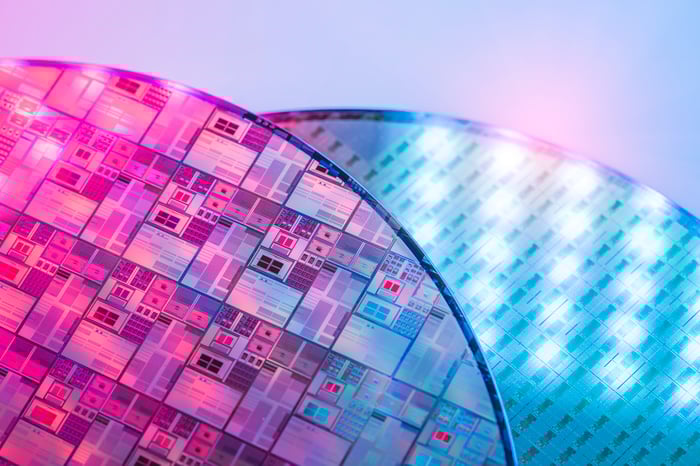
Image source: Getty Images.
Fabless chipmakers -- including Nvidia (NASDAQ: NVDA), AMD (NASDAQ: AMD), Broadcom (NASDAQ: AVGO), and Qualcomm -- outsource their chip production to TSMC and other foundries. Those foundries couldn't manufacture those chips -- including the latest AI chips from Nvidia, AMD, and Broadcom -- without ASML's EUV systems.
That makes ASML one of the top "picks and shovels" plays on the AI infrastructure market, which could grow at a CAGR of 29.1% from 2025 to 2032, according to Fortune Business Insights. It's also a well-balanced way to profit from the AI market's long-term expansion without worrying about competitive pressure among individual chipmakers.
2. The memory market is recovering
ASML also sells many lithography systems to memory chipmakers like Micron (NASDAQ: MU), which uses its EUV systems to manufacture its newest DRAM chips and its older deep ultraviolet (DUV) systems to produce its older DRAM chips and NAND chips.
However, the memory market goes through boom-and-bust cycles. Its last bust occurred from 2022 to 2023, when the PC and smartphone markets stalled out, and rising interest rates drove many tech companies to throttle their data center expansions.
Yet in 2024 and 2025, a new boom began as the PC and smartphone markets stabilized, interest rates declined, and the AI market's breakneck growth drove more data centers to upgrade their solid-state drives (SSDs) and high-bandwidth memory (HBM) chips. That expansion, which analysts predict will continue for at least 2 more years, should complement broader demand for AI accelerator chips and boost ASML's EUV sales.
3. It recently raised its 2026 guidance
In 2024, ASML's net sales only rose 3% to 28.3 billion euros ($33.8 billion), its gross margin stayed flat at 51.3%, and its earnings per share (EPS) fell 3%. That decline can be attributed to the export curbs against China, a temporary reduction in capex from its top customers, and slowing orders for its older "low-NA" EUV systems as it rolled out its newer "high-NA" EUV systems -- which can manufacture even smaller, denser, and more power-efficient chips.
Yet in 2025, ASML's net sales grew 16% to 32.7 billion euros ($39.1 billion), its gross margin expanded to 52.8%, and its EPS increased 28%. That acceleration was driven by the growth of the AI and memory markets, as well as the normalization of its sales in China. Its low-NA EUV system sales continued rising as it gradually deployed more high-NA EUV systems.
ASML's orders, which lag its revenues because its massive systems take months to build and ship, spiked in the second half of 2025, boosting its year-end backlog to 38.8 billion euros ($46.4 billion). That acceleration drove it to raise its 2026 revenue guidance to 34 billion ($40.7 billion) to 39 billion ($46.6 billion) euros -- which represents 12% growth at the midpoint. Analysts had previously only expected 7% growth.
ASML also expects its revenue to hit 44 billion euros ($52.6 billion) to 60 billion euros ($71.8 billion) by 2030. The midpoint of that forecast would imply a 10% five-year CAGR from 2025.
ASML deserves its premium valuation
From 2025 to 2027, analysts expect ASML's EPS to grow at a 22% CAGR. Its stock might not seem like a bargain at 42 times this year's earnings. Still, its monopolization of the EUV market, its irreplaceable position in the global semiconductor market, and its exposure to the booming AI and memory chip markets all justify that higher valuation.
Should you buy stock in ASML right now?
Before you buy stock in ASML, consider this:
The Motley Fool Stock Advisor analyst team just identified what they believe are the 10 best stocks for investors to buy now… and ASML wasn’t one of them. The 10 stocks that made the cut could produce monster returns in the coming years.
Consider when Netflix made this list on December 17, 2004... if you invested $1,000 at the time of our recommendation, you’d have $456,457!* Or when Nvidia made this list on April 15, 2005... if you invested $1,000 at the time of our recommendation, you’d have $1,174,057!*
Now, it’s worth noting Stock Advisor’s total average return is 950% — a market-crushing outperformance compared to 197% for the S&P 500. Don't miss the latest top 10 list, available with Stock Advisor, and join an investing community built by individual investors for individual investors.
*Stock Advisor returns as of January 29, 2026.
Leo Sun has positions in ASML. The Motley Fool has positions in and recommends ASML, Advanced Micro Devices, Intel, Micron Technology, Nvidia, Qualcomm, and Taiwan Semiconductor Manufacturing. The Motley Fool recommends Broadcom. The Motley Fool has a disclosure policy.
Mentioned In This Article
Latest News
| 17 min | |
| 2 hours | |
| 2 hours | |
| 4 hours | |
| 5 hours | |
| Oct-10 | |
| Oct-10 | |
| Oct-10 | |
| Oct-10 | |
| Oct-10 | |
| Oct-10 | |
| Oct-10 | |
| Oct-09 | |
| Oct-09 | |
| Oct-09 |
