Target vs. Costco: Which Discount Retail Stock Has Better Upside Now?
Target Corporation TGT and Costco Wholesale Corporation COST are two leading players in the U.S. discount retail sector, catering to budget-conscious shoppers. Target, with a market capitalization of nearly $53 billion, stands out as a major general merchandise retailer recognized for its strong portfolio of private-label brands, advanced omnichannel capabilities and diverse product assortment across essentials, apparel, home goods and electronics. The company operates close to 2,000 stores nationwide, backed by an extensive digital platform.
Conversely, Costco, with a market capitalization of about $442 billion, runs 924 membership-based warehouses globally, with a substantial presence in the United States. Its durable business model is driven by recurring membership revenues, efficient inventory turnover and a carefully curated product selection that fosters deep customer loyalty. Costco’s value proposition remains particularly attractive, supported by steady store traffic, pricing leverage and expanding presence in categories, such as fresh food, pharmacy and fuel.
Both retailers are operating in a rapidly evolving consumer environment, marked by changing spending patterns and intensifying competition. For investors, the central question is which discount retail stock currently presents the greater upside opportunity.
The Case for TGT
Target is moving through a pivotal phase of transformation, fueled by accelerating momentum in design-led merchandising, enhanced guest experiences and sustained technology investments. The repositioning centers on carefully curated assortments, trend-forward offerings and distinctive owned brands that reinforce differentiation in a competitive retail landscape. By sharpening its style authority and elevating presentation, the company aims to deepen its connection with guests.
Digital capabilities are becoming increasingly central to how guests interact with the brand. Convenience services, such as Drive Up, pickup and same-day fulfillment, are being woven more tightly into store operations to create a seamless omnichannel experience. Meanwhile, Target Plus continues to expand its marketplace assortment and strengthen guest engagement, while Roundel — the company’s in-house retail media network — is gaining influence by monetizing traffic and first-party data with greater precision and efficiency.
Technology innovation is accelerating through a partnership with OpenAI, creating conversational shopping experiences that guide guests from inspiration to purchase. These tools offer curated recommendations, multi-item basket building and flexible fulfillment in a seamless, personalized journey. Tools like Target Trend Brain and AI-enabled consumer insight dashboards give merchants real-time visibility into social trends and product performance, helping them forecast demand, identify emerging styles and accelerate speed to market. Synthetic audiences allow the marketing team to test campaigns and assortments virtually before launch.
Target plans to increase its capital expenditure 25% to $5 billion in fiscal 2026 to support store remodels, larger-format locations, expanded fulfillment capabilities and major floor-pad upgrades. Combined with organizational simplification and sharper strategic focus, these investments are intended to strengthen operational foundations, enhance guest relevance and position the company for long-term growth.
The Case for COST
Costco’s competitive strength is driven by its membership-based business model, which supports stable and predictable earnings. Membership fees generate a reliable, high-margin revenue stream and consistently strong renewal rates reflect deep customer loyalty. That loyalty is reinforced by Costco’s ability to keep prices low through bulk purchasing power and an efficient, streamlined supply chain. In addition, its private-label brand, Kirkland Signature, strengthens customer trust and repeat buying while also supporting the overall margin performance.
The company has also demonstrated agility in responding to evolving consumer behavior. Its merchandising strategy blends everyday essentials with a rotating assortment of distinctive, high-demand products, encouraging repeat visits and incremental spending. Through data-driven decision-making, Costco has expanded thoughtfully across domestic and international markets while preserving operational simplicity.
Digital momentum was particularly notable in the first quarter of fiscal 2026, with digitally enabled comparable sales rising 20.5%, fueled by higher website traffic and stronger app engagement. Management highlighted that digital initiatives are helping the company better monetize its product mix, particularly in non-food and big-ticket categories.
Operational excellence remains a core strength. Productivity improvements from pre-scan technology accelerated checkout times, while AI-powered pharmacy inventory systems boosted in-stock rates and drove healthy prescription growth. Same-day delivery services, facilitated through third-party partnerships in the United States and abroad, enhance convenience for members by enabling faster access to products, strengthening customer engagement and supporting incremental sales growth.
How Does the Zacks Consensus Estimate Compare for TGT & COST?
The Zacks Consensus Estimate for Target’s current fiscal-year sales and EPS implies declines of 1.6% and 17.6%, respectively, from the year-ago period’s actuals. For the next fiscal year, the consensus estimate indicates an 2.2% rise in sales and 6.3% growth in earnings. The consensus estimate for EPS for the current fiscal year has increased 1 cent to $7.30 over the past 60 days, while for the next fiscal year, it has improved by 2 cents to $7.77.
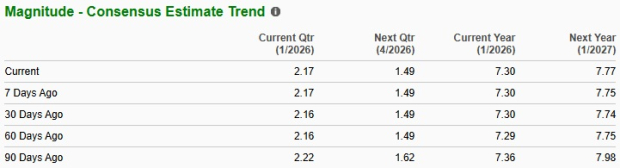
Image Source: Zacks Investment Research
The Zacks Consensus Estimate for Costco’s current fiscal-year sales and EPS implies growth of 8% and 12.2%, respectively, from the year-ago period’s actuals. For the next fiscal year, the consensus estimate indicates a 7.1% rise in sales and 9.3% growth in earnings. The consensus estimate for EPS for the current fiscal year has increased 9 cents to $20.18 over the past 60 days, while for the next fiscal year, it has improved by 12 cents to $22.05.

Image Source: Zacks Investment Research
Stock Performances of TGT & COST
Over the past three months, shares of Target have jumped 39.6%, whereas Costco has gained 11.7%.

Image Source: Zacks Investment Research
Dive Into Stock Valuations of TGT & COST
Target is trading at a forward price-to-sales (P/S) multiple of 0.49, below its median of 0.56 in the last three years. Costco’s forward 12-month P/S multiple sits at 1.44, above its median of 1.36 in the last three years.

Image Source: Zacks Investment Research
TGT or COST: Which Is the Better Bet Now?
Target emerges as the stronger investment candidate, underpinned by its strategic transformation, growing digital capabilities and expanding omnichannel offerings. AI-driven merchandising, personalized shopping experiences and private-label brand strength position Target to capture discretionary spending and enhance customer engagement. Recent initiatives like store remodels, fulfillment expansion and the Roundel retail media network further support growth potential.
While Costco benefits from a resilient membership-based model, predictable earnings and high customer loyalty, its already high valuation makes it less attractive in the current market environment. In contrast, Target’s attractive valuation and recent momentum highlight it as the better option for investors seeking upside potential.
While Target currently carries a Zacks Rank #2 (Buy), Costco has a Zacks Rank #3 (Hold). You can see the complete list of today’s Zacks #1 Rank (Strong Buy) stocks here.
Want the latest recommendations from Zacks Investment Research? Today, you can download 7 Best Stocks for the Next 30 Days. Click to get this free report
Target Corporation (TGT): Free Stock Analysis Report
Costco Wholesale Corporation (COST): Free Stock Analysis Report
This article originally published on Zacks Investment Research (zacks.com).
Mentioned In This Article
Latest News
| 1 hour | |
| 2 hours | |
| 3 hours | |
| 4 hours | |
| 5 hours | |
| 11 hours | |
| Oct-14 | |
| Oct-14 | |
| Oct-14 | |
| Oct-13 | |
| Oct-12 | |
| Oct-12 | |
| Oct-12 | |
| Oct-12 | |
| Oct-12 |
