|
|
|

|
|||||
|
|
|
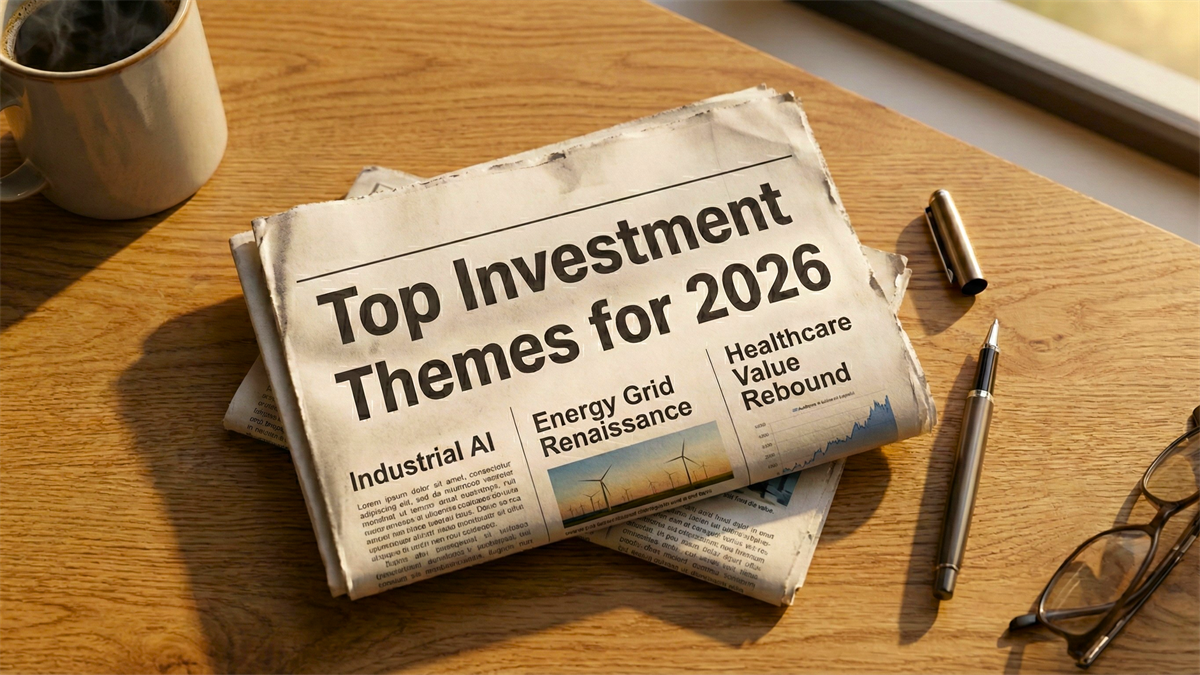
The stock market has enjoyed a remarkable run over the past 12 months. Driven by a successful soft landing engineered by the Federal Reserve and the initial excitement surrounding generative artificial intelligence (AI), 2025 rewarded risk-taking. Major indices pushed to record-high valuations, and investors who chased momentum were largely vindicated. However, as the calendar turns to 2026, the economic terrain is shifting. The phase of easy money driven by pure speculation is likely coming to an end.
High valuations demand high performance. For stock prices to justify their current levels, companies must demonstrate tangible earnings and execution. The market is moving from a phase of wondrous possibility to a phase of expected results and production. This environment favors a specific type of investment strategy: a rotation into the companies building the physical economy, providing essential power, and offering value at a reasonable price.
The outlook for 2026 is about the reallocation of capital. The market's focus is expected to shift to Return on Investment (ROI) and tangible cash flows. Three distinct themes are emerging as the pillars of this new fiscal year, offering a blend of aggressive growth potential and defensive stability.
For the past two years, the AI narrative has focused on software, chatbots, and large language models (LLMs). In 2026, the focus will likely shift to the industrial sector’s implementation of these technologies. This industrial implementation is expected to drive high-performance computing (HPC) demand far beyond 2025’s record-high levels. In addition, the tech sector as a whole is quickly moving toward Agentic AI, a specialized software system capable of running complex enterprise workflows. Large language models, physical sector implementation, and agentic systems all require massive physical facilities to operate, known as data centers or AI factories.
Technology giants, often called hyperscalers, are projected to spend nearly $500 billion on capital expenditures in 2026 alone. This spending will be dedicated to building the physical backbone of the AI powered internet. This massive outflow of cash from tech giants becomes revenue for the companies that own the land, the servers, and the cooling systems.
Investors looking to capture this trend might look beyond the software developers and toward the infrastructure providers. The Global X Data Center REITs & Digital Infrastructure ETF (NASDAQ: VPN) serves as a primary vehicle for this theme. This fund invests in the landlords of the digital economy, such as Equinix (NASDAQ: EQIX) and Digital Realty (NYSE: DLR). Because these companies are structured as Real Estate Investment Trusts (REITs), they are required to pass on the majority of their taxable income to shareholders, creating a steady income stream alongside capital appreciation.
Additionally, the fund holds hardware manufacturers such as NVIDIA (NASDAQ: NVDA) and cooling technology firms, which are essential for preventing these massive server farms from overheating. Global data center revenue is forecasted to exceed $600 billion by 2029. Regardless of which specific AI software wins the war for consumer attention, every competitor must pay rent to data centers and purchase hardware to compete. This creates a pick-and-shovel investment opportunity with multi-year revenue visibility.
The expansion of digital infrastructure leads directly to a second critical constraint: electricity. Artificial intelligence queries require significantly more energy than standard computing tasks. As data centers multiply, they place an unprecedented demand on the already critically strained power grid. Estimates suggest that power demand from data centers could grow between 14% and 17% annually through the end of the decade.
This demand shock is forcing a pragmatic shift in the energy sector. While renewable energy sources like wind and solar are important, technology companies require baseload power, electricity that is available 24 hours a day, regardless of the weather. A data center cannot shut down when the wind stops blowing. This reality is driving a renaissance for regulated utilities, particularly those with exposure to nuclear energy and natural gas.
The Utilities Select Sector SPDR Fund (NYSEARCA: XLU) offers exposure to this dynamic. Historically, utilities were viewed as slow-growth income stocks. Today, they are growth hybrids. Companies held within this sector, such as nuclear operator Constellation Energy (NASDAQ: CEG) and renewables leader NextEra Energy (NYSE: NEE), are signing long-term power supply contracts with tech firms at premium rates.
Furthermore, the macroeconomic backdrop supports this sector. With the Federal Reserve expected to maintain interest rates in the neutral 3.00% to 3.25% range, the dividend yields offered by utilities become attractive again.
XLU offers a yield of approximately 2.69%, providing a steady income stream that helps buffer against market volatility. In 2026, the boring business of selling electricity is becoming one of the most exciting growth stories on Wall Street.
While technology and infrastructure act as the offense in a portfolio, investors also need a strong defense. Valuations in the tech sector remain elevated, leaving little room for error. Consequently, investors seeking a margin of safety are increasingly turning their eyes toward the healthcare sector. After trailing the S&P 500 for the better part of two years, healthcare stocks are trading at a historical discount.
Currently, the healthcare sector trades at roughly a 20% discount relative to the broader market. This valuation gap presents an opportunity for a mean-reversion rally, a scenario where the sector catches up to the rest of the market. The Health Care Select Sector SPDR Fund (NYSEARCA: XLV) provides a diversified way to enter this space.
This sector offers a barbell strategy that is particularly effective in mid-cycle economic conditions. On the one hand, the fund holds major insurance and service providers like UnitedHealth (NYSE: UNH), which offer defensive stability. People need medical care regardless of GDP growth. On the other hand, the fund holds pharmaceutical innovators such as Eli Lilly (NYSE: LLY), which are capitalizing on the explosive demand for GLP-1 weight-loss drugs.
Furthermore, 2026 is expected to be a strong year for mergers and acquisitions (M&A) in this space. Large pharmaceutical companies facing patent expirations are cash-rich and looking to buy smaller biotech innovators to replenish their pipelines. This combination of defense, high-growth innovation, and M&A potential creates a profile known as Growth at a Reasonable Price (GARP).
Underpinning all these themes is the broader economic environment. The Federal Reserve has transitioned from a restrictive stance to a neutral one. With interest rates likely to settle near 3%, capital costs are manageable for companies with real cash flow, but still high enough to punish speculative companies that do not generate profits.
This environment reinforces the need for a disciplined approach. The easy gains of the early bull market are in the rearview mirror. 2026 will reward the builders of infrastructure, the providers of essential power, and the undervalued innovators in healthcare. By diversifying across these three themes, investors can position themselves to capture the growth of the next industrial evolution while maintaining a necessary safety net against valuation risks. The coming year is not for gamblers; it is for investors who demand tangible assets and real returns.
Before you make your next trade, you'll want to hear this.
MarketBeat keeps track of Wall Street's top-rated and best performing research analysts and the stocks they recommend to their clients on a daily basis.
Our team has identified the five stocks that top analysts are quietly whispering to their clients to buy now before the broader market catches on... and none of the big name stocks were on the list.
They believe these five stocks are the five best companies for investors to buy now...
The article "The Top 3 Investment Themes That Will Dominate 2026" first appeared on MarketBeat.
| 19 min | |
| 24 min | |
| 25 min | |
| 25 min | |
| 27 min |
Stock Market Today: Dow Falls As Oil Prices, Yields Jump; Nvidia, Cerebras Slide (Live Coverage)
NVDA
Investor's Business Daily
|
| 33 min | |
| 45 min | |
| 1 hour | |
| 1 hour | |
| 1 hour | |
| 1 hour | |
| 1 hour | |
| 2 hours | |
| 2 hours | |
| 2 hours |

Join thousands of traders who make more informed decisions with our premium features. Real-time quotes, advanced visualizations, alerts, and much more.
Learn more about Finviz Elite