|
|
|

|
|||||
|
|
|
Subscribers to Chart of the Week received this commentary on Sunday, January 18.
This past week Google parent Alphabet (GOOGL) crossed the $4 trillion market cap level, joining Nvidia (NVDA) in rarified air. The company has been wheeling and dealing across AI specter, kicking off 2026 by penning a multi-year partnership with Apple (AAPL) to power the iPhone’s AI technology. The ‘Magnificent Seven’ name also enjoyed tailwinds when its Gemini AI model curtailed broader concerns surrounding OpenAI’s marketplace dominance.
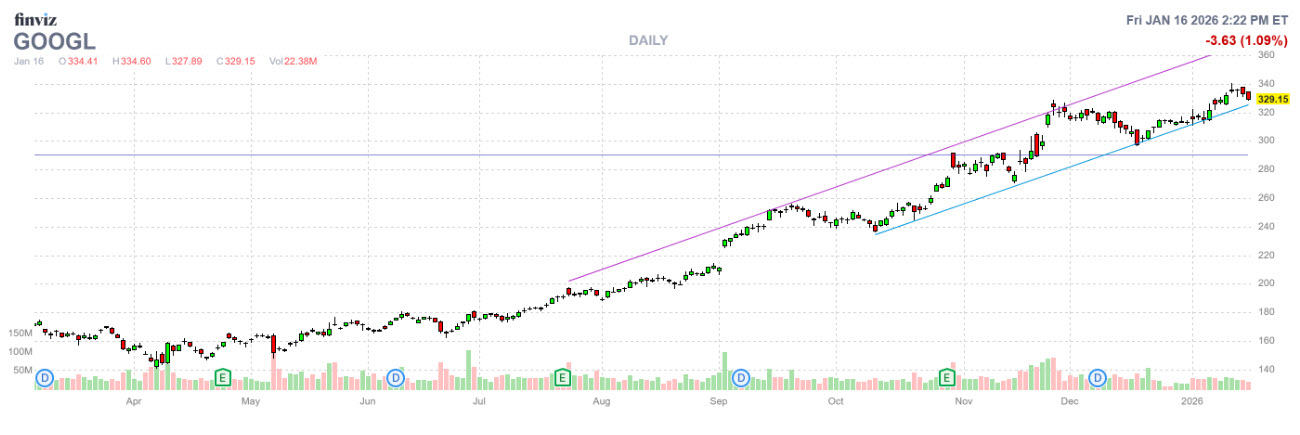
GOOGL’s encore for that record peak of $340.49 on Wednesday was three-straight losses to end the week with only a 0.4% gain to show for it. The stock never actually even closed above $340 and is now testing its 30-day moving average. Is this hangover from history a pattern for megacaps?
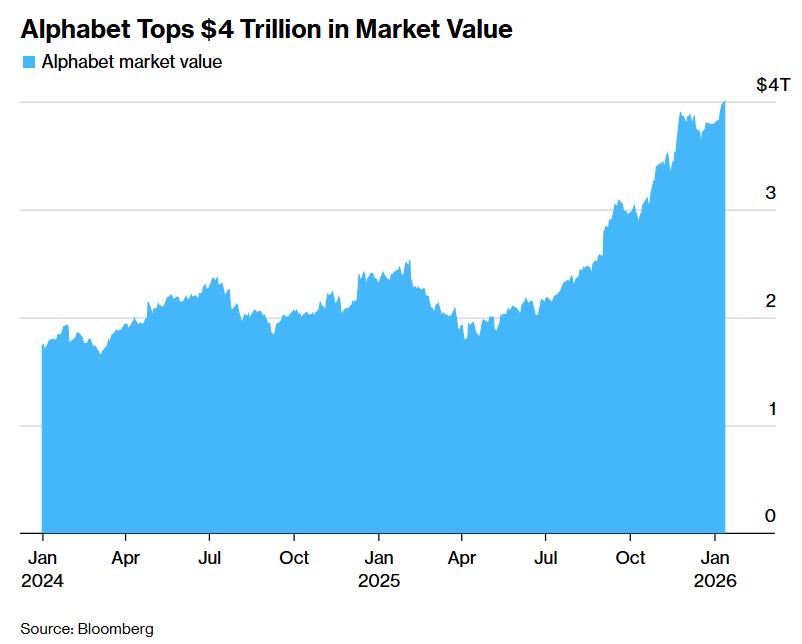
Alphabet is not the only megacap to pull back from after a historic peak. Not only did Apple (AAPL) reverse from $4 trillion top within a few days, while Nvidia’s (NVDA) failed $5 trillion. Back in September, Oracle (ORCL) inched within four points of its $1 trillion market cap before falling short. These are round numbers are psychologically significant for a reason.
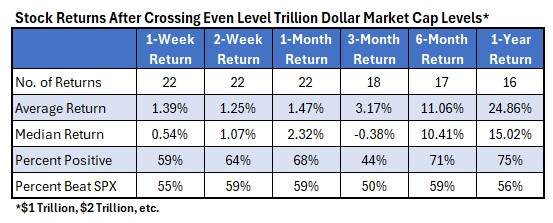
Schaeffer’s Senior Quantitative Analyst Rocky White pulled data from stocks crossing an even level market cap and their subsequent returns over a one-week, two-week, one-month, three-month, six-month, and one-year return. The stocks had to close above the even trillion dollar level. For example, Amazon.com (AMZN) got there in September 2018, but at the close, the stock had moved back below club trillion. It didn’t close above a trillion dollars until Feb. 4, 2020.
For all stocks that have toppled an even number trillion-dollar threshold on a closing basis, there are 16 returns 52 weeks out, which garner an average 24.86% move a year later. These returns were positive 75% of the time, too, with more than half beating the S&P 500 Index (SPX). But note the choppiness one, two, and three weeks out.
Narrowing it down to Alphabet (GOOGL) stock’s $4 trillion peers, the list encompasses aforementioned AAPL and NVDA, as well as Microsoft (MSFT), all in 2025. MSFT topped $4 trillion in July but finished the year at $3.6 trillion. Below, the returns for the highest valued companies show a broad range of outcomes, with MSFT sporting a grim post-$4 trillion performance. Specifically, the shares suffered a 10.4% pullback within a month of hitting its top.
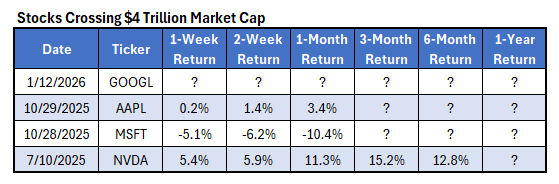
This shows the residual hangover that comes with accomplishing such a feat. Despite the short-term collateral damage though, the quantified long-term returns do nothing to discourage buy-and-hold investors bullish on Big Tech. If anything, Eli Lilly (LLY) and Walmart (WMT) eyeing $1 trillion, Taiwan Semiconductor (TSM) barreling toward $2 trillion and AAPL’s renewed quest at $4 trillion are all storylines to watch unfold this year, with this knowledge in tow.
| 32 min | |
| 1 hour | |
| 1 hour | |
| 1 hour | |
| 1 hour | |
| Apr-02 | |
| Apr-02 | |
| Apr-02 | |
| Apr-02 | |
| Apr-02 | |
| Apr-02 | |
| Apr-02 | |
| Apr-02 | |
| Apr-02 | |
| Apr-02 |

Join thousands of traders who make more informed decisions with our premium features. Real-time quotes, advanced visualizations, alerts, and much more.
Learn more about Finviz Elite